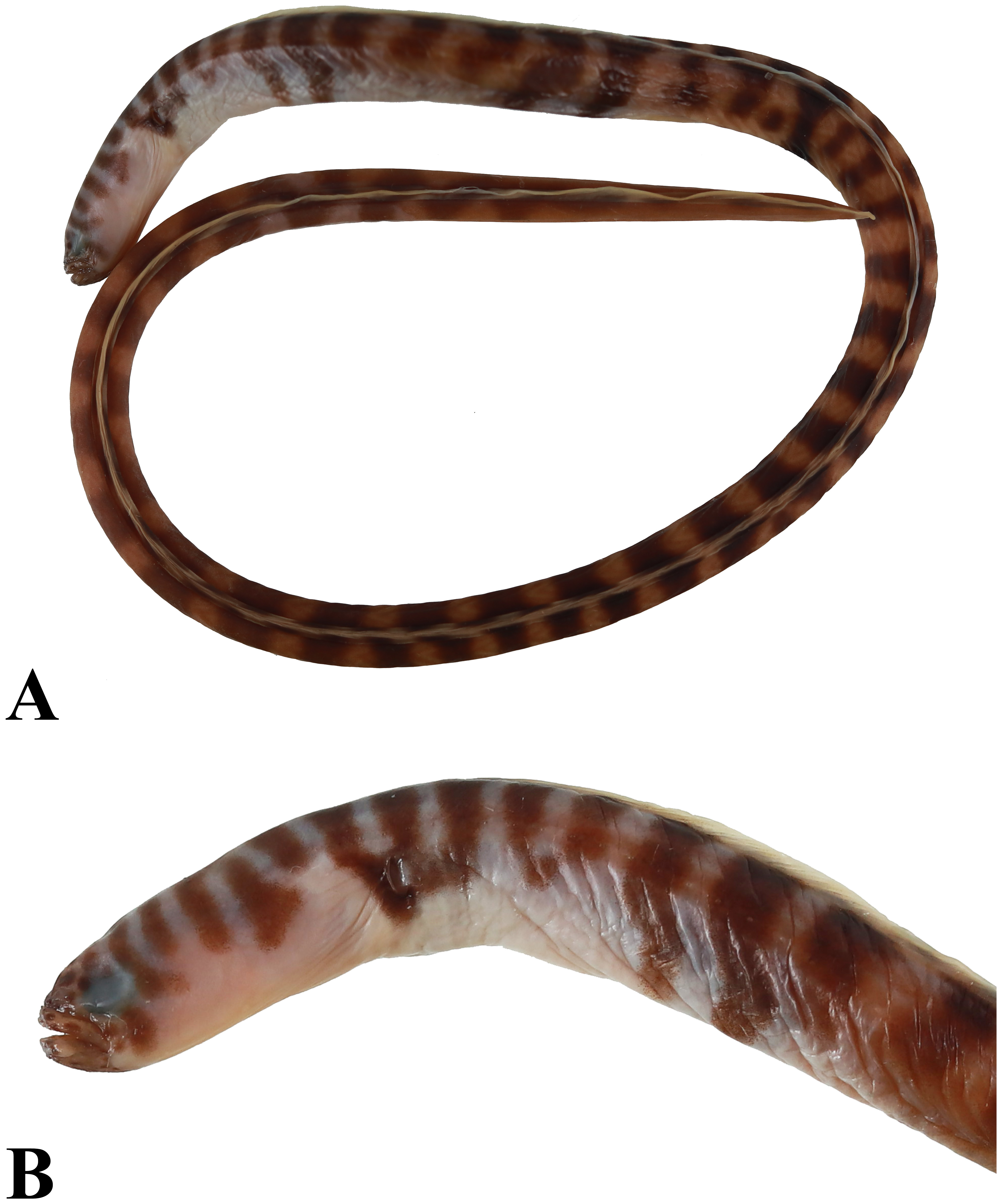
Description of Taiwanese specimen. Head length 6.3 % of TL; preanal length 31.9; predorsal length 7.6; trunk length 25.6; tail length 68.1. Head length 19.8 of % PAL; predorsal length 23.8; trunk length 80.2. Depth at gill opening 39.9 % of HL; depth at anus 38.0; interorbital width 10.8; interbranchial width 25.2; eye diameter 10.1; snout length 13.6; upper jaw length 17.1; lower jaw length 16.5. Body moderately elongate, anteriorly cylindrical in cross section, becoming oval posteriorly; anus at about anterior third of total length; tail much longer than body. Dorsal-fin origin slightly behind gill opening. Anal fin beginning immediately behind anus. Gill opening relatively small, slightly smaller than eye diameter; interbranchial width larger than gill opening and eye diameter. Head medium size; snout short, rounded; eye large, slightly longer than snout. Upper and lower jaws with fleshy lips; posterior end of upper jaw located slightly behind vertical line of anterior margin of eye. Anterior nostril tubular, located in front of upper lip, and directed forward. Posterior nostril hole-shaped, located in front of eye, about same level as dorsal margin of eye. Lateral line complete, 4 pores before gill opening, 6 pores before dorsal-fin origin, 47 pores before anal-fin origin, and 133 total pores. Posterior part of body, about one head long, without lateral line pores. Few pores on lateral line of head (Fig. 6). Supraorbital canal with 3 pores; located in front of and above posterior nostril. Infraorbital canal with 3 pores; first pore located between anterior and posterior nostrils, second pore located below eye, and third pore located below posterior edge of eye. Mandibular canal 4 in numbers. No pore on preopercular canal, frontal, and supratemporal commissure. Predorsal vertebrae 9; preanal vertebrae 48; total vertebrae 152. Teeth conical and blunt (Fig. 7 A, B); arranged in wide rows, with 4 rows of canine teeth in front of upper and lower jaws; two middle rows rounder and blunt, rear teeth in single row. Vomer bearing drop-shaped teeth, front teeth wider and arranged in about 6 rows, rear teeth in 2 rows. No intermaxillary tooth. Coloration. Fresh coloration unknown. For preserved specimen (Fig. 5 A, B), body white with many black stripes, like in pattern in zebra. Small black spots on snout, upper and lower lips. Chin black. Black stripes on other parts of head somewhat worm-like. Seventeen black stripes on back of trunk, aligned or slightly staggered left and right; stripes in order of, 4 – 6, 9 – 11, 15 – 16 extending downward to ventral side or with both sides connected forming rings. Tail with 24 black stripes; stripes at middle extending downward forming a ring, rear stripes becoming wider and lighter in color. Black stripes at tail about 1 head long, not obvious and limited to base of the dorsal fin. Dorsal and anal fins white, except at base parts with black stripes extending from body; dorsal fin also bearing few black dots.