
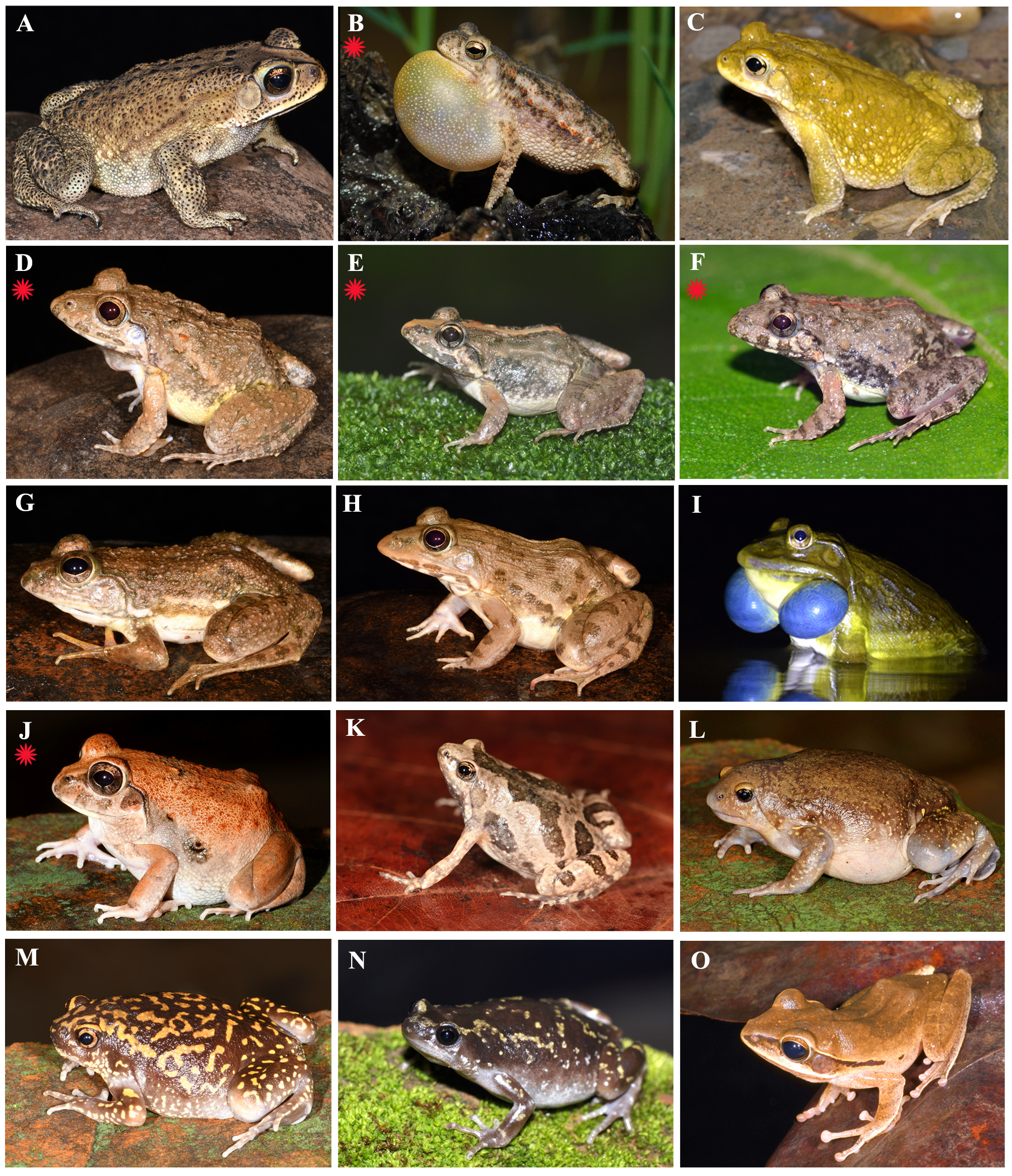
This is the largest frog of Terai region. Yellow colored breeding males were frequently observed in puddles during monsoon (Fig. 5).
Sumber: Amphibians and reptiles of Parsa National Park, Nepal
Family Dicroglossidae · Order Anura
Data diperbarui secara berkala dari berbagai sumber observasi biodiversitas.

Foto: Bhattarai, Santosh;Pokheral, Chiranjibi Prasad;Lamichhane, Babu Ram;Regmi, Uba Raj;Ram, Ashok Kumar;Subedi, Naresh
Otoritas penamaan: (Daudin, 1802) (1802)
Status taksonomi: ACCEPTED
Status konservasi (IUCN): LC Risiko Rendah
Total Catatan di Indonesia
0
Provinsi Ditemukan
0
dari 38 provinsi
Catatan Pertama
0
tahun pertama tercatat
Tren Tahunan
-0%
-50.0% vs 1929
Bull Frog (Hoplobatrachus tigerinus) termasuk dalam famili Dicroglossidae, ordo Anura, kelas Amphibia. Berdasarkan data yang terhimpun, spesies ini telah tercatat sebanyak 46 kali di Indonesia, tersebar di 3 provinsi. Catatan pertama tercatat pada tahun 1864.
Bali merupakan provinsi dengan catatan observasi terbanyak untuk spesies ini, dengan 3 catatan (6.5% dari total). Data distribusi ini mencerminkan akumulasi dari berbagai kegiatan survei, penelitian, dan kontribusi citizen science. Pola distribusi yang tercatat mungkin tidak sepenuhnya menggambarkan persebaran alami spesies, karena dipengaruhi oleh intensitas pengamatan di masing-masing wilayah.
Tren observasi tahunan Hoplobatrachus tigerinus menunjukkan penurunan signifikan (-50%) pada periode terakhir dibanding tahun sebelumnya, dengan catatan pertama pada tahun 1864.
Catatan deskriptif tentang Hoplobatrachus tigerinus dari sumber literatur primer (via GBIF).
This is the largest frog of Terai region. Yellow colored breeding males were frequently observed in puddles during monsoon (Fig. 5).
Sumber: Amphibians and reptiles of Parsa National Park, Nepal
(Fig 4 I) Specimens examined: one adult male (WIIAD 228). Morphological features: An adult male, SVL 153.9 mm; body large and stout; head marginally longer than wide; snout obtusely pointed in dorsal view and projecting beyond mouth; tympanum distinct, nearly equal to the diameter of eye, prominent supratympanic fold; arms short and strong; dorsal skin glandular with broken longitudinal ridges; finger tips without discs, relative length of fingers II <IV <I <III; toes nearly full webbed, webbing formula I 0 – 0 II 0 – ½ III ½ – ½ IV ½ – ½ V), relative toes length 1 <2 <3 <5 <4, inner metatarsal tubercle present. Coloration in life: Adult male pale brown or greyish (lemon yellowish during breeding season) with dark plump spots on dorsum; prominent greenish or pale yellowish stripe from behind the eye to the groin; a white streak on upper jaw; hind limbs cross-barred with four prominent bands; ventral sides pale white. Males had distinct blue paired subgular vocal sac which is likely to be an optical cue for attraction of females (Gomez et al. 2009; Fig 4 I). Bioacoustics: We analysed 50 advertisement calls from five males of H. tigerinus. The males were recorded calling between 23: 30 – 03: 00 hours in July and site air temperature was between 26 ° C – 28.5 ° C. The mean call duration of analysed calls was 235.30 ± 48.65 ms (181 – 430 ms). Recorded mean pulse rate was 76.92 ± 5.32 pulses / s (61.82 – 87.18 pulses / s) with 17.36 ± 2.88 pulses (13 – 29 pulses) delivered per call. The mean dominant frequency was 1819.14 ± 388.87 Hz (1205.90 – 2239.50 Hz).
Sumber: Identification of anuran species diversity of the Panna Tiger Reserve, Central India, using an integrated approach
Figures 1 and 3 (a – b); Table 2 specimens examined: CMDN-A 91 – 96, 156. Distribution in the KTM Valley: Encountered only in Lalitpur. Neither Pokhrel et al. (2011) or Aryal et al. (2013) encountered this species. Remarks: We observed large numbers of this species on the edge of an urban area. We encountered a large adult calling in a shallow pool on the edge of a village road in the vicinity of Microhyla, which were also calling (Figure 1; Figure 3 (b )). When approached, the frog raised its posterior end in a defensive position, as has been previously reported for this species (Anders 2002). We also observed large numbers of individuals in a wetland where males were calling (Figures 3 (a) and 4 (d )). Several juveniles were also present at this locality, which probably represents common breeding habitat for this species in the KTM Valley.
Sumber: A herpetological survey of the Kathmandu Valleyı Nepalı and phylogenetic identification of Megophrys (Xenophrys) zhangi
Nama-nama ilmiah lain yang pernah digunakan untuk Hoplobatrachus tigerinus dalam literatur taksonomi.
| Nama Sinonim | Otoritas | Status |
|---|---|---|
| Dicroglossus tigrinus | (Daudin, 1802) | SYNONYM |
| Euphlyctis tigerina | (Daudin, 1802) | SYNONYM |
| Limnonectes tigerinus | (Daudin, 1802) | SYNONYM |
| Rana picta | Gravenhorst, 1829 | SYNONYM |
| Rana tigerina | Daudin, 1802 | SYNONYM |
| Rana tigerina tigerina | Daudin, 1802 | SYNONYM |
| Rana tigrina | Daudin, 1802 | SYNONYM |
| Tigrina tigrina | (Daudin, 1802) | SYNONYM |
| # | Provinsi | Catatan | % |
|---|---|---|---|
| 1 | Bali | 3 | 6.5% |
| 2 | Sulawesi Selatan | 2 | 4.3% |
| 3 | Sulawesi Tengah | 1 | 2.2% |
Jumlah catatan observasi Hoplobatrachus tigerinus di Indonesia per tahun
Hoplobatrachus tigerinus
Foto: Bhattarai, Santosh;Pokheral, Chiranjibi Prasad;Lamichhane, Babu Ram;Regmi, Uba Raj;Ram, Ashok Kumar;Subedi, Naresh
Hoplobatrachus tigerinus
Foto: Prasad, Vishal Kumar;Gautam, Kumudani Bala;Gupta, Sandeep Kumar;Murthy, R. Sreenivasa;Ramesh, K.;Shinde, Ajinkya Duttatray;Das, Abhijit
Hoplobatrachus tigerinus
Foto: O, Kyle A.;Connell;Aryal, Prakash C.;Sherchan, Adarsh M.;Dhakal, Bimala;Chaudhary, Hemanta Kumari;Ranabhat, Rishi;Karmacharya, Dibesh
Hoplobatrachus tigerinus
Foto: O, Kyle A.;Connell;Aryal, Prakash C.;Sherchan, Adarsh M.;Dhakal, Bimala;Chaudhary, Hemanta Kumari;Ranabhat, Rishi;Karmacharya, Dibesh
| Nama | Bahasa | Sumber |
|---|---|---|
| Bull Frog | Inggris | Catalogue of Life |
| Bull frog | Inggris | Saidabad Water Treatment Plant Project, Phase III |
| Golden Frog | Inggris | Catalogue of Life |
| Indian Bullfrog | Inggris | Amphibia-Malaysia |
| Indian bullfrog | Inggris | Catalogue of Life |
| Indische brulkikker | Belanda | Catalogue of Life |
| Indus Valley bullfrog | Inggris | Catalogue of Life |
| Pakistani مینڈک | urd | Catalogue of Life |
| Rana toro indiana | Italia | Catalogue of Life |
| Sapo-touro | Inggris | Catálogo Taxonômico da Fauna do Brasil |
| Tiger Frog | Inggris | Catalogue of Life |
| Tiger Peters Frog | Inggris | Catalogue of Life |
| Tigerfrosch | Jerman | Catalogue of Life |
| Tigrisbéka | hun | Catalogue of Life |
| skokan tygrovitý | ces | Catalogue of Life |
| Тигровая лягушка | rus | Catalogue of Life |
| पुंगवाभ मंडूक | hin | Catalogue of Life |
| বামুণ ভেকুলা | asm | Catalogue of Life |
| ਡੱਡੂ | pan | Catalogue of Life |
| ಗೊಂಪೆ | - | Catalogue of Life |
Berdasarkan data 46 observasi, Bali adalah provinsi dengan catatan Bull Frog (Hoplobatrachus tigerinus) terbanyak — 3 observasi (6.5% dari total catatan di Indonesia). Spesies ini tersebar di 3 provinsi.
Catatan pertama Bull Frog (Hoplobatrachus tigerinus) di Indonesia tercatat pada tahun 1864. Hingga kini terdapat 46 catatan dari 3 provinsi, yang dihimpun dari survei lapangan, koleksi museum, dan platform citizen science.
Menurut IUCN Red List, Bull Frog (Hoplobatrachus tigerinus) berstatus "Risiko Rendah" (kode LC). Status ini mencerminkan tingkat risiko kepunahan global spesies, bukan khusus Indonesia.
Ya, Hoplobatrachus tigerinus memiliki 8 nama sinonim ilmiah, di antaranya: Dicroglossus tigrinus, Euphlyctis tigerina, Limnonectes tigerinus. Nama sinonim adalah nama-nama lain yang pernah digunakan untuk spesies yang sama dalam literatur taksonomi.
Hoplobatrachus tigerinus diklasifikasikan sebagai berikut: Kingdom Animalia, Phylum Chordata, Class Amphibia, Order Anura, Family Dicroglossidae, Genus Hoplobatrachus. Spesies ini dideskripsikan oleh (Daudin, 1802).
11 titik observasi Hoplobatrachus tigerinus di Indonesia
Memuat peta...
Setiap titik merepresentasikan satu lokasi observasi yang tercatat. Klik titik untuk melihat detail.