
Konservasieng
Conservation: IUCN – Lower Risk (lc). Common.
Sumber: Order Peramelemorphia
Family Peramelidae · Order Peramelemorphia
Data diperbarui secara berkala dari berbagai sumber observasi biodiversitas.
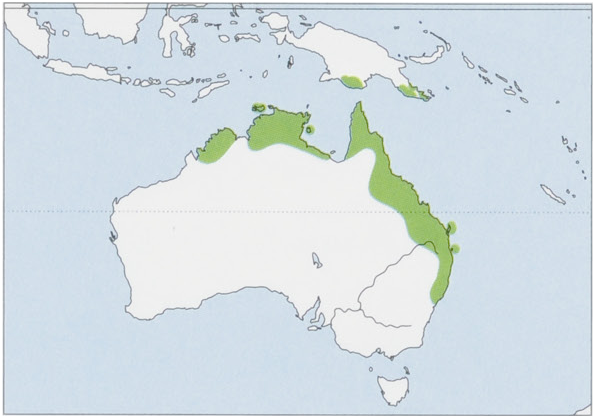
Foto: Russell A. Mittermeier;Don E. Wilson
Otoritas penamaan: (Gould, 1842) (1842)
Status taksonomi: ACCEPTED
Status konservasi (IUCN): LC Risiko Rendah
Dipublikasikan dalam: Proc. Zool. Soc. Lond. vol.1842 p.41
Total Catatan di Indonesia
0
Provinsi Ditemukan
0
dari 38 provinsi
Catatan Pertama
0
tahun pertama tercatat
Tren Tahunan
+0%
+100.0% vs 2006
Brindled Bandicoot (Isoodon macrourus) termasuk dalam famili Peramelidae, ordo Peramelemorphia, kelas Mammalia. Berdasarkan data yang terhimpun, spesies ini telah tercatat sebanyak 12 kali di Indonesia, tersebar di 2 provinsi. Catatan pertama tercatat pada tahun 1960.
Papua merupakan provinsi dengan catatan observasi terbanyak untuk spesies ini, dengan 3 catatan (25.0% dari total). Data distribusi ini mencerminkan akumulasi dari berbagai kegiatan survei, penelitian, dan kontribusi citizen science. Pola distribusi yang tercatat mungkin tidak sepenuhnya menggambarkan persebaran alami spesies, karena dipengaruhi oleh intensitas pengamatan di masing-masing wilayah.
Tren observasi tahunan Isoodon macrourus menunjukkan peningkatan signifikan (+100%) pada periode terakhir dibanding tahun sebelumnya, dengan catatan pertama pada tahun 1960.
Catatan deskriptif tentang Isoodon macrourus dari sumber literatur primer (via GBIF).
Conservation: IUCN – Lower Risk (lc). Common.
Sumber: Order Peramelemorphia
Distribution: NE Western Australia, N Northern Territory, E Queensland, and NE New South Wales (Australia); S and E New Guinea.
Sumber: Order Peramelemorphia
DISTRIBUTION: N. E. Western Australia; N. Northern Territory, E. Queensland; New South Wales; S. and E. New Guinea.
Sumber: Order Marsupialia
Habitat. Occurs in grassland, woodland, open forest and on occasion rainforest in both Australia and New Guinea, and successfully exploits gardens and other disturbed habitats if sufficient ground coveris available to allow access. Prefers ground cover comprising dense shrubs or tall grass in southern parts ofits range, but readily uses areas with sparse ground in monsoon tropical regions in northern Australia and New Guinea. In drier parts of range in Australia, this species persists in marshy areas with heavy ground cover, and penetrates west in Queensland to about the 625 mm rainfall isohyet by moving along densely vegetated riparian corridors. Nest usually a simple scrape under a dome of sticks, leaf litter, and other debris, with two or more openings; individuals may also use logs, grass tussocks, or crevices in rocks for shelter.
Sumber: Peramelidae
Movements, Home range and Social organization. Both sexes are solitary. Males and females tolerate each other briefly when females are in estrus, but otherwise interactions are characterized by aggression, chases, and fights. Both sexes produce secretions from glands behind the ears and rub them on ground or vegetation during encounters, perhaps using them as “ keep-away ” signals to reduce likelihood of further encounters. Home ranges relatively small compared with those of its two smaller congeners, averaging 2 - 7 ha (maximum 6 ha) in one study in abandoned pasture-shrubland area and 1 - 5 ha in another study in remnant vegetation within limits of city of Brisbane. Population densities can be correspondingly large, ranging from 0 - 2 ind / ha to 2: 6 ind / ha in New South Wales and southern Queensland, but lower densities of 0 - 05 ind / ha to 0 - 7 ind / ha appear to be more typical in tropical regions. Lower densities, larger ranges and more seasonal breeding in northern compared with southern Australia may reflect less abundant and more strongly seasonal food resources in monsoonal tropics compared with mid-latitude habitats. Corresponding differences in recruitment of young into adult population might be expected between regional areas, but limited evidence suggests that recruitment rates are usually 10 - 15 %. Higher recruitment of young, however, follows disturbances such as fire and mechanical damage to habitat and, as with the Southern Brown Bandicoot (1. obesulus), the life-history strategy of present species has been interpreted as one that allows rapid colonization of newly created habitat.
Sumber: Peramelidae
Status and Conservation. Classified as Least Concern on The IUCN Red List. Population trend stable. This bandicoot is not considered to be at currentrisk as it occupies an extensive geographical range, has a large overall population, and occurs in many protected areas. Declines have occurred in drier, inland areas near S edge of range of race torosus. While the species continues to decline owing to development, habitat loss, and changes in fire regimes, and overhunting for bushmeat in New Guinea, the declines are mostly local. The larger size of this bandicoot means that it is at less risk of predation from the feral cat (Felis catus), although it still falls prey to Red Foxes (Vulpes vulpes) and domestic and wild dogs (Canis). Historical declines in inland pastoral areas were not extensive, and these appear to have slowed or halted. All subspecies appear to be secure.
Sumber: Peramelidae
Nama-nama ilmiah lain yang pernah digunakan untuk Isoodon macrourus dalam literatur taksonomi.
| Nama Sinonim | Otoritas | Status |
|---|---|---|
| Perameles macroura | Gould, 1842 | SYNONYM |
| # | Provinsi | Catatan | % |
|---|---|---|---|
| 1 | Papua | 3 | 25.0% |
| 2 | Papua Barat | 2 | 16.7% |
Jumlah catatan observasi Isoodon macrourus di Indonesia per tahun
Isoodon macrourus
Foto: Russell A. Mittermeier;Don E. Wilson
Isoodon macrourus
Foto: Russell A. Mittermeier;Don E. Wilson
| Nama | Bahasa | Sumber |
|---|---|---|
| Bandicoot a longue queue | Prancis | Peramelidae |
| Bandicoot brun du Nord | Prancis | Catalogue of Life |
| Bandicoot à longue queue | Prancis | Catalogue of Life |
| Bandicut Marrón Septentrional | Spanyol | Catalogue of Life |
| Bandicut de hocico corto septentrional | - | Peramelidae |
| Brindled Bandicoot | Inggris | Catalogue of Life |
| Brindled Bandicoot | - | Phthiraptera.myspecies.info |
| Flekkpunggrevling | nob | Catalogue of Life |
| Giant Brindled Bandicoot | Inggris | Catalogue of Life |
| GroRer Kurznasenbeutler | Jerman | Catalogue of Life |
| Grote Kortneusbuideldas | Belanda | Catalogue of Life |
| Großer Kurznasenbeutler | Jerman | Catalogue of Life |
| Langnasenbeutler | Jerman | Catalogue of Life |
| Large Northern Bandicoot | Inggris | Catalogue of Life |
| Nordbandikut | nob | Catalogue of Life |
| Northern Brown Bandicoot | Inggris | Integrated Taxonomic Information System (ITIS) |
| Northern Brown Bandicoot | - | Phthiraptera.myspecies.info |
| Northern Shortnosed Bandicoot | Inggris | Catalogue of Life |
| Péramèle À Grosse Queue | Prancis | Catalogue of Life |
| Short-nosed Bandicoot | Inggris | Peramelidae |
Berdasarkan data 12 observasi, Papua adalah provinsi dengan catatan Brindled Bandicoot (Isoodon macrourus) terbanyak — 3 observasi (25.0% dari total catatan di Indonesia). Spesies ini tersebar di 2 provinsi.
Catatan pertama Brindled Bandicoot (Isoodon macrourus) di Indonesia tercatat pada tahun 1960. Hingga kini terdapat 12 catatan dari 2 provinsi, yang dihimpun dari survei lapangan, koleksi museum, dan platform citizen science.
Menurut IUCN Red List, Brindled Bandicoot (Isoodon macrourus) berstatus "Risiko Rendah" (kode LC). Status ini mencerminkan tingkat risiko kepunahan global spesies, bukan khusus Indonesia.
Ya, Isoodon macrourus memiliki 1 nama sinonim ilmiah, di antaranya: Perameles macroura. Nama sinonim adalah nama-nama lain yang pernah digunakan untuk spesies yang sama dalam literatur taksonomi.
Isoodon macrourus diklasifikasikan sebagai berikut: Kingdom Animalia, Phylum Chordata, Class Mammalia, Order Peramelemorphia, Family Peramelidae, Genus Isoodon. Spesies ini dideskripsikan oleh (Gould, 1842).
3 titik observasi Isoodon macrourus di Indonesia
Memuat peta...
Setiap titik merepresentasikan satu lokasi observasi yang tercatat. Klik titik untuk melihat detail.