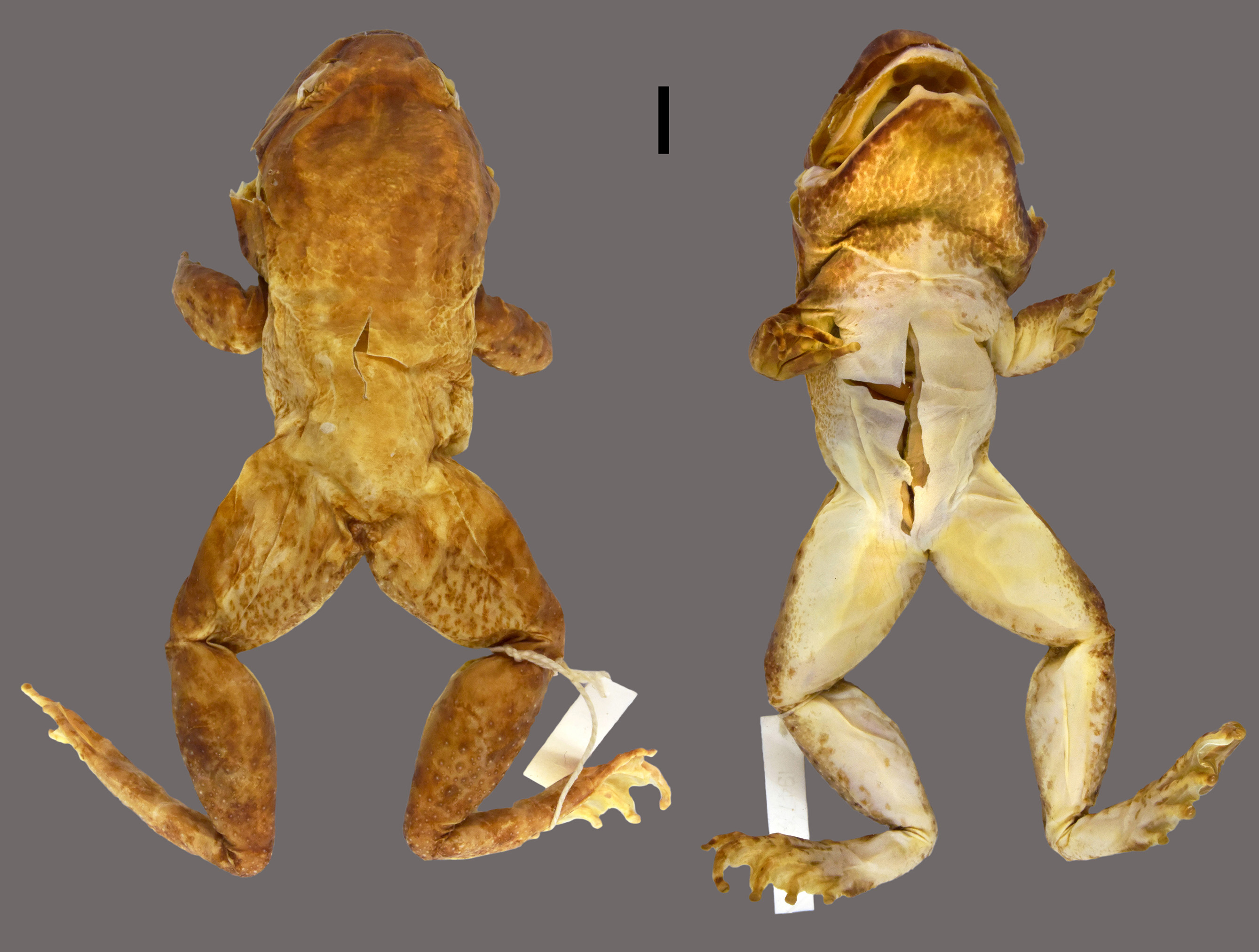
Description of lectotype: Adult male; body large (SVL 75.0 mm; Table 2), stout, widest at posterior end of jaw (Fig. 2); head very large (HL / SVL 0.45, HW / SVL 0.43), somewhat longer than wide (HW / HL 0.94); snout relatively short (SL / HL 0.32), subaCuminate in dorsal view, rounded in profile, slightly projeCting beyond lower jaw, wider than long (SL / EE 0.92); Canthus rostralis moderately expressed between eye and nostril, straight-lined; loreal region grooved; nostrils rounded, direCted dorsolaterally, situated halfway between tip of snout and eye (EN / NS 1.00), separated from eaCh other by distanCe greater than distanCe between eye and nostril (NN / EN 1.24); eyes direCted anterolaterally, protruding, Comparatively small (ED / HL 0.25); eye diameter shorter than snout length (ED / SL 0.77); interorbital distanCe muCh wider than upper eyelid (IO / EW 1.57) and wider than internarial distanCe (IO / NN 1.09); tympanum ConCealed under thiCk layer of skin but weakly disCernible; tympanum diameter smaller than eye diameter (TD / ED 0.44); upper jaw with dentition; Choanae rounded (Fig. 3); vomerine teeth in two highly elevated, large, broad posteromedially direCted ridges, almost meeting eaCh other medially, separated by less than width of individual ridge (Fig. 3); mandibular symphysis thiCkened to large bony knob; odontoid proCess present Close to mandibular symphysis on both sides, direCted dorsally, large, long (OL / MH 2.2; OL / SVL 0.08) with blunt, rounded tip, fitting into deep rounded Cavities in upper jaw when mouth Closed (Fig. 3); tongue Comparatively short and narrow, Covered with small pustules, most densely in anterior third (Fig. 3). Dorsal side of trunk, head, and limbs relatively smooth, weakly Corrugated; distal part of thigh, tibiofibula (Fig. 4) and tarsus, as well as supraCloaCal region sCattered with enlarged subConiCal tuberCles with keratinous tips; supratympaniC fold ConspiCuous, slightly Curved, running from posterior Corner of eye to anterior edge of forelimb insertion, approaChing but not Covering tympanum; supraCloaCal dermal flap present, small; ventral side smooth but sparsely Covered with minute, hardly disCernible, Ceratinous spines; weak but disCernible transversal dermal fold between head and Chest. Forelimbs stout, short (ARM / SVL 0.42); hand short (HND / SVL 0.23); tips of fingers rounded, slightly swollen palmarly (Fig. 3); relative length of fingers: II <I <IV <III; subartiCular tuberCles rounded, well developed, numbering one on Fingers I and II, two on Fingers III and IV; tuberCles on Fingers I and II and proximal tuberCles on Fingers III and IV muCh larger than distal ones, highly elevated with free distal end (Fig. 3); fingers without webbing but with dermal fringes between fingers along metaCarpals and phalanges, widest between subartiCular tuberCles and disCs, espeCially on Fingers II and III (Fig. 3); thenar tuberCle small, Covering about onesixth of metaCarpal of Finger I at proximal end, oval, low; inner palmar tuberCle about twiCe size of thenar tuberCle, Covering proximal part of metaCarpals of Fingers II and III, flat, rounded; outer palmar tuberCle about as long as inner one, narrower, and more prominent, Covering proximal part of metaCarpal of Finger IV; nuptial pad on dorsal side of Finger I, large and distinCt, without disCernible asperities. Hindlimbs stout, moderately long (LEG / SVL 1.49); tibiofibula rather short (TFL / SVL 0.47), about as long as thigh (TFL / THL 1.01); heels overlapping eaCh other slightly when knees flexed and thighs held perpendiCularly to median plane; indistinCt, low transverse dermal fold at heel; prominent dermal fold along distal two-thirds of preaxial side of tarsus to proximal edge of inner metatarsal tuberCle (Fig. 3); foot length about equal to tibiofibula length (FOT / TFL 1.01); relative length of toes: I <II <V <III <IV; tips of toes enlarged to small disCs, without CirCummarginal groove; subartiCular tuberCles well developed, highly elevated, some with free distal end, numbering one on Toes I and II, two on Toes III and V, and three on Toe IV; proximal subartiCular tuberCles larger and more prominent than distal ones; pedal webbing formula I 0.5 / 1 II 0.5 / 1 III 0.5 / 1 IV 1 / 0.5 V (Fig. 3); dermal flap on preaxial side of Toe I and postaxial side of Toe V from distal edges of metatarsal tuberCles to proximal ends of disCs (Fig. 3); inner metatarsal tuberCle very prominent, large and very elongate (length: 6.3 mm), about threefourth length of Metatarsal I and slightly less than two-fifths length of Toe I; outer metatarsal tuberCle muCh smaller, elongate, very prominent. Variation. Three adult female paraleCtotypes have fully webbed toes. They are smaller than the holotype (SVL 64.9 – 69.0 mm; Table 2), have shorter and narrower heads (HL / SVL 0.37 – 0.39, HW / SVL 0.36 – 0.37), and their odontoid proCesses are muCh smaller (OL / SVL 0.035 – 0.040). …… continued on the next page species L. kong L. kong L. kong L. kong L. conspicillatus L. conspicillatus L. conspicillatus L. conspicillatus locality Matang Kubah Kubah Bako Matang Matang Matang Matang collection BMNH NMBE NMBE NMBE BMNH BMNH BMNH BMNH voucher no. 1947.2.29.24 1059917 1059920 1059925 1947.2.29.20 1947.2.29.21 1947.2.29.22 1947.2.29.23 paralectotype paratype paratype paratype lectotype paralectotype paralectotype paralectotype female male male male male female female female 53.3 35.4 47.3 53.1 75.0 69.0 64.9 65.2