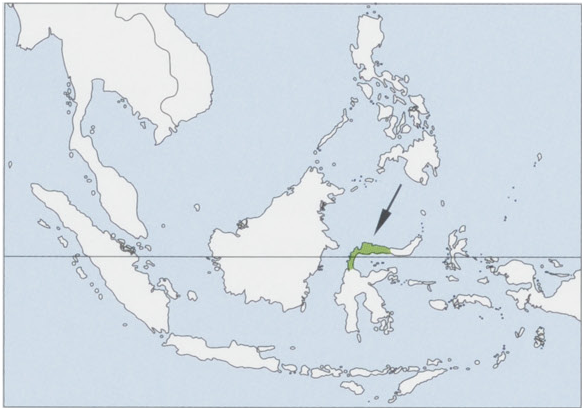
Conservation: CITES – Appendix II; IUCN – Lower Risk (nt).
Sumber: Order Primates
Family Cercopithecidae · Order Primates
Data diperbarui secara berkala dari berbagai sumber observasi biodiversitas.

Foto: Russell A. Mittermeier;Anthony B. Rylands;Don E. Wilson
Otoritas penamaan: (Matschie, 1901) (1901)
Status taksonomi: ACCEPTED
Status konservasi (IUCN): VU Rentan
Dipublikasikan dalam: Abh. Senckenb. Naturf. Ges. vol.25 p.257
Total Catatan di Indonesia
0
Provinsi Ditemukan
0
dari 38 provinsi
Catatan Pertama
0
tahun pertama tercatat
Tren Tahunan
-0%
-33.3% vs 2025
Dihe (Macaca hecki) termasuk dalam famili Cercopithecidae, ordo Primates, kelas Mammalia. Berdasarkan data yang terhimpun, spesies ini telah tercatat sebanyak 94 kali di Indonesia, tersebar di 3 provinsi. Catatan pertama tercatat pada tahun 1914.
Sulawesi Tengah merupakan provinsi dengan catatan observasi terbanyak untuk spesies ini, dengan 22 catatan (23.4% dari total). Data distribusi ini mencerminkan akumulasi dari berbagai kegiatan survei, penelitian, dan kontribusi citizen science. Pola distribusi yang tercatat mungkin tidak sepenuhnya menggambarkan persebaran alami spesies, karena dipengaruhi oleh intensitas pengamatan di masing-masing wilayah.
Tren observasi tahunan Macaca hecki menunjukkan penurunan signifikan (-33%) pada periode terakhir dibanding tahun sebelumnya, dengan catatan pertama pada tahun 1914.
Catatan deskriptif tentang Macaca hecki dari sumber literatur primer (via GBIF).
Conservation: CITES – Appendix II; IUCN – Lower Risk (nt).
Sumber: Order Primates
Distribution: N Sulawesi, from the base of the northern peninsula northeast to Gorontalo (Indonesia).
Sumber: Order Primates
Habitat. Undisturbed or only lightly disturbed primary rainforest at elevations from close to sea level to 1600 - 1800 m. Seasons are not pronounced in these areas, with only one or two drier months each year and annual rainfall of 2500 - 3500 mm (higher in the mountainous regions). The extent to which Heck’s Macaque can thrive in degraded and secondary forest is not known.
Sumber: Cercopithecidae
Movements, Home range and Social organization. Heck’s Macaque is one of the least studied of the Sulawesi macaques. It lives in multimale — multifemale groups averaging 20 individuals (range 7 - 30) and probably in large home ranges of more than a 100 ha. As in all Sulawesi macaques (and typical for the genus), males disperse and females are philopatric. Densities are 20 - 50 ind / km?.
Sumber: Cercopithecidae
Status and Conservation. CITES Appendix II. Classified as Vulnerable on The IUCN Red List. Heck’s Macaque is fully protected by Indonesian Law. It is threatened mainly by loss of habitat, which is increasingly fragmented. The destruction of Sulawesi forests accelerated in the last 40 years, as it has for tropical forests worldwide; commercial logging, Indonesia’s transmigration program, the government-subsidized cash crop industry, and human population growth are all to blame. A report by C. Cannon and colleagues in 2007 reported that 80 % of Sulawesi forests had been destroyed. Heck’s Macaque is hunted in some areas and persecuted as a crop pest. The fearis that intensive hunting for commercial trade within the ranges of the Crested Macaque (M. nigra) and the Gorontalo Macaque, which has resulted in their severely reduced numbers and endangered status, will move south in the northern peninsula into the range of Heck’s Macaque. In 1994, it was estimated that the total population was c. 100,000, but it has certainly declined since then. Forest remains in inaccessible areas, but lowlands in the southern part of its distribution and coastal areas of the northern peninsula, in particular, have been largely converted to agriculture. The suitability of forests for Heck’s Macaques at higher elevations is unknown. In 1999, the lack of strictly protected areas in the range of Heck’s Macaque was seen as the biggest threat to its survival. Protection then was only afforded by a single nature reserve, Panua, of insufficient size (1500 ha), badly degraded and harboring low numbers of macaques. The Paguyaman River catchment was identified as of conservation value for Heck’s Macaque. Since 1999, Nantu Wildlife Reserve and a number of other reserves have been created that protect, or should protect, Heck’s Macaque: Dolangan, Mas Popaya Raja, Pangi Binanga, Pinjam / Tanjung Mantop, and Tangale reserves.

Sumber: Cercopithecidae
Descriptive notes. Head — body 58 - 68 cm (males) and 50 - 57 cm (females), tail 2 - 3 cm (males) and 2 - 3 cm (females); weight 8 - 10 kg (males) and 7 - 8 kg (females). Heck’s Macaque is black, with a brownish underside. Forearms are dark brown, and shanks are gray to light brown (i. e. paler than the trunk). Crown hair is lengthened but does not form a distinct crest, and cheeks are lighter colored and without elongated whiskers. Tail is very short and stubby, although not rudimentary. Ischial callosities are gray to yellow and kidney-shaped, with only a partial transverse furrow across them. Comparing the Gorontalo Macaque (M. nigrescens) with Heck’s Macaque, the Gorontalo Macaque has a baboon-like face, an elongated narrow crest, blackish limbs contrasting with a brown body, and gray ischial callosities. Heck’s Macaque has a short broad face and a short broad, somewhat upstanding crest, on the crown. It is black with strongly contrasting brown shanks (extending up the back of the thighs), weakly contrasting dark brown arms and underparts, and yellow, reniform, and only partially separated callosities. Comparing the Tonkean Macaque (M. tonkeana) with Heck’s Macaque, forearms and shanks of hindlimbs of the Tonkean Macaque are black like the body, underside is no paler than the upper side (it is in Heck’s Macaque), cheek whiskers have a pale grayish or brownish tint (not in Heck’s Macaque), rump patch is more clearly marked and bushy (not so in Heck’s Macaque), and ischial callosities are oval and orange-colored (similar to the Moor Macaque, M. maura, and the Booted Macaque, M. ochreata).
Sumber: Cercopithecidae
Nama-nama ilmiah lain yang pernah digunakan untuk Macaca hecki dalam literatur taksonomi.
| Nama Sinonim | Otoritas | Status |
|---|---|---|
| ? hecki | Matschie, 1901 | SYNONYM |
| Macaca tonkeana hecki | (Matschie, 1901) | SYNONYM |
| Papio hecki | (Matschie, 1901) | HOMOTYPIC_SYNONYM |
| # | Provinsi | Catatan | % |
|---|---|---|---|
| 1 | Sulawesi Tengah | 22 | 23.4% |
| 2 | Gorontalo | 17 | 18.1% |
| 3 | Kalimantan Barat | 1 | 1.1% |
Jumlah catatan observasi Macaca hecki di Indonesia per tahun
Macaca hecki
Foto: Russell A. Mittermeier;Anthony B. Rylands;Don E. Wilson
Macaca hecki
Foto: Russell A. Mittermeier;Anthony B. Rylands;Don E. Wilson
| Nama | Bahasa | Sumber |
|---|---|---|
| Dihe | Indonesia | Catalogue of Life |
| Heck s Macaque | Inggris | Mammal Species of the World |
| Heck şebeği | tur | Catalogue of Life |
| Heck's Macaque | Inggris | Order Primates |
| Heck-Makak | Jerman | Cercopithecidae |
| Heckmakak | Jerman | Catalogue of Life |
| Hecks Makaak | Belanda | Catalogue of Life |
| Heck’s Macaque | Inggris | Catalogue of Life |
| Macaco de Heck | Spanyol | Catalogue of Life |
| Macaco de Heck | - | Cercopithecidae |
| Macaco di Heck | Italia | Catalogue of Life |
| Macaco-de-Heck | Portugis | Catalogue of Life |
| Macaque de Heck | Prancis | Catalogue of Life |
| Macaque à crête | Prancis | Catalogue of Life |
| makak Heckův | ces | Catalogue of Life |
| makak ciemny | pol | Catalogue of Life |
| مكاك هيكي | ara | Catalogue of Life |
| ヘックモンキー | Jepang | Catalogue of Life |
| 黑克獼猴 | Mandarin | Catalogue of Life |
Berdasarkan data 94 observasi, Sulawesi Tengah adalah provinsi dengan catatan Dihe (Macaca hecki) terbanyak — 22 observasi (23.4% dari total catatan di Indonesia). Spesies ini tersebar di 3 provinsi.
Catatan pertama Dihe (Macaca hecki) di Indonesia tercatat pada tahun 1914. Hingga kini terdapat 94 catatan dari 3 provinsi, yang dihimpun dari survei lapangan, koleksi museum, dan platform citizen science.
Menurut IUCN Red List, Dihe (Macaca hecki) berstatus "Rentan" (kode VU). Status ini mencerminkan tingkat risiko kepunahan global spesies, bukan khusus Indonesia.
Di Indonesia dan Malaysia, Macaca hecki dikenal dengan beberapa nama lokal: Dihe. Penamaan dapat berbeda antardaerah dan bahasa.
Ya, Macaca hecki memiliki 3 nama sinonim ilmiah, di antaranya: ? hecki, Macaca tonkeana hecki, Papio hecki. Nama sinonim adalah nama-nama lain yang pernah digunakan untuk spesies yang sama dalam literatur taksonomi.
Macaca hecki diklasifikasikan sebagai berikut: Kingdom Animalia, Phylum Chordata, Class Mammalia, Order Primates, Family Cercopithecidae, Genus Macaca. Spesies ini dideskripsikan oleh (Matschie, 1901).
55 titik observasi Macaca hecki di Indonesia
Memuat peta...
Setiap titik merepresentasikan satu lokasi observasi yang tercatat. Klik titik untuk melihat detail.