
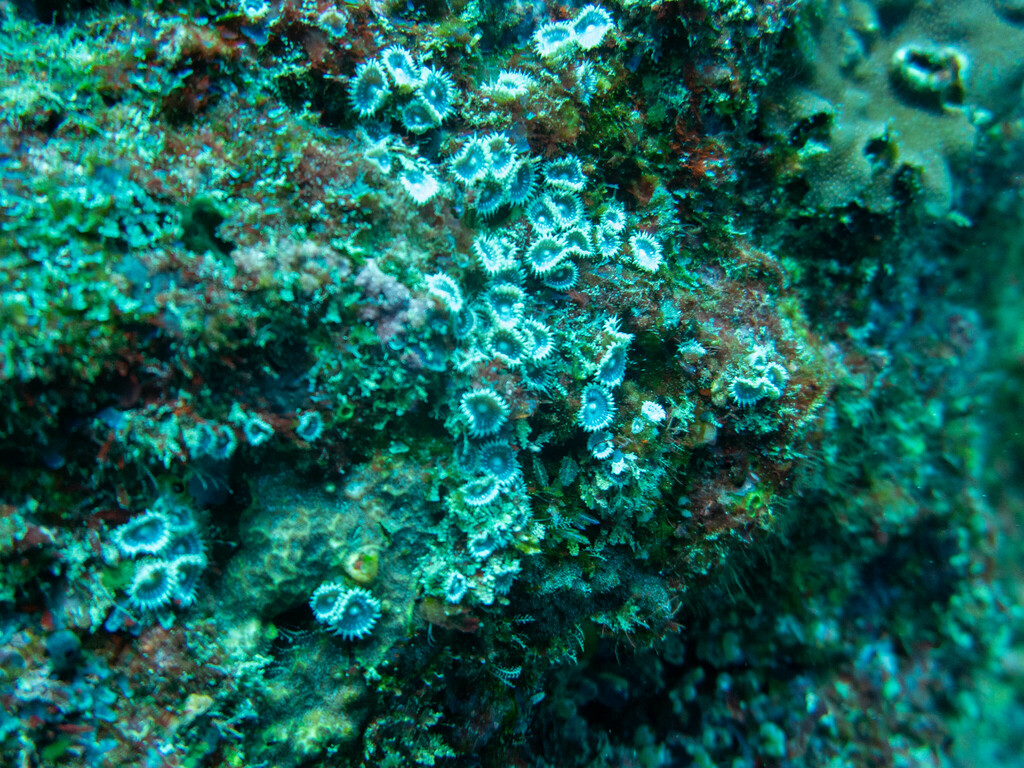
Description. Size: Polyps in situ approximately 2.2 - 5.1 mm in diameter when open, and approximately 2 - 8.5 mm in height. Morphology: Neozoanthus uchina sp. n. has 32 to 42 (average 38 + / - 3.0, n = 24 polyps on 9 colonies) conical tentacles. Tentacles are usually shorter than the expanded oral disk diameter (e. g. 50 - 80 % of oral disk width). Tentacles may be grayish-blue, rust red, or transparent, often with black, white, or fluorescent blue bands or patterning (Figure 4). No bractae are visible, and all specimens were zooxanthellate. Polyps are externally heavily encrusted with sand and other particles of irregular sizes, excepting the oral end, which is free of encrustation and appears a bluish-gray similar to as seen in some Zoanthus species. When fully contracted, the sand free oral end is often not visible, and polyps resemble small balls of sand. Polyps extend well clear of reduced or stoloniferous coenenchyme (Figure 4). Oral disks may be a variety of colors, such as light gray-blue, white, rust or deep wine red. Occasionally, white or light blue dots may be seen on the oral disk in regular circular patterns, and the oral opening (mouth) is often white or cream in color. A " skirt " of different coloration (usually white or lighter coloration than remainder of oral disk) covering up to approximately 90 degrees of the oral disk is often seen in the area of the dorsal directive. Colonies consisted of tens to <100 polyps, connected by stolons with no well-developed coenenchyme. Cnidae: Basitrichs and microbasic p-mastigophores (often difficult to distinguish), holotrichs (large and small), spirocysts (see Table S 1, Figure 5).
Sumber: Two new species of Neozoanthus (Cnidaria, Hexacorallia, Zoantharia) from the Pacific