
Biologi & Ekologieng
Habitat. Various forest types including lowland rainforests, hill forests, lower and upper montane forests, and secondary forests from sea level up to elevations of ¢. 2600 m (on mainland New Guinea). The Papuan Long-eared Bat is rarely recorded in heavily disturbed habitats or agricultural areas and is probably sensitive to habitat alteration.
Sumber: Vespertilionidae
Biologi & Ekologieng
Movements, Home range and Social organization. Papuan Long-eared Bats usually roost in small groups.
Sumber: Vespertilionidae
Konservasieng
Status and Conservation. Classified as Least Concern on The IUCN Red List. The Papuan Long-eared Batis widespread across New Guinea and is the most commonly captured long-eared bat in New Guinea. Nevertheless, compared with other bats, it is captured relatively infrequently and might be less abundant than its relatives in Australia. Its only major threat could be large-scale forest clearing and conversion to monocultures becauseit is not found in most disturbed habitats.
Sumber: Vespertilionidae
Deskripsieng
Descriptive notes. Head-body 42 - 5 - 63 mm, tail 36 - 49 mm, ear 14 - 19 - 4 mm, hindfoot 7 - 10 mm, forearm 37 - 41 - 6 mm; weight 6 - 10 - 5 g. The Papuan Long-eared Bat has relatively large ears and unique simple noseleaf consisting of two ridges, one further on muzzle and another immediately above nostrils, with vertical groove in middle and furred trough between them. Dorsal pelage is medium brown (hairs bicolored blackish brown basally and medium brown distally); venter is pale brown. Wing membranes are blackish brown. Rostrum is short and blunt, with ridge across muzzle over nostrils thatis well developed with deep but thin medial notch. Ears are large and broad, with bluntly rounded tips, but are much smaller, narrower, and more tapered at tip compared with other species of Nyctophilus, have horizontal ribbing on inner surfaces, inward curved anterior edges, and smooth posterior edges (ears can fold back at top of thick part of anterior edge); interauricular membrane typical of genus is either missing or barely present and covered by fur; tragus is almost rectangular, being straight or very slightly convex on anterior margin. Glans penis consists of a pair of relatively small, narrow urethral lappets and subspherical distal nob, which is broad. Baculum has distinct distal notch, curves downward at base, is bifurcated basally, and is straight for rest of shaft. Skull is robust, tympanic bullae are small, and M? ® and lower molars are not reduced.
Sumber: Vespertilionidae
Distribusieng
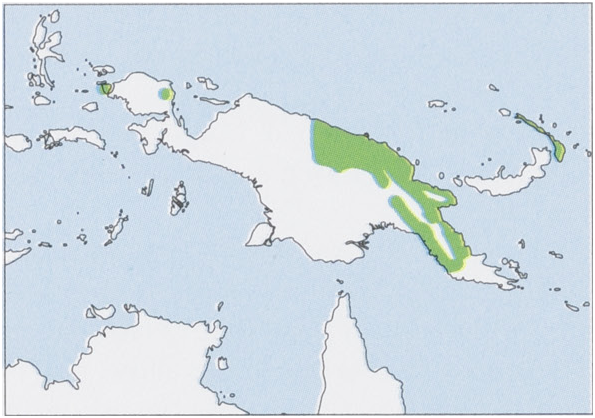
Distribution. Mostly in E New Guinea with one record in West Papua Province and one record each from Salawati and New Ireland Is; possibly on New Britain and SudestIs; there was a recent acoustic record from Manus I that probably is a member of this species complex, but this needs confirmation with a specimen, and the species is most likely widespread in W New Guinea.
Sumber: Vespertilionidae
Konservasieng
Conservation: IUCN 2003 and IUCN / SSC Action Plan (2001) – Lower Risk (lc).
Sumber: Order Chiroptera - Family Vespertilionidae