
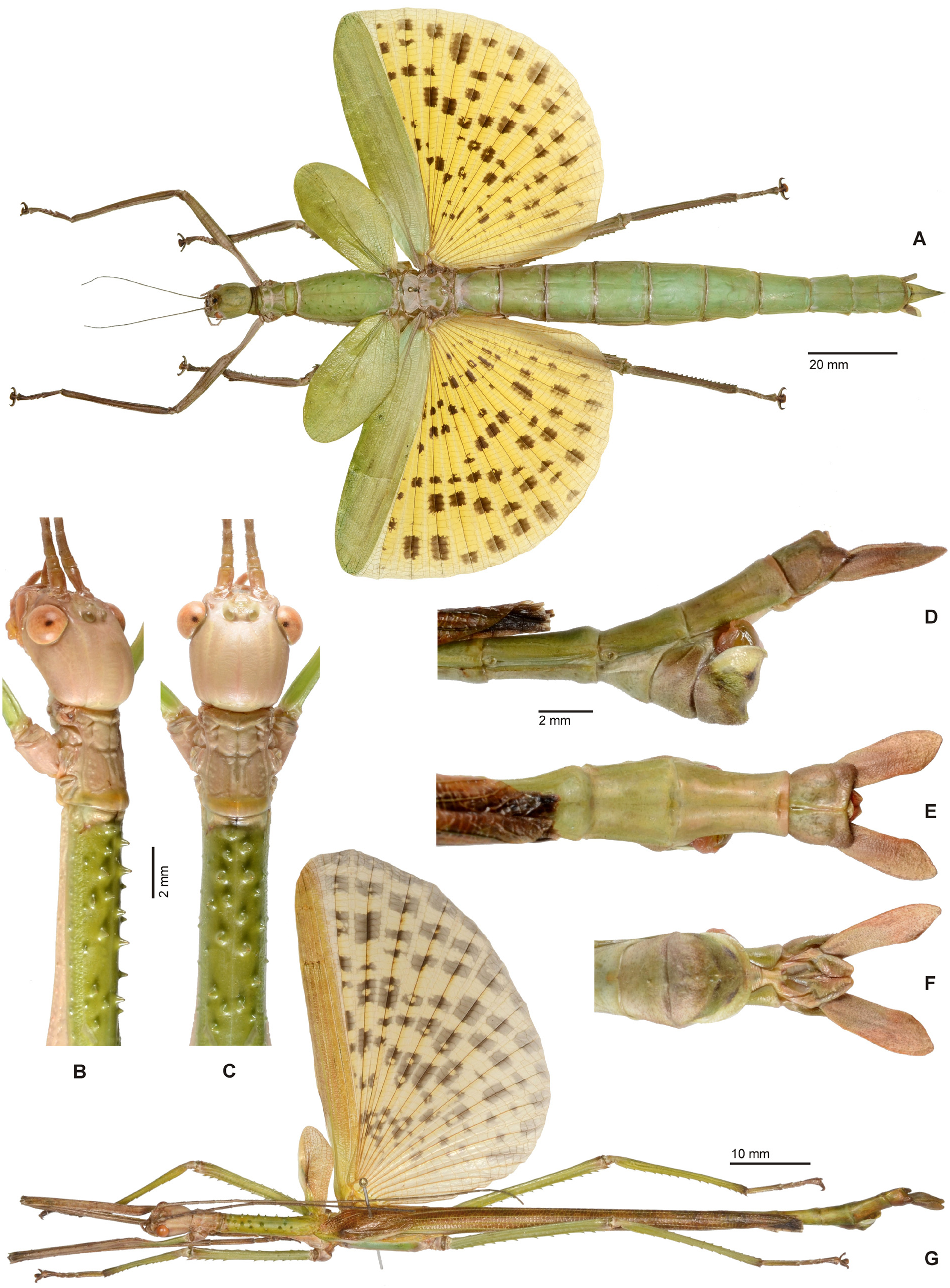
Description: The colouration is described from pictures of live wild and captive reared specimens. ♂ (Fig. 36 G, 37 A – B). Moderately sized Phasmatini (body length excluding cerci 91.0 – 106.0 mm) with a spinose mesothorax and long alae (53.0 – 61.0 mm). Colouration basically a mixture of green and tones of brown. Head, prothorax, front legs (except base of profemora), tarsi and cerci pale to mid creamish or greyish brown. Bases of profemora as well as mid and hind legs green. Mesonotum, meso- and metasternum apple green, mesopleurae ochre with a slight rosy hue, the metapleurae green with the lower portion coloured like mesopleurae. Abdomen greyish green, the terminal two segments with a slight brownish wash. Tegmina mid brown with the anterior margin broadly white and the basal portion apple green. Costal region of alae light brown with a slight greenish wash, the anterior margin white basally. Anal fan transparent dull yellow to orange and all over with several bold and fairly well defined angular dark grey markings (Fig. 36 G). Eyes ferrugineous. Antennae creamish mid brown dorsally and somewhat darker ventrally. Head: Strongly globose, slightly longer than wide, the vertex convex and smooth, broadest just behind the eyes (Figs 36 B – C). Ocelli well developed and frons with a shallow oval impression. Eyes large, projecting hemispherically and their diameter contained almost 1.6 x in length of genae. Antennae reaching to posterior margin of abdominal segment II (Fig. 36 G), densely setose and consisting of 26 antennomeres. Scapus compressed dorsoventrally, rectangular in dorsal aspect and almost 1.5 x longer than wide (Fig. 36 C). Pedicellus short, cylindrical and less than half the length of scapus. III about 2 x longer than pedicellus, IV – XIV very elongate and gradually increasing in length, the following gradually decreasing in length. XIV with a glossy and dark brown, node-like basal swelling dorsally. Thorax: Pronotum considerably shorter and narrower than head, 1.5 x longer than wide, slightly narrowed premedially and with the anterior half somewhat narrower than posterior portion (Fig. 36 C). Transverse median sulcus distinctly impressed, gently curved and spanning almost entire width of segment. Mesothorax about 3.6 x longer than pronotum and parallel-sided with only the very posterior portion gently widened. Anterior ¾ of mesonotum unevenly armed with rather obtuse, conical spines of variable sizes, the lateral surfaces with a marginal row of granules (Figs. 36 B – C). Mesopleurae only with a few minute scattered granules (Fig. 36 B), the mesosternum obtusely tectinate longitudinally and set with a very few small irregularly disposed granules in posterior half. Metapleurae with 5 – 6 small granules along lower margin, metasternum smooth. Tegmina elongate-ovate and somewhat narrowed basally; in basal half with a fairly well developed, rounded central hump. Alae reaching about half way along abdominal segment VII (Fig. 36 G). Abdomen: Median segment slightly shorter than metanotum. Segment II considerably longer then median segment, II – VI uniform in width, parallel-sided and almost uniform in length, on average 3.8 x longer than wide. VII less than ¾ the length of VI, parallel-sided. VIII about 3 / 4 the length of VII and trapezoidal in dorsal aspect with posterior margin notably wider than anterior margin. IX roughly equal in length to VII and constricted medially. Anal segment strongly keeled and tectiform, the lateral surfaces roundly convex and the posterior margin sharply angular in lateral aspect, with the ventral corner slightly protruded and acute (Fig. 36 D); interior surface of posterior margin roundly swollen posteriorly and with a longitudinal bulge that is armed three black in-curving teeth. Cerci very large, foliaceous, strongly flattened laterally, almost 2 x longer than anal segment and with the apex rather obtuse (Figs. 36 D – F). Poculum strongly convex, cup-shaped and with a fairly prominent, obtusely conical sub-basal projection (Fig. 36 D); the posterodorsal margin labiate and broadly rounded (Fig. 36 F). Legs: All moderately long and slender. Profemora about as long as head, pro- and mesothorax combined, mesofemora almost equal to combined length of pro- and mesothorax, metafemora reaching to posterior margin of abdominal segment IV. Bases of profemora strongly compressed and curved, the dorsal margins distinctly approaching each other with the anterior margin raised; all outer carinae sparsely serrate. Medioventral carina fairly indistinct and roughly midways on ventral surface of femur. All outer carinae of protibiae as well as mid and hind legs distinctly and acutely dentate; teeth however smaller and less in number on dorsal carinae. Probasitarsi elongate, unarmed and somewhat shorter than remaining tarsomeres combined. Meso- and metabasitarsi with the ventral carinae minutely dentate and little longer than following three tarsomeres combined.
Sumber: Stick insects of Sulawesi, Peleng and the Sula Islands, Indonesia- a review including checklists of species and descriptions of new taxa (Insecta: Phasmatodea)