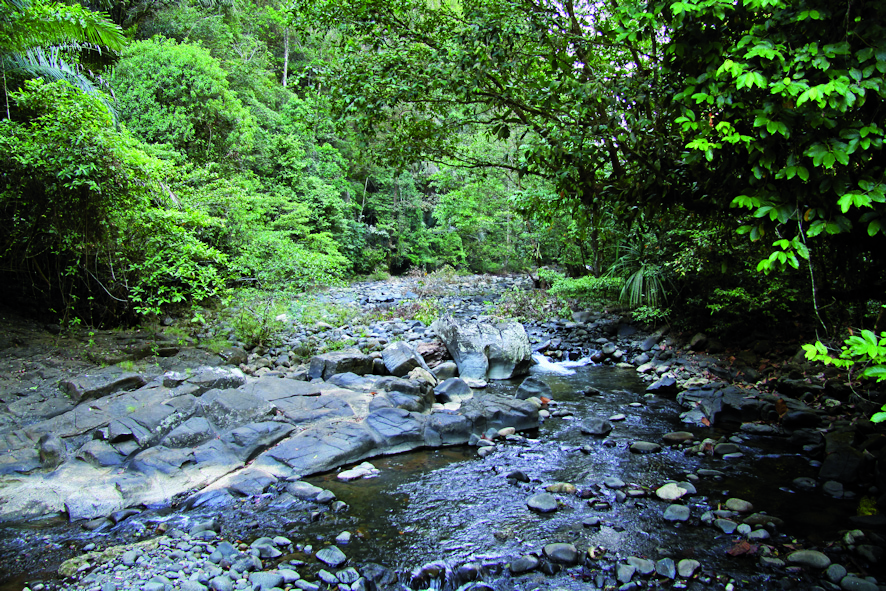
Biologi & Ekologieng
Behaviour The behaviour was studied by GÜNTHER (2008 a) in south-western Sulawesi. Oviposition sites were dead rotting logs, driftwood or other plant substrates lying in the water. Males defend territories around these sites with long- lasting threat displays. The patterns of these threat flights are unique among all Rhinocypha species described here. The synchronous wing beat is signifi- cantly modified. Single hind wings are presented forward and laterally to the rival male. During this display the wing beat of these wings pauses over 2 – 3 strokes. The strongly banded, contrasting colours of the hind wings, described above for the males, probably intensifies the signal effect in this style of presentation. The presentation of the hind wings is of obvious importance during male courtship displays to females. It is conceivable that what we describe as Rhinocypha monochroa, actually consists of several genetically distinct populations that do not interbreed since they are isolated by their behaviour and male colour patterns, and should therefore be treated as separate species. Further behavioural and genetic studies are needed to help clarify this matter.
Sumber: The Odonata of Sulawesi and adjacent islands. Part 8. Revision of the genus Rhinocypha Rambur, 1842 (Chlorocyphidae)
Deskripsieng
Description Male Head (Fig. 39) — Labium brownish black, median lobe black; labrum swol- len, black; mandibles black, with a large blue mark, its base distinctly wider than near labrum, its lower side running parallel to border of mandible, leaving a narrow black margin; clypeus projected as in other Chlorocyphi- dae; anteclypeus shining black; postclypeus, frons, vertex, occiput and post- ocular lobe velvet-black, a paired cream spot behind lateral ocelli, and small cream post-ocular spots close to occiput; genae with large blue spot just above mandibles, extending dorsally with a narrow blue line along the eyes up to the level of the median ocellus. Thorax — Pronotum (Fig. 40) black, with pale-blue markings as follows: an- terior lobe with small spot in latero-posterior corner, continuing onto me- dian lobe, where it is wider anteriorly and tapers in a sharp point, reaching just the posterior half of the median lobe; spots on lateral lobe very variable, some large as in Fig. 40, in other specimens small or even hardly visible; posterior lobe black, unmarked. Synthorax (Fig. 41). Mesopreepisternum black, Mesepisternum black, umarked; a wide, rather straight, blue stripe in lower half of synthorax, run- ning anteriorly from ventro-posterior corner of mesokatepisternum, continuing on ventro-anterior part of mesepimeron; dorsal side of stripe irregular, but usually without conspicuous projection, ending well before posterior border of mesepimeron; lower side of stripe runs from mesokatepisternum just under metathoracic spiracle to metepimeron, where it begins sharply in ventro-anterior corner, continuing at some distance from lower margin of metepimeron, reaching its posterior margin; dorsal side of stripe poste- riorly leaving metapleural suture and meeting the posterior margin of met- epimeron in the middle; metakatepisternum black. Legs — Black, but distal ¾ on innerside of mid and hind tibiae white. Wings — Black with metallic sheen; basal part to the level of Arculus transparent, posteriorly also to level of distal side of quadrangle; metallic blue iridescence on underside of hind wing to level of Px 10, distal part of wing with deep, golden copper iridescence; pterostigma of fore and hind wings dark brown, nearly black against veins. There are remarkable differences in the coloration of the wings between the males of different populations of R. monochroa (Figs 45 – 53). This applies particularly to the iridescent colours of the undersides of the hind wings. Also, being strongly iridescent structural colour, both the colours and the extent of the coloured zones perceived are affected by the angle of reflection, with shallow viewing angles resulting in shorter wavelength reflected light (cf. Figs 46 and 47). The best overall colour impression is seen on photographs of living individuals. Reflective patterns of newly preserved specimens are fairly stable. However, the colours on the wings of pinned specimens can change or fade with time, especially in younger specimens. The populations in the southern part of south-western Sulawesi and on Sa- layar Island show a metallic light blue to deep blue sheen in the proximal half of the underside of the hind wing (‘ blue triangle’), distally followed by a narrow yellow band and a golden brown distal part (Figs 5 and 45). Such coloration is also shown in the lectotype (Fig. 38). In specimens from Palopo (Fig. 47) and Madjene (Fig. 48) the reflection of the basal ‘ blue triangle’ is, depending on the angle of examination, more deep blue to blue violet, while the reflection of the distal parts is golden coppery brown, at slightly altered angle of incidence changing to green. Specimens from Malino and Watampone (Fig. 46) have an intermediate coloration. The tripartite reflec- tion pattern with a basal ‘ blue triangle’ is characteristic of populations from the south-western peninsula. Specimens of the south-eastern peninsula lack this clear zoning in the reflection patterns; the underside of the hind wings reflect bronzy brown with slightly golden sheen (Kolaka, Fig. 49), purple- brown to purple (Kendari, Fig. 50) or green to bluish with a greenish distal part of the wing (Moramo (Fig. 51). A distinctly different reflection pat- tern is shown by specimens from Kabaena Island, off south-eastern Sulawesi (Fig. 52). The main area of the wings reflects green, and towards the distal end one finds a colour gradient from gold to blue violet. The space between C and R 1 reflects, depending on the view angle, steel blue to purple, and the space between R 1 and R 2 purple (see also the conclusions below). Abdomen (Fig. 43) — Dorsum black; side of tergites with extensive blue markings as follows: S 1 large, sub-quadrangular, S 2 rectangular, but ventro- anterior corner emarginate, S 3 – S 8 with progressively smaller markings, that on S 3 large and rectangular, those on S 6 – S 7 tapering dorso-posteriorly, S 8 with oblong triangular marking, pointed posteriorly, ending before poste- rior margin of segment; S 9 – S 10 and anal appendages black. Female Head (Fig. 44) — Mandible with squarish pale bluish-white marking in ba- sal part, distal part shining black; gena with similar marking to R. frontalis, extending along the eyes as a very narrow stripe up to the level of vertex; frons black without pale marking; a paired spot beyond the lateral ocelli, about the size of the ocelli; post-ocular spots of similar size. Thorax — Pronotum velvet black with just a small irregular bluish white marking from the extreme lateral corner of anterior lobe to middle of me- dian lobe; marking widest in the middle. Synthorax. Mesopreepisternum black. Synthorax velvet black with a longi- tudinal bluish white stripe from ventro-posterior corner of mesokatepister- num, over ventro-anterior part of mesepimeron, continuing over meta- thoracic spiracle on metepisternum, and over middle of metepimeron. Legs — Black. Wings — Basal part of fore wing opaque dark brown up to level of Px 24; posterior part transparent white, the extreme tip opaque white; pterostigma white, basal corner brown; hind wing dark brown, with tip posterior to posterior side of pterostigma opaque white; pterostigma with significant variation in both fore and hind wings, from basal half dark brown and rest creamy white, to nearly fully dirty white. Abdomen — Black, with small bluish white markings as follows: S 1 with small oblong spot mediolaterally; S 2 with longitudinal marking about length of segment mediolaterally, with sub-cylindrical spot in same line against posterior margin, ventrally a spot of ca ¼ of segment length, half as high as long; a series of similar spots at same level on S 3 – S 7, large on S 3 – S 5, smaller on S 6 – S 7; anterior margin of S 3 – S 6 with narrow stripe, very small on S 7; rest of abdomen black. Measurements Males: Measurements of specimens from south-western Sulawesi [mm] — Hind wing length (n = 5) x = 24.5 (23.0 – 26.0); hind wing width (n = 5) x = 6.0 (5.5 – 6.5); abdomen length (including appendages) (n = 5) x = 20.5 (19.5 – 22.0). Females: Measurements of specimens from south-western Sulawesi [mm] — Hind wing length (n = 5) x = 26.0 (25.5 – 29.5); hind wing width (n = 5) x = 6.5 (6.0 – 7.0); abdomen length (including appendages) (n = 5) x = 20.5 (19.0 – 21.5). Specimens from Salayar [mm] — Hind wing length (n = 3) 24.0 – 25.0; hind wing width (n = 3) 5.5 – 6.0; abdomen length (including appendages) (n = 3) 18.0 – 20.0.