
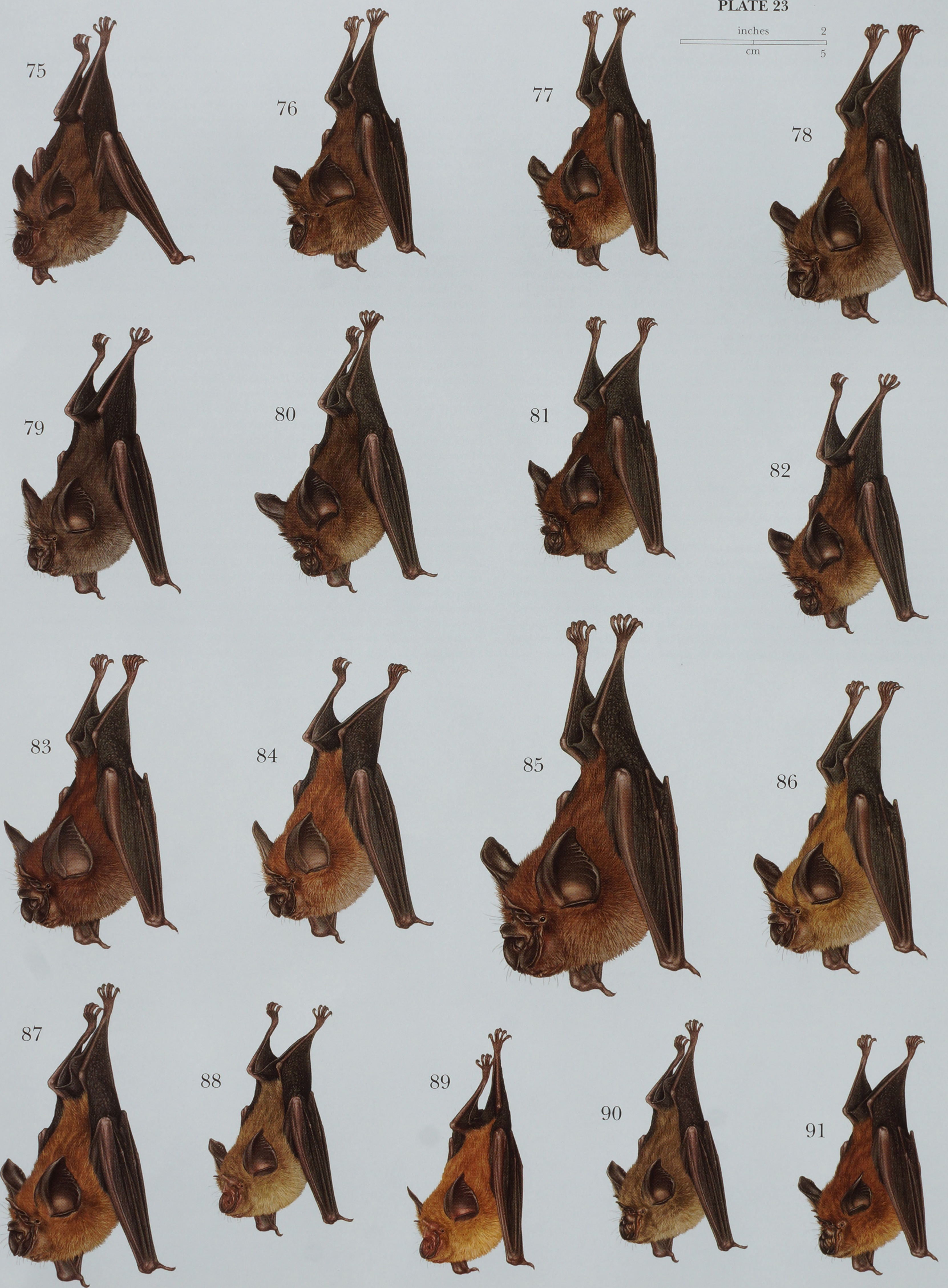
DISTRIBUTION: Aru Isis, Buru, Amboina, Seram, and Timor Laut Isis, Kei Isis, Halmahera, and Sulawesi (Indonesia); New Guinea; Bismarck Arch.; adjacent small islands.
Sumber: Order Chiroptera
Family Rhinolophidae · Order Chiroptera
Data diperbarui secara berkala dari berbagai sumber observasi biodiversitas.

Foto: Burgin, Connor
Otoritas penamaan: Temminck, 1835 (1835)
Status taksonomi: ACCEPTED
Status konservasi (IUCN): LC Risiko Rendah
Dipublikasikan dalam: Monogr. Mamm. vol.2 p.26
Total Catatan di Indonesia
0
Provinsi Ditemukan
0
dari 38 provinsi
Catatan Pertama
0
tahun pertama tercatat
Tren Tahunan
+0%
+0.0% vs 1998
Broad-eared Horseshoe Bat (Rhinolophus euryotis) termasuk dalam famili Rhinolophidae, ordo Chiroptera, kelas Mammalia. Berdasarkan data yang terhimpun, spesies ini telah tercatat sebanyak 185 kali di Indonesia, tersebar di 2 provinsi. Catatan pertama tercatat pada tahun 1848.
Maluku merupakan provinsi dengan catatan observasi terbanyak untuk spesies ini, dengan 18 catatan (9.7% dari total). Data distribusi ini mencerminkan akumulasi dari berbagai kegiatan survei, penelitian, dan kontribusi citizen science. Pola distribusi yang tercatat mungkin tidak sepenuhnya menggambarkan persebaran alami spesies, karena dipengaruhi oleh intensitas pengamatan di masing-masing wilayah.
Tren observasi tahunan Rhinolophus euryotis relatif stabil pada periode terakhir dibanding tahun sebelumnya, dengan catatan pertama pada tahun 1848.
Catatan deskriptif tentang Rhinolophus euryotis dari sumber literatur primer (via GBIF).
DISTRIBUTION: Aru Isis, Buru, Amboina, Seram, and Timor Laut Isis, Kei Isis, Halmahera, and Sulawesi (Indonesia); New Guinea; Bismarck Arch.; adjacent small islands.
Sumber: Order Chiroptera
DISTRIBUTION: Aru Isis.; Buru, Amboina, Seram, and Timor Laut Isis.; Kei Isis.; Batchian Isl.; New Guinea; Bismarck Arch.; Sulawesi; adjacent small islands.
Sumber: Order Chiroptera
Ears large, very similar to those of Rh. affinis, but less acute, and the outer margin more deeply concave immediately beneath the tip; nose-leaf broad, the horizontal leaf concealing the muzzle, and even projecting slightly beyond it, divided in front by a longitudinal groove with raised edges, which is bounded behind and separated from the commencement of the horizontal base of the sella by a short erect projection (Plate VI. fig. 1 a); base of the sella with a triangular lappet on either side concealing the nostrils, the erect process expanded above, with strongly convex sides and rounded summit, scarcely exceeded in height by the rounded upper margin of the connecting-process; terminal leaf acute, but its extremity not attenuated. Lower lip with three grooves. Tail very short; interfemoral membrane square or concave behind; last rudimentary caudal vertebra projecting. Wings from the lower end of the tibia near the ankles; feet very long (Plate VI. fig- I - Fur light brown above, buffy brown beneath. First upper premolar in the outer side of the space between the canine and second premolar; lower incisors trifid, not crowded. Length, head and body 2 " - 4, tail 0 " - 7, ear O', - 9, forearm 2 ” - 2, thumb O' ' - 35; third finger — metacarp. T' - 55, 1 st ph. 0 ” ’ 65, 2 nd ph. 1 " T; fifth finger — metacarp. " - 6, 1 st ph. O', - 5, 2 nd ph. 0 " - 6; calcanéum T', foot 0 ” - 5.
Sumber: Rhinolophus
Habitat. Known to forage in both primary and secondary rainforest from sea level up to elevations of 2050 m. Food and Feeding. The New Guinea Broad-eared Horseshoe Bat forages for insects by substrate-gleaning. Breeding. Pregnant females were reported in late August on New Britain, and four pregnant and one lactating females were captured in late October on Batanta Island; based on these data, females probably give birth in late October. Each pregnant female carried only a single embryo. Activity patterns. New Guinea Broad-eared Horseshoe Bats roost by day in caves and tunnels. Call shape is FM / CF / FM, with peak frequencies of 52 - 58 kHz recorded in New Guinea. Movements, Home range and Sodai organization. Colonies can reach over 1000 individuals (e. g. a maternity colonywith over 1000 bats was reported in November on New Guinea).
Sumber: Rhinolophidae
Status and Conservation. Classified as Least Concern on The IUCN Red List. The New Guinea Broad-eared Horseshoe Bat is widespread but is likely to be threatened by roost disturbance, as well as habitat destruction and alteration.
Sumber: Rhinolophidae
Descriptive notes. Head — body 54 - 73 mm, tail 16 — 28 mm, ear 19 — 26 - 5 mm, hindfoot 11 — 15 mm, forearm 50 — 60 mm; weight 14 - 1 — 27 - 5 g. Dorsal pelage is brown (hairs paler drab basally), whereas ventral pelage is lighter brownish or wood brown. Ears are moderately long. Noseleaf has more or less straight-sided and densely haired lancet; connecting process is semicircular and hairy; sella is wide but relatively short and almost parallel-sided, with convex outlined tip; horseshoe has longitudinal groove with raised edges extending from median edge to intemarial region, is dark in color with exception of whitish stripe on median longitudinal groove, is very wide (10 - 2 — 13 mm), covers muzzle and even projects slighdy beyond it, and has very shallow median emargination. Lower lip has three mental grooves. Skull is large but relatively slender in build (zygomatic breadth is only slighdy larger than mastoid breadth); anterior median swellings are prominent and bulbous; posterior swellings are reduced; frontal depression extends anteriorly to medium swellings and is elongated and moderately deep; supraorbital crests are conspicuous but not very sharp; sagittal crest is moderately developed. C 1 is long and strong; P 2 is medium-sized and within tooth row or halfway extruded from it; P is small and completely extruded from tooth row, or is sometimes missing entirely; P, and P 4 are usually very close to one another or touching. Dental formula is the usual of 32 teeth for the genus or only 30 teeth when a lower premolar is missing.
Sumber: Rhinolophidae
Nama-nama ilmiah lain yang pernah digunakan untuk Rhinolophus euryotis dalam literatur taksonomi.
| Nama Sinonim | Otoritas | Status |
|---|---|---|
| Rhinolophus aruensis | K.Andersen, 1907 | SYNONYM |
| Rhinolophus burius | Hinton, 1925 | SYNONYM |
| Rhinolophus praestens | K.Andersen, 1905 | SYNONYM |
| Rhinolophus tartar | Bergmans & Rozendaal, 1982 | SYNONYM |
| Rhinolophus timidus | K.Andersen, 1905 | SYNONYM |
| # | Provinsi | Catatan | % |
|---|---|---|---|
| 1 | Maluku | 18 | 9.7% |
| 2 | Papua Barat | 7 | 3.8% |
Jumlah catatan observasi Rhinolophus euryotis di Indonesia per tahun
Rhinolophus euryotis
Foto: Burgin, Connor
Rhinolophus euryotis
Foto: Burgin, Connor
| Nama | Bahasa | Sumber |
|---|---|---|
| Broad-eared Horseshoe Bat | Inggris | Integrated Taxonomic Information System (ITIS) |
| Herradura de Nueva Guinea | - | Rhinolophidae |
| Neuguinea-Hufeisennase | Jerman | Catalogue of Life |
| New Guinea Broad-eared Horseshoe Bat | Inggris | Integrated Taxonomic Information System (ITIS) |
| New Guinea Horseshoe Bat | Inggris | Catalogue of Life |
| Rhinolophe euryote I German | Prancis | Catalogue of Life |
Berdasarkan data 185 observasi, Maluku adalah provinsi dengan catatan Broad-eared Horseshoe Bat (Rhinolophus euryotis) terbanyak — 18 observasi (9.7% dari total catatan di Indonesia). Spesies ini tersebar di 2 provinsi.
Catatan pertama Broad-eared Horseshoe Bat (Rhinolophus euryotis) di Indonesia tercatat pada tahun 1848. Hingga kini terdapat 185 catatan dari 2 provinsi, yang dihimpun dari survei lapangan, koleksi museum, dan platform citizen science.
Menurut IUCN Red List, Broad-eared Horseshoe Bat (Rhinolophus euryotis) berstatus "Risiko Rendah" (kode LC). Status ini mencerminkan tingkat risiko kepunahan global spesies, bukan khusus Indonesia.
Ya, Rhinolophus euryotis memiliki 5 nama sinonim ilmiah, di antaranya: Rhinolophus aruensis, Rhinolophus burius, Rhinolophus praestens. Nama sinonim adalah nama-nama lain yang pernah digunakan untuk spesies yang sama dalam literatur taksonomi.
Rhinolophus euryotis diklasifikasikan sebagai berikut: Kingdom Animalia, Phylum Chordata, Class Mammalia, Order Chiroptera, Family Rhinolophidae, Genus Rhinolophus. Spesies ini dideskripsikan oleh Temminck, 1835.
49 titik observasi Rhinolophus euryotis di Indonesia
Memuat peta...
Setiap titik merepresentasikan satu lokasi observasi yang tercatat. Klik titik untuk melihat detail.