
Biologi & Ekologieng
Habitat. [Lowland and montane primary rainforests and lightly disturbed forests from sea level up to elevations of 2400 m.
Sumber: Pteropodidae
Family Pteropodidae · Order Chiroptera
Data diperbarui secara berkala dari berbagai sumber observasi biodiversitas.
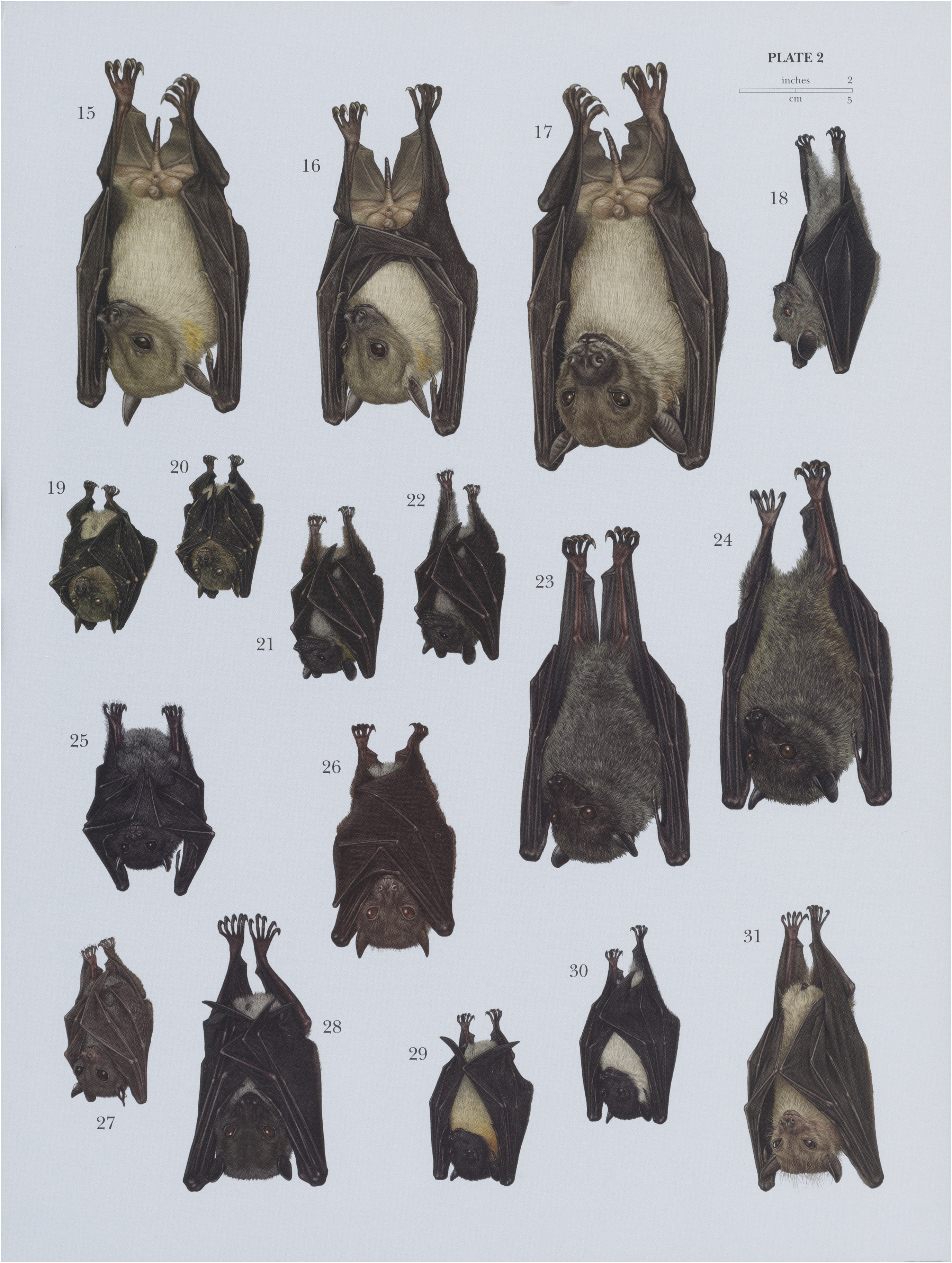
Foto: Don E. Wilson;Russell A. Mittermeier
Otoritas penamaan: (Gray, 1870) (1870)
Status taksonomi: ACCEPTED
Status konservasi (IUCN): LC Risiko Rendah
Dipublikasikan dalam: Cat. Monkeys, Lemurs, Fruit-eating Bats Brit. Mus. p.123
Total Catatan di Indonesia
0
Provinsi Ditemukan
0
dari 38 provinsi
Catatan Pertama
0
tahun pertama tercatat
Tren Tahunan
+0%
+100.0% vs 2021
Common Swift Fruit Bat (Thoopterus nigrescens) termasuk dalam famili Pteropodidae, ordo Chiroptera, kelas Mammalia. Berdasarkan data yang terhimpun, spesies ini telah tercatat sebanyak 520 kali di Indonesia, tersebar di 2 provinsi. Catatan pertama tercatat pada tahun 1821.
Sulawesi Selatan merupakan provinsi dengan catatan observasi terbanyak untuk spesies ini, dengan 49 catatan (9.4% dari total). Data distribusi ini mencerminkan akumulasi dari berbagai kegiatan survei, penelitian, dan kontribusi citizen science. Pola distribusi yang tercatat mungkin tidak sepenuhnya menggambarkan persebaran alami spesies, karena dipengaruhi oleh intensitas pengamatan di masing-masing wilayah.
Tren observasi tahunan Thoopterus nigrescens menunjukkan peningkatan signifikan (+100%) pada periode terakhir dibanding tahun sebelumnya, dengan catatan pertama pada tahun 1821.
Catatan deskriptif tentang Thoopterus nigrescens dari sumber literatur primer (via GBIF).
Habitat. [Lowland and montane primary rainforests and lightly disturbed forests from sea level up to elevations of 2400 m.
Sumber: Pteropodidae
Movements, Home range and Social organization. Infestation with parasites on Common Swift Fruit Bats suggests communal roosting in permanent locations, perhaps cavities or caves.
Sumber: Pteropodidae
Status and Conservation. Classified as Least Concern on The IUCN Red List. The Common Swift Fruit Bat is common, even dominant, and able to adapt to disturbed forest habitats. Population trend is unknown, but most of the population not fragmented.
Sumber: Pteropodidae
Descriptive notes. Head-body 94 - 111 mm, tail 6 mm (single individual), ear 13 - 17 mm, hindfoot 18 - 20 mm, forearm 70 - 82 mm; weight 67 - 99 g. Head of the Common Swift Fruit Bat has relatively long muzzle, nostrils are short and barely divergent, philtrum reaches upper lip, and lowerlip has two large and flat triangular pads. Eyes are moderately large; iris is warm brown to chocolate-brown. Ears are short and rounded. Head pelage is darker than body, moderately long, dense, and dark grayish brown, with short guard hairs on nape; dorsal pelage is long (¢. 9 mm), soft, silky, and dark grayish brown, somewhat irregularly washed in light brown especially on dorsal forearm. Uropatagium is narrow at center, with dorsal hairs extending over tibia; underside of uropatagium is naked; tail is minute, infrequently absent; and calcar is short (7 - 8 mm). Chest and belly fur is dark gray, occasionally silvery, and dense. Wing membranes are black from sides of body and attach to second toe; index claw is present. Skull lacks basicranial deflection, rostrum is moderately long, orbit is large with marked rim, zygomatic root is from above alveolar line, zygoma is moderately thick and strongly arched posteriorly, and braincase is domed. Dorsally, rostrum is long and slightly tapering; paranasal recesses are inflated, passing short postorbital processes posteriorly; there is no postorbital foramen; postorbital constriction is obvious; braincase is oval; sagittal crest is present but low; and nuchal crest is obvious. Ventrally, palate is flat, with diverging tooth rows; post-dental is moderately short, and sides are slightly convergent; end of post-dental palate is straight; and ectotympanic is small and wide anteriorly, narrowly edged internally by entotympanic. Mandible is moderately thick; coronoid is tall, almost vertical with wide tip; condyle is slightly above lower alveolar line; and angle is distinct and rounded. There are nine arched interdental palatal ridges, and posterior one-half is divided at middle, followed by three post-dental divided ridges, the last one is denticulate, plus a last, ill-defined ridge, denticulate, near end of post-dental palate. Dental formula for all species of Thoopterusis 12 / 2, C 1 / 1, P 3 / 3, M 1 / 2 (x 2) = 30. Upper incisors are conical, with I longer than I *; C' is long and decurved, with anterointernal groove, longer and bulkier in males; P' is small; and posterior cheekteeth are large, decreasing in size, with squarish outline, and lingual cusps reduced. Lower incisors are small and crowded; C, 1 s rather small and straight, with strong cingulum and cusp-like lobule; P, is well developed, with triangular crown; posterior cheekteeth are tall, very wide, and squarish, with reduced lingual cusp and strong surface cusp, and M, very low and peg-like. Diploid number is 2 n = 38.
Nama-nama ilmiah lain yang pernah digunakan untuk Thoopterus nigrescens dalam literatur taksonomi.
| Nama Sinonim | Otoritas | Status |
|---|---|---|
| Cynopterus marginatus nigrescens | Gray, 1870 | SYNONYM |
| # | Provinsi | Catatan | % |
|---|---|---|---|
| 1 | Sulawesi Selatan | 49 | 9.4% |
| 2 | Sulawesi Tengah | 17 | 3.3% |
Jumlah catatan observasi Thoopterus nigrescens di Indonesia per tahun
Thoopterus nigrescens
Foto: Don E. Wilson;Russell A. Mittermeier
Thoopterus nigrescens
Foto: Don E. Wilson;Russell A. Mittermeier
| Nama | Bahasa | Sumber |
|---|---|---|
| Bystrolot ciemny | pol | Catalogue of Life |
| Common Swift Fruit Bat | Inggris | Catalogue of Life |
| Cynoptere sombre | Prancis | Pteropodidae |
| Schwarzflligelflughund | Jerman | Catalogue of Life |
| Schwarzflügelflughund | Jerman | Catalogue of Life |
| Swift Fruit Bat | Inggris | Catalogue of Life |
| Toptérido cenizo | - | Pteropodidae |
| kaloň hbitý | ces | Catalogue of Life |
| viirusilmähekko | fin |
Berdasarkan data 520 observasi, Sulawesi Selatan adalah provinsi dengan catatan Common Swift Fruit Bat (Thoopterus nigrescens) terbanyak — 49 observasi (9.4% dari total catatan di Indonesia). Spesies ini tersebar di 2 provinsi.
Catatan pertama Common Swift Fruit Bat (Thoopterus nigrescens) di Indonesia tercatat pada tahun 1821. Hingga kini terdapat 520 catatan dari 2 provinsi, yang dihimpun dari survei lapangan, koleksi museum, dan platform citizen science.
Menurut IUCN Red List, Common Swift Fruit Bat (Thoopterus nigrescens) berstatus "Risiko Rendah" (kode LC). Status ini mencerminkan tingkat risiko kepunahan global spesies, bukan khusus Indonesia.
Ya, Thoopterus nigrescens memiliki 1 nama sinonim ilmiah, di antaranya: Cynopterus marginatus nigrescens. Nama sinonim adalah nama-nama lain yang pernah digunakan untuk spesies yang sama dalam literatur taksonomi.
Thoopterus nigrescens diklasifikasikan sebagai berikut: Kingdom Animalia, Phylum Chordata, Class Mammalia, Order Chiroptera, Family Pteropodidae, Genus Thoopterus. Spesies ini dideskripsikan oleh (Gray, 1870).
Sumber: Pteropodidae
Conservation: IUCN / SSC Action Plan (1992) – No Data. IUCN 2003 – Lower Risk (nt).
Sumber: Order Chiroptera - Family Pteropodidae
Distribution: Sulawesi, Sula Isls, Sangihe Isls, Karakelang (Talaud Isls), and Morotai (Indonesia).
Sumber: Order Chiroptera - Family Pteropodidae
| Catalogue of Life |
| Тёмный крылан | rus | Catalogue of Life |
| スフィフトフルーツコウモリ | Jepang | Catalogue of Life |
69 titik observasi Thoopterus nigrescens di Indonesia
Memuat peta...
Setiap titik merepresentasikan satu lokasi observasi yang tercatat. Klik titik untuk melihat detail.