Conservation: IUCN – Lower Risk (lc).
Sumber: Order Soricomorpha
Family Soricidae · Order Soricomorpha
Data diperbarui secara berkala dari berbagai sumber observasi biodiversitas.

Foto: Esselstyn, Jacob A.;Achmadi, Anang S.;Handika, Heru;Swanson, Mark T.;Giarla, Thomas C.;Rowe, Kevin C.
Otoritas penamaan: Miller & Hollister, 1921 (1921)
Status taksonomi: ACCEPTED
Status konservasi (IUCN): LC Risiko Rendah
Dipublikasikan dalam: Proc. Biol. Soc. Wash. vol.34 p.102
Total Catatan di Indonesia
0
Provinsi Ditemukan
0
dari 38 provinsi
Catatan Pertama
0
tahun pertama tercatat
Tren Tahunan
-0%
-66.7% vs 2014
Kleine SchwarzfuR- \ Weil 3 zahnspitzmaus (Crocidura lea) termasuk dalam famili Soricidae, ordo Soricomorpha, kelas Mammalia. Berdasarkan data yang terhimpun, spesies ini telah tercatat sebanyak 66 kali di Indonesia, tersebar di 3 provinsi. Catatan pertama tercatat pada tahun 1916.
Sulawesi Tengah merupakan provinsi dengan catatan observasi terbanyak untuk spesies ini, dengan 27 catatan (40.9% dari total). Data distribusi ini mencerminkan akumulasi dari berbagai kegiatan survei, penelitian, dan kontribusi citizen science. Pola distribusi yang tercatat mungkin tidak sepenuhnya menggambarkan persebaran alami spesies, karena dipengaruhi oleh intensitas pengamatan di masing-masing wilayah.
Tren observasi tahunan Crocidura lea menunjukkan penurunan signifikan (-67%) pada periode terakhir dibanding tahun sebelumnya, dengan catatan pertama pada tahun 1916.
Catatan deskriptif tentang Crocidura lea dari sumber literatur primer (via GBIF).
Conservation: IUCN – Lower Risk (lc).
Sumber: Order Soricomorpha
Distribution: N and C Sulawesi, tropical rain forest (Musser, 1987 a).
Sumber: Order Soricomorpha
DISTRIBUTION: N and C Sulawesi, tropical rain forest (Musser, 1987).
Sumber: Order Insectivora
DISTRIBUTION: Known only from the type locality.
Sumber: Order Insectivora
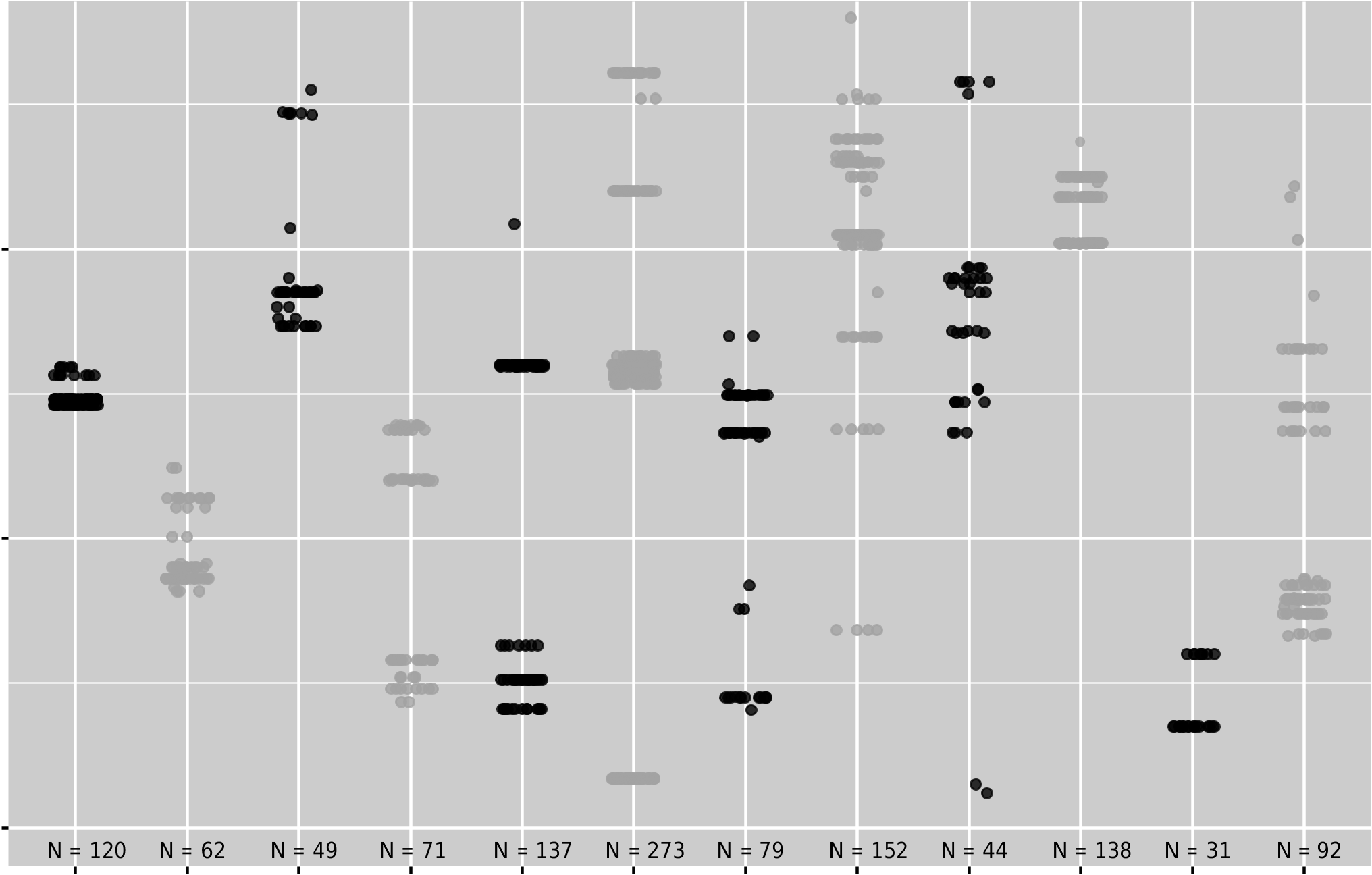
COMPARISONS: Crocidura lea is much smaller than all Sulawesi Crocidura outside of the Small- Bodied Group (fig. 9). Among the Small-Bodied species, only C. baletei and C. tenebrosa are known from the northern peninsula. Crocidura levicula, C. parva, and C. mediocris are apparently restricted to the central core and eastern and southwestern peninsulas (fig. 25). We therefore focus our comparisons on the cooccurring, northern peninsula species. However, first we note that the allopatric C. levicula has a broader skull (figs. 10, 26; tables 8, 9), shorter tail, shorter hind feet, and more tail bristles than does C. lea (figs. 27, 29; table 2). Among the Small-Bodied shrews of the northern peninsula, C. lea has a slightly paler and more strongly dorsoventrally bicolored pelage than C. baletei or C. tenebrosa. Both of the latter species are relatively uniform in color, C. baletei being medium brown and C. tenebrosa dark brown. Crocidura lea also has paler skin wherever it is exposed than either C. baletei (somewhat darker) or C. tenebrosa (much darker). Dorsally, the feet of both C. baletei and C. tenebrosa are uniformly dark, whereas the foot color transitions posteriorly from brown at the heel to white or pink at the digits in C. lea (fig. 27). Similarly, the tails of both C. baletei and C. tenebrosa are not obviously bicolored, and both are darker. Tail bristles are present on approximately three-fourths of the tail length in all three species, but they are much more abundant and longer on the tails of C. baletei and C. tenebrosa than in C. lea (fig. 27). Applied hairs on the tail are also much more visible in the two new species than in C. lea. Tail length in C. lea is greater, on average, than in C. baletei, and substantially so compared to C. tenebrosa (fig. 9; table 2). The skulls of C. lea are comparable in length, but significantly narrower at the braincase, interorbital region, maxillary process, and to a lesser extent at the rostrum than those of C. baletei and C. tenebrosa (figs. 10, 30; table 8). Crocidura lea occupies distinct morphometric space from the other northern peninsula endemics in bivariate plots of skull length and width and the first two principal components from an analysis of 12 cra- nial measurements (fig. 26). The C (U 3) is larger than I 3 (U 2) in C. lea, but they are usually subequal in occlusal surface area in C. baletei and C. tenebrosa. The parastyle of P 4 is more prominent in C. tenebrosa than in C. lea or C. baletei.

Sumber: Fourteen New, Endemic Species Of Shrew (Genus Crocidura) From Sulawesi Reveal A Spectacular Island Radiation
Habitat. Lowland evergreen rainforests to moss forests covering highest summits from near sea level to elevations of ¢. 2300 m. The Lesser Black-footed White-toothed Shrew is found in primary and secondary forests among leaf litter or on moss-covered vegetation.
Sumber: Soricidae
| # | Provinsi | Catatan | % |
|---|---|---|---|
| 1 | Sulawesi Tengah | 27 | 40.9% |
| 2 | Gorontalo | 21 | 31.8% |
| 3 | Sulawesi Utara | 12 | 18.2% |
Jumlah catatan observasi Crocidura lea di Indonesia per tahun
Crocidura lea
Foto: Esselstyn, Jacob A.;Achmadi, Anang S.;Handika, Heru;Swanson, Mark T.;Giarla, Thomas C.;Rowe, Kevin C.
Crocidura lea
Foto: Esselstyn, Jacob A.;Achmadi, Anang S.;Handika, Heru;Swanson, Mark T.;Giarla, Thomas C.;Rowe, Kevin C.
Crocidura lea
Foto: Esselstyn, Jacob A.;Achmadi, Anang S.;Handika, Heru;Swanson, Mark T.;Giarla, Thomas C.;Rowe, Kevin C.
Crocidura lea
Foto: Esselstyn, Jacob A.;Achmadi, Anang S.;Handika, Heru;Swanson, Mark T.;Giarla, Thomas C.;Rowe, Kevin C.
Crocidura lea
Foto: Esselstyn, Jacob A.;Achmadi, Anang S.;Handika, Heru;Swanson, Mark T.;Giarla, Thomas C.;Rowe, Kevin C.
Crocidura lea
Foto: Esselstyn, Jacob A.;Achmadi, Anang S.;Handika, Heru;Swanson, Mark T.;Giarla, Thomas C.;Rowe, Kevin C.
Crocidura lea
Foto: Esselstyn, Jacob A.;Achmadi, Anang S.;Handika, Heru;Swanson, Mark T.;Giarla, Thomas C.;Rowe, Kevin C.
Crocidura lea
Foto: Esselstyn, Jacob A.;Achmadi, Anang S.;Handika, Heru;Swanson, Mark T.;Giarla, Thomas C.;Rowe, Kevin C.
Crocidura lea
Foto: Esselstyn, Jacob A.;Achmadi, Anang S.;Handika, Heru;Swanson, Mark T.;Giarla, Thomas C.;Rowe, Kevin C.
Crocidura lea
Foto: Esselstyn, Jacob A.;Achmadi, Anang S.;Handika, Heru;Swanson, Mark T.;Giarla, Thomas C.;Rowe, Kevin C.
Crocidura lea
Foto: Esselstyn, Jacob A.;Achmadi, Anang S.;Handika, Heru;Swanson, Mark T.;Giarla, Thomas C.;Rowe, Kevin C.
Crocidura lea
Foto: Esselstyn, Jacob A.;Achmadi, Anang S.;Handika, Heru;Swanson, Mark T.;Giarla, Thomas C.;Rowe, Kevin C.
| Nama | Bahasa | Sumber |
|---|---|---|
| Crocidure lionne | Prancis | Soricidae |
| Kleine SchwarzfuR- \ | Jerman | Soricidae |
| Kleine SchwarzfuR- \ Weil 3 zahnspitzmaus | Inggris | Soricidae |
| Kleine SchwarzfuR- \\ | Jerman | Catalogue of Life |
| Kleine SchwarzfuR- \\ Weil 3 zahnspitzmaus | Inggris | Catalogue of Life |
| Lesser Black-footed White-toothed Shrew | Inggris | Soricidae |
| Musarana de pies negros menor | - | Soricidae |
| Sulawesi Shrew | Inggris | Order Soricomorpha |
| bělozubka lea | ces | Catalogue of Life |
| sulawesinmetsäsupiainen | fin | Catalogue of Life |
| zębiełek sulaweski | pol | Catalogue of Life |
| Львиная белозубка | rus | Catalogue of Life |
| レアジネズミ | Jepang | Catalogue of Life |
Berdasarkan data 66 observasi, Sulawesi Tengah adalah provinsi dengan catatan Kleine SchwarzfuR- \ Weil 3 zahnspitzmaus (Crocidura lea) terbanyak — 27 observasi (40.9% dari total catatan di Indonesia). Spesies ini tersebar di 3 provinsi.
Catatan pertama Kleine SchwarzfuR- \ Weil 3 zahnspitzmaus (Crocidura lea) di Indonesia tercatat pada tahun 1916. Hingga kini terdapat 66 catatan dari 3 provinsi, yang dihimpun dari survei lapangan, koleksi museum, dan platform citizen science.
Menurut IUCN Red List, Kleine SchwarzfuR- \ Weil 3 zahnspitzmaus (Crocidura lea) berstatus "Risiko Rendah" (kode LC). Status ini mencerminkan tingkat risiko kepunahan global spesies, bukan khusus Indonesia.
Crocidura lea diklasifikasikan sebagai berikut: Kingdom Animalia, Phylum Chordata, Class Mammalia, Order Soricomorpha, Family Soricidae, Genus Crocidura. Spesies ini dideskripsikan oleh Miller & Hollister, 1921.
56 titik observasi Crocidura lea di Indonesia
Memuat peta...
Setiap titik merepresentasikan satu lokasi observasi yang tercatat. Klik titik untuk melihat detail.