Deskripsieng
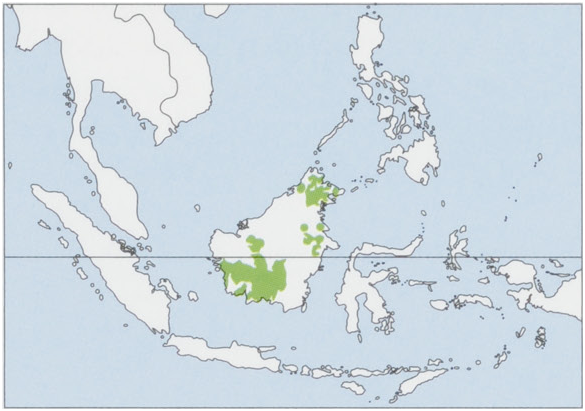
Southern Kalimantan, Indonesia, between the Kahayan and Kapuas rivers and formerly possibly farther west to Pontianak (in which case it takes the name Pongo pygmaeus borneo). Resembles Pongo pygmaeus borneo in palate size but rest of skull much larger.
Sumber: The type specimens and type localities of the orangutans, genus Pongo Lacépède, 1799 (Primates: Hominidae)
Konservasieng
PROTECTED STATUS: CITES - Appendix I as Pongidae and U. S. ESA - Endangered as P. pygmaeus.
Sumber: Order Primates
Distribusieng
DISTRIBUTION: Sumatra, N. W. of Lake Toba; discontinuous in Borneo.
Sumber: Order Primates
Biologi & Ekologieng
Habitat. Mature riparian, freshwater swamp, peat-swamp, lowland dipterocarp, and hill dipterocarp forest up to elevations of 500 m (occasionally up to 750 m); also young and old secondary forest, forest patches in mosaic landscapes, and occasionally montane forest. Bornean Orangutans now occur in fragmented and isolated populations. Large rivers and mountains act as impassable natural barriers that limit their dispersal, but current fragmentation is largely a product of forest destruction by humans. They are most abundant in lowland forest below 500 m elevation. Flood-prone riparian and freshwater swamp forests and peat swamps produce more regular and consistent fruit crops than dryland dipterocarp forests, and they have the highest densities of Bornean Orangutans.
Sumber: Hominidae
Biologi & Ekologieng
Movements, Home range and Social organization. Most adult male Bornean Orangutans lead a semi-solitary existence in a large home range that overlaps with 3 - 4 adult females, each with 1 - 2 dependent offspring. Flanged males advertise their location to females and other males by regularly emitting long calls. Within a given area, there is normally one dominant flanged male, who is largely intolerant of other adult males in his vicinity. Unflanged males remain silent, which they use as a “ stealth ” strategy to avoid flanged males and to gain access to females. In general, male home ranges overlap, but dominant males show a tendency to remain in a specific area of forest while subordinate males travel more widely. Adults of the opposite sex come together only for brief consortships. Two adult females will occasionally travel together for a few days (they are usually related), and several adolescents or unflanged males may associate with each other or with an adult of either sex temporarily. Average adult female feeding party size is 1 - 1 - 3 individuals. Flanged males usually avoid each other and react aggressively if they come into close proximity. Both sexes disperse at adolescence and leave their mother’s home range, although young females generally remain close to their mother’s home range as they mature; young males disperse farther. Average densities in the Bornean forests are 1 - 3 ind / km?.
Sumber: Hominidae
Konservasieng
Status and Conservation. CITES Appendix I. Classified as Endangered on The IUCN Red List, along with the three subspecies. The Bornean Orangutan is fully protected under both Malaysian and Indonesian law. Although some major populations of Bornean Orangutans are found in protected areas, it is now well established that the vast majority live outside of them, in forests that are already being, or are slated to be, exploited for their resources (timber, coal, or gold) or converted to agriculture (notably for oil palm plantations). In addition, hunting for meat and the pet trade remain major threats across most of Borneo, especially in the interior. In some areas, hunting has probably been directly responsible for local extinctions. Orangutans living in close proximity to plantations are likely to raid crops, for which they are persecuted as pests and shot by crop owners. There has been an estimated decline of well over 50 % in the overall population of Bornean Orangutans during the last 60 years, and this decline is expected to continue at its present rate due to continuing forest loss. Fire is another notable threat throughout Borneo. Fires destroyed 90 % of Kutai National Park in 1983 and 1998, reducing its orangutan population from ¢. 4000 individuals to only c ¢. 600 individuals. In Central Kalimantan, more than 4000 km? of peatland forest burned in 1997 - 1998 and an estimated 8000 orangutans died, representing a 33 % loss of the species in just one year. Similarly, drought in Central Kalimantan is thought to have killed hundreds of orangutans in six months of 2006. Because of their close phylogenetic proximity, orangutans and people are susceptible to similar diseases, and interspecific contamination is a recognized threat. The most recent population estimate for the Bornean Orangutan, obtained between 2000 and 2003, was 45,000 - 69,000 individuals living in ¢. 86,000 km * of habitat. Nevertheless, the inaccessibility of much of their range and poorvisibility in dense forests, combined with the low densities, semi-solitary habits, and cryptic nature of Bornean Orangutans, makes surveying them with precision difficult. Currently, no more than 16 % of the Bornean Orangutan’s habitat is protected. Where logging has occurred and forests are fragmented, conservation measures must be taken to create corridors and prevent genetic isolation, allowing gene flow between geographically separated subpopulations.
Sumber: Hominidae