Biologi & Ekologieng
Habitat. B. celebensis inhabits tropical rainforest. Whereas previously the animal had been reported to occur in low-lying areas near coasts, recent anecdotal and survey reports indicate that the species is now confined mostly to the interior, on higher and less accessible ground. Although often associated with swamp and riverine areas, there is still insufficient data to be conclusive on the aquatic affinities of the species. The species frequently uses mineral salt licks.
Sumber: Suidae
Biologi & Ekologieng
Movements, Home range and Social organization. The information available from field and captive studies indicates B. celebensis is a social species. Groups of up to 13 have been observed in the rainforest, especially around water, communal wallowing areas, and salt licks. Rarely aggregations as large as 46 individuals comprising several distinct groups have congregated at salt licks. Most (84 %) of all sightings of solitary animals were of adult males. Single adult males were seen with single adult females, but never with two or more females unless young animals were present. Adult females were rarely seen without company; they were sometimes found together with other adult animals, but most often they were with young babirusas. Of the 226 groups studied, 84 contained adult females and young. Two thirds (56) of these groups had no adult males present. Very little is known about the ranging behavior of B. celebensis. Field observations suggest that the adult males have home ranges that overlap with those of a number of other adult males. Density estimates in two protected areas where the species still occurred in 2003 varied from 4 - 3 - 11 - 8 ind / km? to 0 - 7 - 4 - 1 ind / km?. Like other pigs, babirusas evidently swim well. A single adult male was reported approximately 500 m from the shore of a large lake in central Sulawesi. It is not certain whether this individual was B. celebensis, but it is likely that all babirusa species can swim and cover relatively large distances.
Sumber: Suidae
Konservasieng
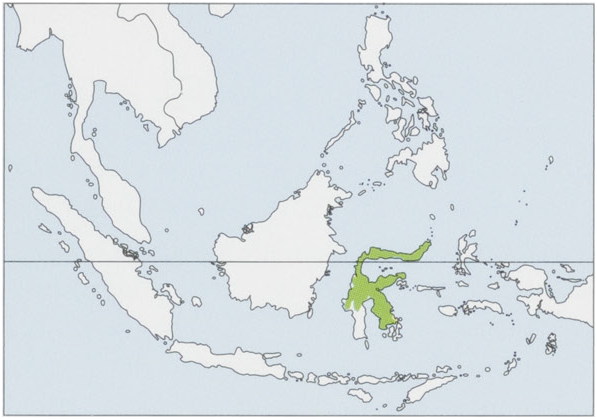
Status and Conservation. CITES Appendix I, although international trade in this species is not thought to be an important issue. Classified as Vulnerable on The IUCN Red List. Adult B. celebensis appear to have few, if any, natural predators. There are no large native mammalian carnivores on Sulawesi, and the most likely non-human predators are probably large snakes and crocodiles. We here follow The IUCN Red List and treat all individuals occurring on Sulawesi, as well as those previously known from the Muna, Buton, and Lembeh Islands as belonging to B. celebensis, pending resolution of the taxonomy. B. celebensis has been much reduced on the northern peninsula of Sulawesi, primarily due to overhunting, and its distribution may now be largely limited to the western end of the Bogani Nani Wartabone National Park, the Nantu Wildlife Reserve, and the Panua Nature Reserve, all of which are in the western half of the northern peninsula. The species still occurs in central Sulawesi and the eastern and south-eastern peninsula, although precise information regarding the current extent of occurrence and area of occupancy is lacking. The species is unlikely to remain on the severely deforested southern island of Muna. On Buton the species was not found during recent mammal surveys, and its continued presence on the island of Lembeh is also uncertain. The small numbers of young born suggest that the species is not adapted to a high rate of natural predation. However, hunting by humans with snares, nets, spears, and dogs has undoubtedly been an important factor since prehistoric times, and widespread snare trapping constitutes the main threat to the remaining populations of B. celebensis in North Sulawesi and, more recently, elsewhere in Sulawesi. B. celebensis is apparently not hunted specifically for its own meat, but represents a by-catch to the hunting of the Sulawesi Warty Pig (Sus celebensis). Therefore, the population of B. celebensis in the wild is being placed under severe and increasing pressure by the market demand for wild pig meat. The species is also increasingly threatened by commercial logging, and by the spread of other land-uses resulting in forest conversion and degradation. Total lowland forest loss on the island is estimated to be likely more than 75 %. The genus Babyrousa was accordedfull protection under Indonesian law in 1931. B. celebensis occurs in several protected areas of various levels on Sulawesi, including Bogani Nani Wartabone National Park, Lore Lindu National Park, Rawa Aopa Watumohai National Park, the Nantu Wildlife Reserve, the Panua Nature Reserve, Morowali Nature Reserve, and others.
Sumber: Suidae
Deskripsieng
Descriptive notes. Head-body 85 - 110 cm, tail 20 - 32 cm, shoulder height 65 - 80 cm; weight up to 100 kg. B. celebensis is characterized by its sparse or absent body hair, a nearly hairless tail tuft, and long, relatively thick upper canines that emerge vertically, converge slightly, and curl dorsally in a circle. The upper canines of males are generally long and thick. They merge vertically and do not cross the lower canines in lateral view. The skulls of B. celebensis are longer than the two other species. They are relatively narrower than one specimen from central Sulawesi, for which the taxonomic status remains unresolved. The lower (M, and M,) and upper (M * and M?) molars in B. celebensis are longer than in the other two species. Unlike most other pig species, babirusas do not have the typical adaptations for rooting. The nose lacks the rostral bone that in other pigs provides support for the tough connective tissue plate of the rhinarium. Reanalyses of the soft tissue anatomy of the limbs and digestive tract of B. celebensis have revealed mistakes of identification in earlier work. This has reversed the earlier conclusion that babirusas were constructed in a significantly different way from pigs (Susspp.); in general the muscular anatomies are similar and the stomach of babirusas does not resemble that of ruminants.
Sumber: Suidae
Distribusieng
Distribution: Northern peninsula of Sulawesi, at least as far west as Bumbulan and including Lembeh Isl.
Sumber: Order Artiodactyla