
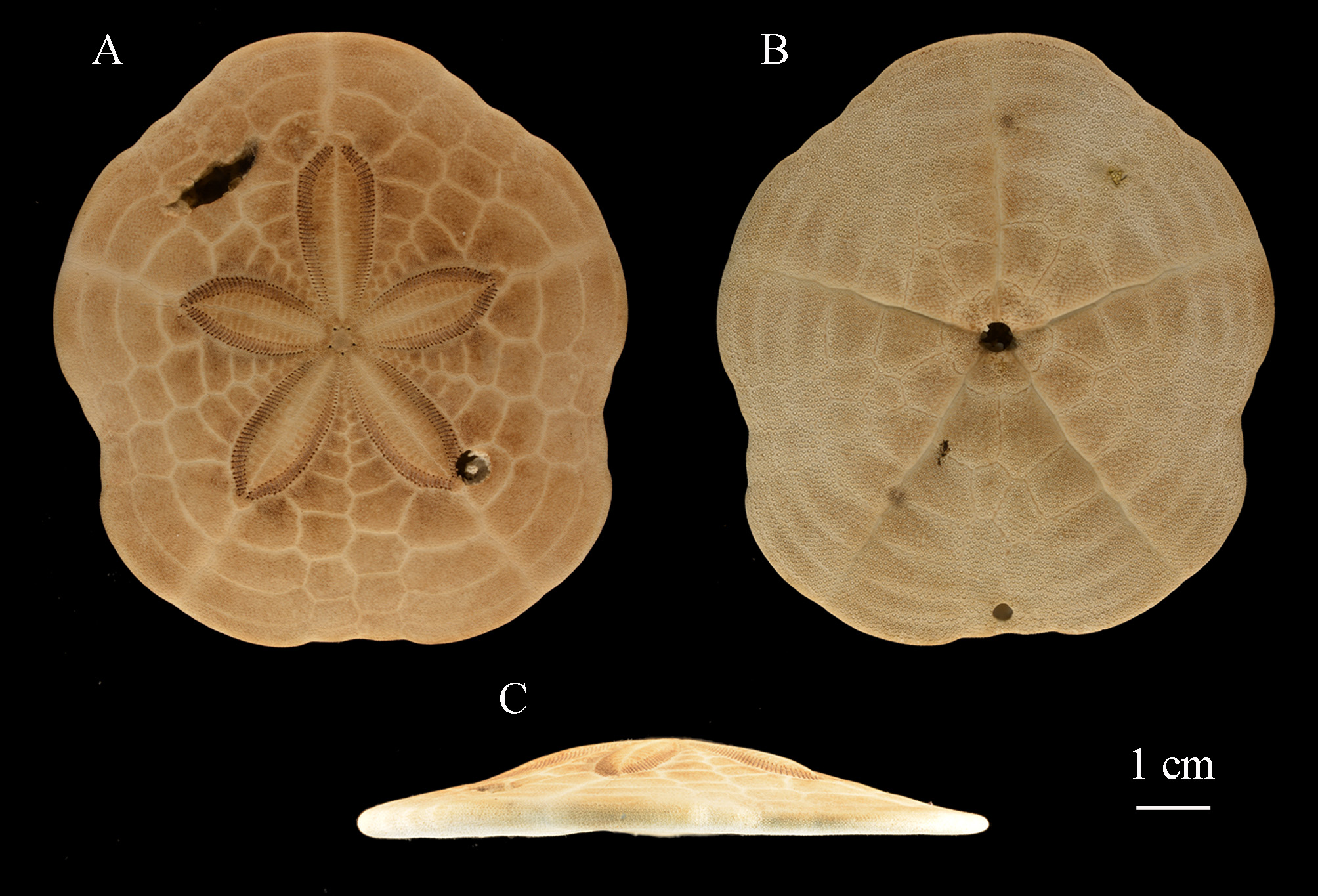
Description. Shape and size — Test pentagonal, large, 70.5 – 96.9 mm TL, distinctly longer than broad, width 87 – 93 % TL, greatest width at anterior paired petals, more prominently demonstrated in larger specimens; TH 16 – 21 % TL; in larger specimens, all interambulacra (except interambulacrum 5) usually conspicuously indented at test margin; in smaller specimens, posterior end more rounded and all other interambulacra only slightly indented or with regular ovoid outline; oral side more or less flat to slightly concave, particularly near peristome; infundibulum shallow, 6 – 8 % TL in depth. Apical system — Monobasal, situated closer to centre of aboral surface, 50 – 53 % TL (mean = 52 % TL, SD = 1.2) away from anterior margin; a circular gonopore in each interambulacrum adjacent to madreporic plate; ocular pores small and indistinct. Ambulacra — Petaloid small, 53 – 56 % TL (mean = 55 % TL, SD = 1.0), considerably elevated; petals more or less broad, elongate ovoid in shape, closed distally; except in petal III, which is slightly open distally in some specimens; opening 1 – 4 % TL; petal III length 27 – 30 % TL (mean 29 % TL) and is distinctly longer than other petals; anterior paired petals length range from 23 to 26 % TL (mean 25 % TL) and are shorter than other petals; posterior paired petals length 27 – 28 % TL (mean 27 % TL). Shape of inner pore of each pore pair circular, outer pore elongate, length about twice diameter of inner pore; interporiferous zones conspicuously elevated, bearing 9 – 16 primary tubercles across widest part of petals; furrow connecting pores of each pore pair deep and sharply delimited; 3 – 7 primary tubercles on ridges between furrows; ambulacral furrows of oral side simple unbranched and prominent. Interambulacra — Slightly inflated adapically between petals; densely packed with primary tubercles; all interambulacra on oral surface disjunct and more or less flat. Tuberculation — Primary tubercles perforate, areoles sunken; miliary tubercles more or less densely and evenly distributed among primary tubercles; density and size (mean size = 0.23 % TL, N = 5) of primary tubercles on aboral surface almost homogenous, primary tubercles on oral surface slightly larger (mean = 0.30 % TL, N = 5), density increasing towards edge of test. Peristome — Small, 5 – 8 % TL (mean length = 6 % TL, mean width = 7 % TL); slightly wider than long, located slightly anterior of centre, c. 48 % TL away from anterior margin. Periproct — Small, 3 – 6 % TL; slightly oval, transversely elongated (mean width = 5 % TL), situated close to posterior edge, c. 3 % TL from posterior margin. Internal buttressing — Marginal buttressing well-developed and reinforced by dense internal pillar system, best developed close to margin. Geographic range. Indo-West Pacific, from East Africa & Madagascar (Brown 1910 a; Clark 1923), Red Sea (Koehler 1922), South East Arabia (Clark 1925 a; Mortensen 1948 c), Persian Gulf (Mortensen 1940), Sri Lanka (Clark 1915; Herdman et al. 1904), North Australia (Clark 1946) and East Indies (de Meijere 1904) to Philippine Islands (Mortensen 1948 e; Mooi & Munguia 2014) and South Pacific Islands (Agassiz 1872). Bathymetric range. 0 – 216 m (Mortensen 1948 b). Observed occurrence in Sri Lanka. Sandy bottoms on the western, and north-western coasts of Sri Lanka at depths of 25 – 30 m (Fig. 21); first recorded in Sri Lanka by Agassiz (1872). Bathymetric range in Sri Lanka is 15 – 30 m.
Sumber: Taxonomy and distribution of irregular echinoids (Echinoidea: Irregularia) from Sri Lanka