
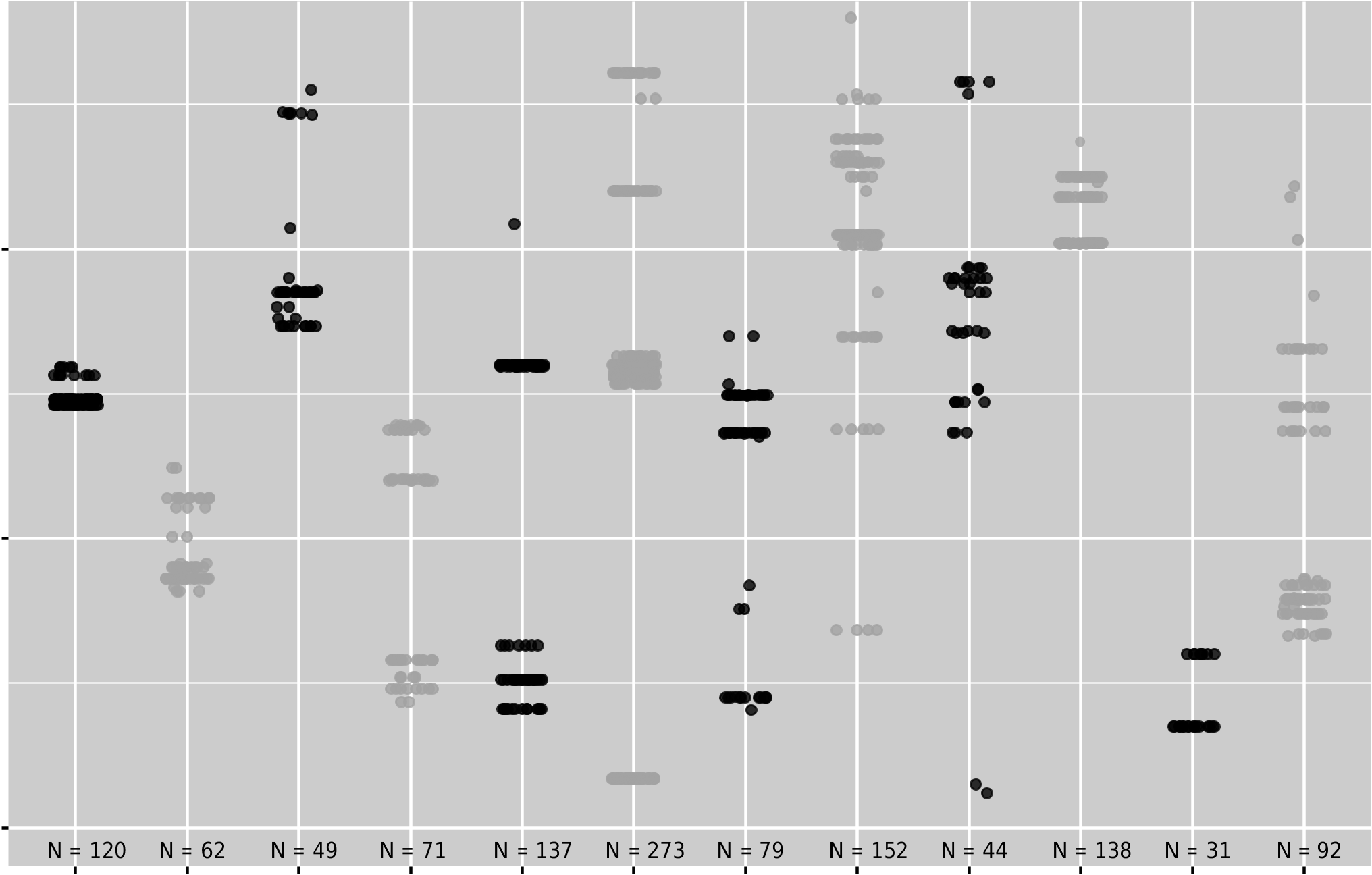
COMPARISONS: Crocidura lea is much smaller than all Sulawesi Crocidura outside of the Small- Bodied Group (fig. 9). Among the Small-Bodied species, only C. baletei and C. tenebrosa are known from the northern peninsula. Crocidura levicula, C. parva, and C. mediocris are apparently restricted to the central core and eastern and southwestern peninsulas (fig. 25). We therefore focus our comparisons on the cooccurring, northern peninsula species. However, first we note that the allopatric C. levicula has a broader skull (figs. 10, 26; tables 8, 9), shorter tail, shorter hind feet, and more tail bristles than does C. lea (figs. 27, 29; table 2). Among the Small-Bodied shrews of the northern peninsula, C. lea has a slightly paler and more strongly dorsoventrally bicolored pelage than C. baletei or C. tenebrosa. Both of the latter species are relatively uniform in color, C. baletei being medium brown and C. tenebrosa dark brown. Crocidura lea also has paler skin wherever it is exposed than either C. baletei (somewhat darker) or C. tenebrosa (much darker). Dorsally, the feet of both C. baletei and C. tenebrosa are uniformly dark, whereas the foot color transitions posteriorly from brown at the heel to white or pink at the digits in C. lea (fig. 27). Similarly, the tails of both C. baletei and C. tenebrosa are not obviously bicolored, and both are darker. Tail bristles are present on approximately three-fourths of the tail length in all three species, but they are much more abundant and longer on the tails of C. baletei and C. tenebrosa than in C. lea (fig. 27). Applied hairs on the tail are also much more visible in the two new species than in C. lea. Tail length in C. lea is greater, on average, than in C. baletei, and substantially so compared to C. tenebrosa (fig. 9; table 2). The skulls of C. lea are comparable in length, but significantly narrower at the braincase, interorbital region, maxillary process, and to a lesser extent at the rostrum than those of C. baletei and C. tenebrosa (figs. 10, 30; table 8). Crocidura lea occupies distinct morphometric space from the other northern peninsula endemics in bivariate plots of skull length and width and the first two principal components from an analysis of 12 cra- nial measurements (fig. 26). The C (U 3) is larger than I 3 (U 2) in C. lea, but they are usually subequal in occlusal surface area in C. baletei and C. tenebrosa. The parastyle of P 4 is more prominent in C. tenebrosa than in C. lea or C. baletei.
Sumber: Fourteen New, Endemic Species Of Shrew (Genus Crocidura) From Sulawesi Reveal A Spectacular Island Radiation