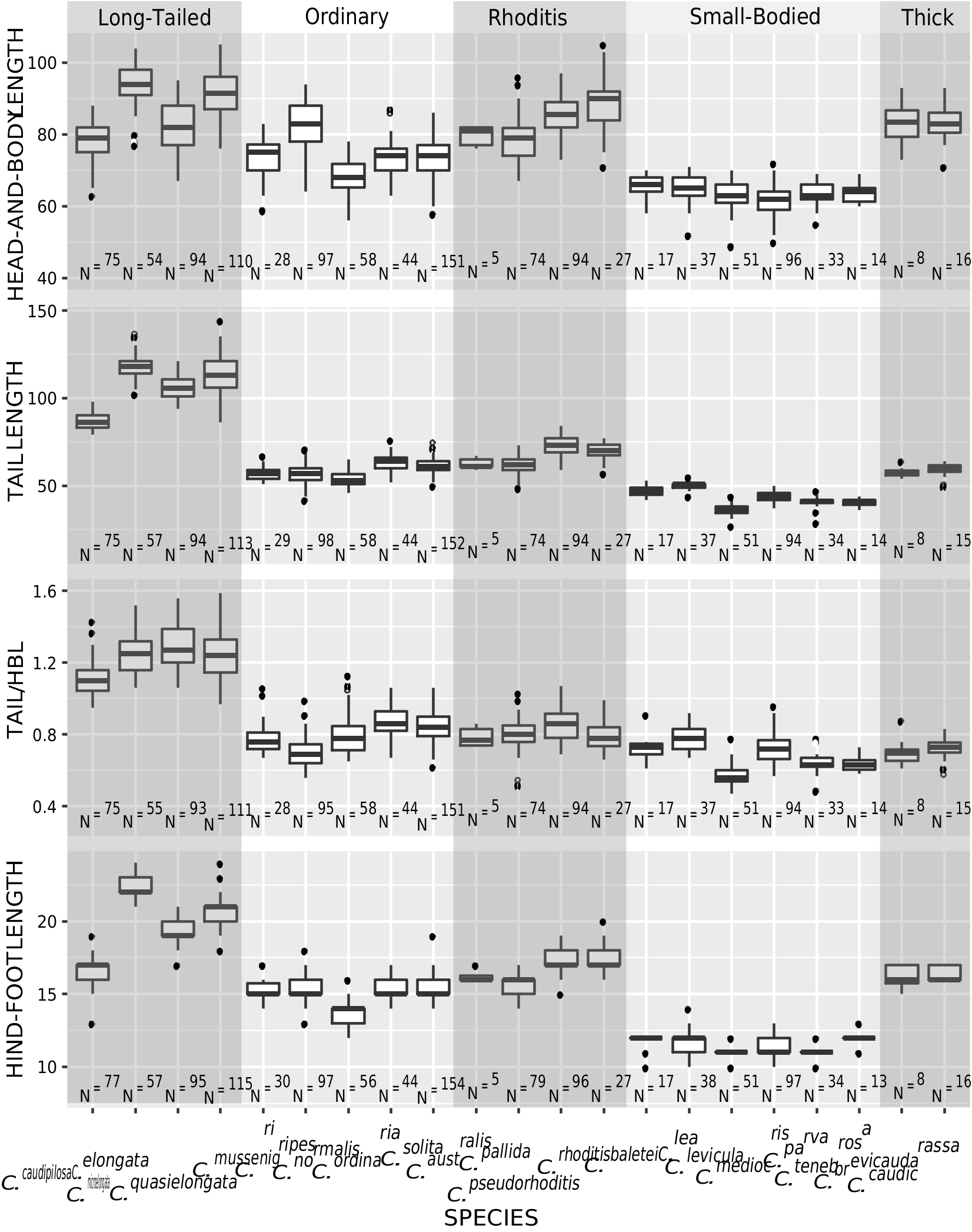
COMPARISONS: Crocidura nigripes is generally very dark in color with a short tail and moderate body size, but there is substantial variation in size and color. The feet are often nearly black, which will, in most cases, distinguish this species from all Sulawesi shrews except the darkest members of the Small-Bodied Group, which are much smaller. Typically, C. nigripes is smaller than C. elongata, C. quasielongata, C. caudicrassa, and C. rhoditis, comparable in size to C. microelongata, C. pseudorhoditis, C. brevicauda, and C. australis, and larger than the remaining species known from Sulawesi. It is the largest species in the Ordinary Group. These size differences can be observed using measures of skull length, head-and-body length, mass, or hind foot length (figs. 9, 17). Tail length is shorter than head-and-body length, which will distinguish C. nigripes from all similarly sized shrews (as judged by HBL, CIL, etc.) except the two Thick-Tailed species, which have greater relative hind-foot lengths (HF / HBL) and stockier bodies (figs. 9, 17). The skull of C. nigripes has a more angular braincase, more prominent maxillary process (enhanced by the narrow interorbital region), and more robust dentition (larger occlusal surface area) than all other Sulawesi shrews. The relative interorbital width (IOW / CIL) is substantially less than in all other species except C. elongata and C. quasielongata (fig. 10), two species with much longer skulls, tails, hind feet, and bodies.
Sumber: Fourteen New, Endemic Species Of Shrew (Genus Crocidura) From Sulawesi Reveal A Spectacular Island Radiation