Biologi & Ekologieng
Habitat. In New Guinea occurs in grassland, scrub, lowland rainforest, and foothill forest at altitudes from sea level to 1200 m, occasionally to 2100 m; found also in generally drier and more disturbed habitats than other species in genus. It occupies similar habitats in Australia, but occurs there also in coastal closed heath and extends into drier country along gallery forest, from sea level to 800 m. May rest in logs or under leaflitter in sheltered sites in a similar manner to that of other peramelids, but present species also shows considerable propensity to construct burrows. In Australia, burrow complexes may be 50 - 80 cm deep, cover up to 3 m? in area, and have two or more entrances.
Sumber: Peramelidae
Biologi & Ekologieng
Movements, Home range and Social organization. There is some evidence that animals make repeated use of the same paths through vegetation and that range areas are of the order of 1 - 2 ha. Captive individuals are intensely intolerant of each other, and males, in particular, often bear scars and wounds inflicted in fights. Despite such mutual intolerance, local population density can be high if resources are available. At Iron Range, 48 resident animals were present on a grid of 2 - 25 ha, equating ostensibly to a density of 21 ind / ha; true density would have been less than this as the grid probably sampled an area greater than 2 - 25 ha, but would still have exceeded 10 ind / ha.
Sumber: Peramelidae
Konservasieng
Status and Conservation. Classified as Least Concern on The IUCN Red List. Has a decreasing population trend. In New Guinea, nominate subspecies is considered to be uncommon in most parts of its range, although it can achieve high abundance locally if conditionsare suitable. It has a large geographical range, occurs in a number of protected areas, and may be tolerant of at least some habitat disturbance. It is, nonetheless, a favored game species and is susceptible to overhunting. There is also anecdotal evidence that it is susceptible to the gross habitat disturbance that accompanies mining and the forest-firing and clearing that precedes production of commercial crops such as oil palm (Elaeis guineensis, Arecaceae). Thus, while nominate rufescens is declining in some areas, the overall rate of decline appears slow and the subspecies cannot be considered at risk. In Australia, subspecies australis appears to be secure. It faces no obvious or immediate threats, has not declined in its distributional range, and remains locally abundantin suitable habitat.
Sumber: Peramelidae
Deskripsieng
Descriptive notes. Head-body 21.5 - 54.5 cm, tail 7.5 - 11.5 cm; weight 0.3 - 3 kg. The subspecies australis is smaller of the two subspecies, males attaining head-body length of up to 48 cm and weight of up to 2 - 2 kg, compared with 54 - 5 cm and 3 kg, respectively, for nominate rufescens, a small form of latter occurs in Sepik region and a much larger form in Gulf Province. In both subspecies body weight of males may average 70 % more than that of females, although occasional females may approach male body size. Dorsal fur is tawny, dark brown or rufous with characteristically stiff, broad, spiky hairs that give pelage a brindled appearance; ventral fur is pale. Crown of head is dark, often black, grading to pale gray on face and throat but with no hint of striping; snout is notably elongated, ears are short and round, and tail short, black, and naked. This species is variable in size and color, with small individuals similar in appearance to female Clara’s Echymipera (E. clara) and the Common Echymipera (E. kalubu); can be distinguished from these two byits usually more rufous toning and the presence of a small black pad on hindfoot.
Sumber: Peramelidae
Distribusieng
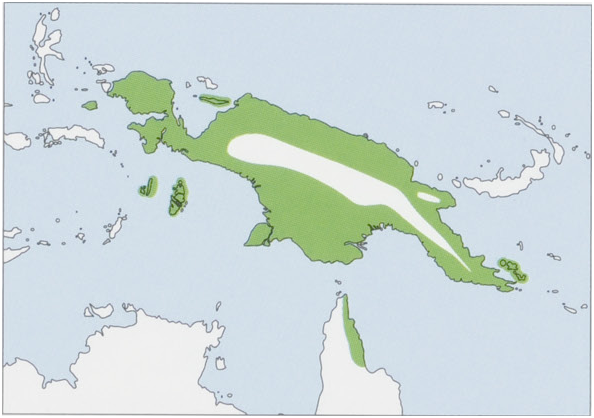
DISTRIBUTION: Cape York Peninsula (Queensland); New Guinea and certain small islands off S. E. coast; Kei and Aru Isis.
Sumber: Order Marsupialia
Konservasieng
Conservation: IUCN – Lower Risk (lc). Uncommon.
Sumber: Order Peramelemorphia