
Distribusieng
<p>Malesia: S Peninsular Thailand (Narathiwat), Sumatera, Peninsular Malaysia, Borneo, Maluku (Pulau Ceram).</p>
Sumber: CATE Araceae
Family Araceae · Order Alismatales
Data diperbarui secara berkala dari berbagai sumber observasi biodiversitas.
9 titik observasi Homalomena rostrata di Indonesia
Memuat peta...
Setiap titik merepresentasikan satu lokasi observasi yang tercatat. Klik titik untuk melihat detail.
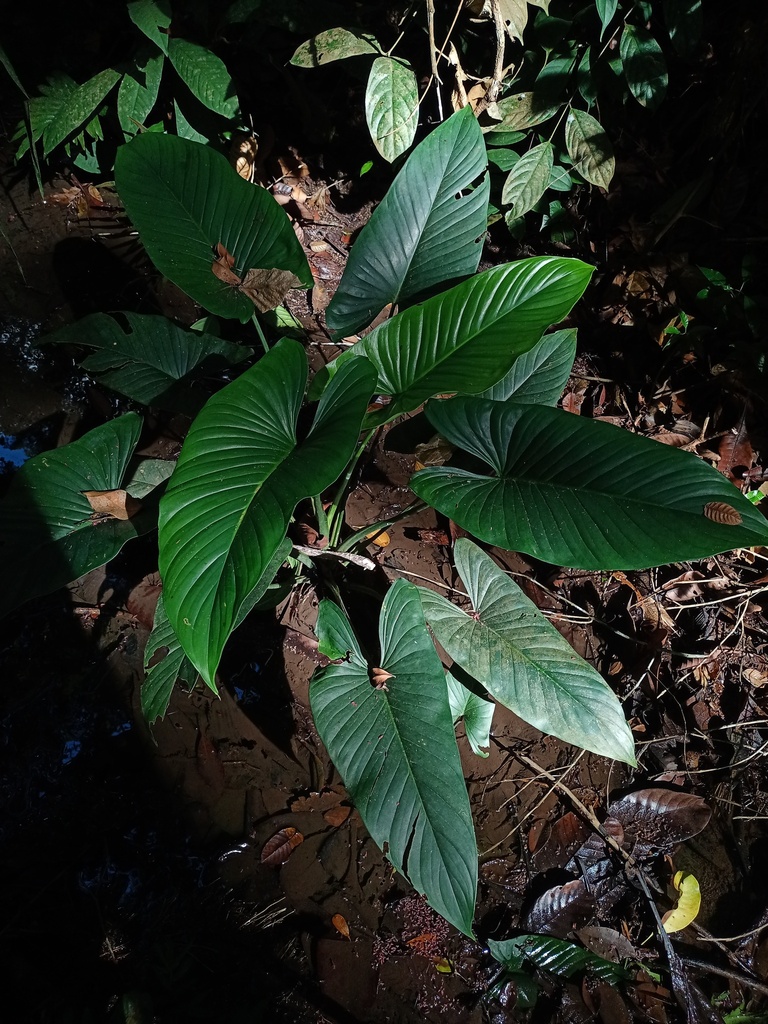
Foto: Naufal Urfi Dhiya'ulhaq | http://creativecommons.org/licenses/by-nc/4.0/
Otoritas penamaan: Griff.
Status taksonomi: ACCEPTED
Status konservasi (IUCN): NE Belum Dievaluasi
Dipublikasikan dalam: Not. Pl. Asiat. 3: 154 (1851)
Total Catatan di Indonesia
0
Provinsi Ditemukan
0
dari 38 provinsi
Catatan Pertama
0
tahun pertama tercatat
Tren Tahunan
+0%
+0.0% vs 2009
Homalomena rostrata (Homalomena rostrata) termasuk dalam famili Araceae, ordo Alismatales, kelas Liliopsida. Berdasarkan data yang terhimpun, spesies ini telah tercatat sebanyak 53 kali di Indonesia, tersebar di 4 provinsi. Catatan pertama tercatat pada tahun 1865.
Sumatera Utara merupakan provinsi dengan catatan observasi terbanyak untuk spesies ini, dengan 4 catatan (7.5% dari total). Data distribusi ini mencerminkan akumulasi dari berbagai kegiatan survei, penelitian, dan kontribusi citizen science. Pola distribusi yang tercatat mungkin tidak sepenuhnya menggambarkan persebaran alami spesies, karena dipengaruhi oleh intensitas pengamatan di masing-masing wilayah.
Tren observasi tahunan Homalomena rostrata relatif stabil pada periode terakhir dibanding tahun sebelumnya, dengan catatan pertama pada tahun 1865.
Catatan deskriptif tentang Homalomena rostrata dari sumber literatur primer (via GBIF).
<p>Malesia: S Peninsular Thailand (Narathiwat), Sumatera, Peninsular Malaysia, Borneo, Maluku (Pulau Ceram).</p>
Sumber: CATE Araceae
<p>Peninsular Thailand, Peninsular Malaysia, Sumatra, N.W. Borneo. For a detailed discussion of typifications of H. rostrata see Wong, Boyce & Fasihuddin, Gardens Bulletin Singapore 62(2): 313–325. 2011.</p>
Sumber: CATE Araceae
<p>Clump or colony-forming stoloniferous very strongly aromatic (terpenoids – ocimene or carene?) usually helophytic herbs to c. 1 m tall. <i>Stem </i>an erect to creeping rhizome to c. 20 cm long, c. 2 cm thick, somewhat spongy, emitting cataphylliferous stolons to c. 25 cm long, 1 cm thick, these eventually upturned, becoming rhizomatous, leafy, and thence emitting further stolons from the base of the rhizomatous portion. <i>Leaves </i>clustered, up to c. 20 together; <i>petiole </i>10–50 cm long, distally weakly to rather strongly D-shaped in cross-section , rather spongy within, deep-green to dark red or brown, especially for the basal half, with conspicuous broken dark green to brown longitudinal striations, sheathing in the lower 1/3 to half; <i>petiolar sheath </i>broadly winged, the wings spreading and somewhat fleshy, sheath open, the petiole essentially canaliculate in cross-section; <i>lamina </i>deep green to deep brown, glossy, very variable in overall shape, ranging from sub-linear to broadly ovato-oblong, leathery, c. 10–50 cm long, 3–25 cm wide, the apex ranging from acuminate to broadly obtuse, abruptly and shortly acuminate for c. 1 cm, finally stiffly apiculate for c. 10 mm, base decurrent-cuneate to truncate, shallowly cordate to sagittate or hastate, usually distinctly asymmetric, posterior lobes where present straight to rather widely divergent, up to 12 cm long, truncate, rather regular in size, 1–2 mm across, polygonal, slightly sinuous on the abaxial side, the thecae overtopped by a pronounced synconnective. <i>Infructescences </i>declinate by flexing of the peduncle; spathe persistent, turning deep red; at fruit maturity spathe shed by the abscising of the lower spathe at the insertion on the peduncle. <i>Fruit </i>oblong-globose, dull red, smelling strongly of butyric acid. <i>Seeds </i>elongate-ellipsoid, c. 1 × 0.3 mm, very finely longitudinally striate, pale brown. somewhat acutely rounded; midrib adaxially flat, abaxially prominent, with c. 5–7 adaxially impressed abaxially rather prominent primary lateral veins on each side, posterior lobes where present with 2 or 3 clustered veins running into them, primary lateral veins alternating with somewhat fainter interprimaries and diverging all at c. 60º from the mid-rib. <i>Inflorescences </i>2–3 together, the synflorescence subtended by a conspicuous prophyll; <i>peduncle </i>8–15 cm long, 5–10 mm diam., robust and somewhat spongy, medium green to reddish or brown, especially near the base, exceptionally glossy bright red. <i>Spathe </i>externally green, flushed red, or more rarely deep red, rather glossy, internally somewhat pale, rather variable in size, 5–15cm long, conspicuously constricted at a point corresponding to the top of the female flower zone; opening by inflation of the lower spathe and loosening of the spathe limb (female anthesis), and then spreading of the spathe limb (male anthesis); post anthesis spathe closing and tightly clasping the spadix; <i>lower spathe </i>oblongo-ovate to ovato-globose, c. 1/3 spathe length, up to 5 cm long, 2 cm wide, externally with conspicuous glands (extrafloral nectaries?); <i>spathe limb </i>narrowly to somewhat broadly triangular, c. 2/3 spathe length, up to 7 cm long, 3 cm wide, rostrate-apiculate for c. 10 mm. <i>Spadix </i>subequalling the spathe, up to 14 cm long; shortly stipitate; <i>stipe </i>c. 6 mm; <i>female flower zone </i>weakly to rather strongly fusiform, up to 5 × 1.5 cm; <i>pistils </i>subglobose, 1–2 mm diam., green to red depending on the overall colour of the spathe, red pistils associated mainly with red or red-flushed spathes; <i>stigmas </i>subsessile, discoid to rather well-lobed, slightly wider than the ovary, occasionally remarkably robust, papillate at anthesis; <i>interpistillar staminodes </i>weakly to very strongly clavate, subequalling the associated pistil, waxy white; <i>male flower zone </i>tapering-cylindrical, up to 10 cm long, 1 cm wide, tapering to an acute tip, ivory to very pale yellow; <i>male flowers </i>irregular 3–4-staminate; <i>stamens</i></p>
Nama-nama ilmiah lain yang pernah digunakan untuk Homalomena rostrata dalam literatur taksonomi.
| Nama Sinonim | Otoritas | Status |
|---|---|---|
| Chamaecladon sanguinolentum | (Griff.) Schott | SYNONYM |
| Cyrtocladon sanguinolentum | Griff. | SYNONYM |
| Homalomena beccariana | Engl. | SYNONYM |
| Homalomena ensiformis | Alderw. | SYNONYM |
| Homalomena miqueliana | Schott | SYNONYM |
| Homalomena miqueliana truella | Alderw. | SYNONYM |
| Homalomena paludosa | Hook.f. | SYNONYM |
| Homalomena portei | Engl. |
| # | Provinsi | Catatan | % |
|---|---|---|---|
| 1 | Sumatera Utara | 4 | 7.5% |
| 2 | Jambi | 1 | 1.9% |
| 3 | Jawa Barat | 1 | 1.9% |
| 4 | Kalimantan Tengah | 1 | 1.9% |
Jumlah catatan observasi Homalomena rostrata di Indonesia per tahun
Homalomena rostrata
Foto: Naufal Urfi Dhiya'ulhaq
http://creativecommons.org/licenses/by-nc/4.0/Homalomena rostrata
Foto: Naufal Urfi Dhiya'ulhaq
http://creativecommons.org/licenses/by-nc/4.0/Homalomena rostrata
Foto: Naufal Urfi Dhiya'ulhaq
http://creativecommons.org/licenses/by-nc/4.0/Homalomena rostrata
Foto: Naturalis Biodiversity Center
http://creativecommons.org/publicdomain/zero/1.0/Homalomena rostrata
Foto: Conveyor Belt
http://creativecommons.org/publicdomain/zero/1.0/Homalomena rostrata
Foto: Naturalis Biodiversity Center
http://creativecommons.org/publicdomain/zero/1.0/Homalomena rostrata
Foto: Naturalis Biodiversity Center
http://creativecommons.org/publicdomain/zero/1.0/Homalomena rostrata
Foto: Naturalis Biodiversity Center
http://creativecommons.org/publicdomain/zero/1.0/Homalomena rostrata
Foto: Naturalis Biodiversity Center
http://creativecommons.org/publicdomain/zero/1.0/Berdasarkan data 53 observasi, Sumatera Utara adalah provinsi dengan catatan Homalomena rostrata (Homalomena rostrata) terbanyak — 4 observasi (7.5% dari total catatan di Indonesia). Spesies ini tersebar di 4 provinsi.
Catatan pertama Homalomena rostrata (Homalomena rostrata) di Indonesia tercatat pada tahun 1865. Hingga kini terdapat 53 catatan dari 4 provinsi, yang dihimpun dari survei lapangan, koleksi museum, dan platform citizen science.
Ya, Homalomena rostrata memiliki 12 nama sinonim ilmiah, di antaranya: Chamaecladon sanguinolentum, Cyrtocladon sanguinolentum, Homalomena beccariana. Nama sinonim adalah nama-nama lain yang pernah digunakan untuk spesies yang sama dalam literatur taksonomi.
Homalomena rostrata diklasifikasikan sebagai berikut: Kingdom Plantae, Phylum Tracheophyta, Class Liliopsida, Order Alismatales, Family Araceae, Genus Homalomena. Spesies ini dideskripsikan oleh Griff..
Sumber: CATE Araceae
<p>Deciduous herb to 0.5 m tall. Subterranean stem a subglobose tuber, to 6 cm across × 4 cm high, brownish. Pseudostem to 20 cm long. Leaves 1–2; cataphylls green, chequered dark pink; petiole to 25 × 1–1.5 cm, white-green or carmine; leaf blade trifoliolate; leaflets elliptic or obovate, to 35 × 18 cm, margins entire, apex acuminate ending in a short arista, base convex; central leaflet with a petiolule to 4 cm long; lateral leaflets with a petiolule to 1.5 cm long, plain green, with impressed veins above, underside with raised veins. Inflorescence more or less held at foliage level; peduncle equalling or shorter than the petiole, pale green; spathe tube cylindrical, slightly constricted near the mouth, 2.5–6 × 1–2 cm, white-green with faint darker veins near the base, white at the base; spathe mouth margins hardly recurved, green; spathe limb lanceolate, horizontal, nearly the length of the tube and scarcely wider, outside and inside yellow-green with a white spot at throat level, tip long-acuminate; spadix appendix protruding from the tube, but shorter than the spathe, bent forward, conical, ending in a naked and subulate tail, 5–6 cm long × 4–6 mm across at base, smooth, dull olive-green, sessile with carmine or green, stiff and short bristles above the fertile part; fertile zone staminate or pistillate, 1.5–2.5 cm long; staminate flowers loosely arranged, 2–3-androus, anthers white and dark purple at top, on a short stalk; thecae dehiscent by an oval pore; pistillate flowers densely arranged; ovaries ovoid, truncate at the top dark green with white striations; stigma on a short style, penicillate, white. Infructescence on an erect peduncle, cylindrical, 8 × 3 cm; fruits ca 10 × ca 7 mm, prismatic, apically flattened, red-orange when ripe, up to 3 seeds per berry. Seeds globose, 3–4 mm diam.</p>
Sumber: CATE Araceae
<p>Lowland swamp forest, or peatswamp forest.</p>
Sumber: CATE Araceae
<p>Swampy areas in lowland forest, forest margins, in freshwater or peatswamp, or wet facies of <i>kerangas</i>, or <i>kerapah</i>, often, but not exclusively, in full sun.</p>
Sumber: CATE Araceae
| SYNONYM |
| Homalomena propinqua | Ridl. | HETEROTYPIC_SYNONYM |
| Homalomena raapii | Engl. | SYNONYM |
| Homalomena ridleyana | Engl. | SYNONYM |
| Homalomena sagittifolia | Jungh. | HOMOTYPIC_SYNONYM |