
Konservasieng
PROTECTED STATUS: CITES - Appendix I as Hylobates spp. and U. S. ESA - Endangered as Hylobates spp. (including Nomascus spp.).
Sumber: Order Primates
Family Hylobatidae · Order Primates
Data diperbarui secara berkala dari berbagai sumber observasi biodiversitas.
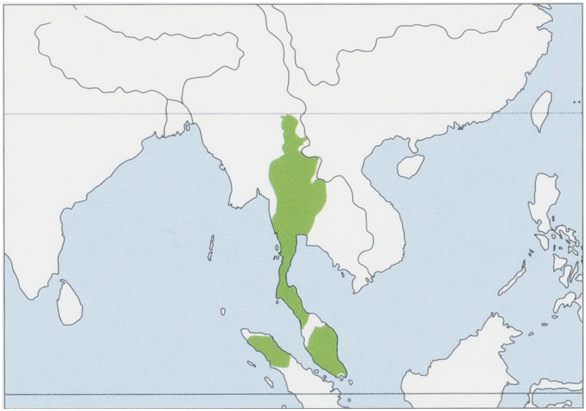
Foto: Russell A. Mittermeier;Anthony B. Rylands;Don E. Wilson
Otoritas penamaan: (Linnaeus, 1771) (1771)
Status taksonomi: ACCEPTED
Status konservasi (IUCN): EN Terancam Punah
Dipublikasikan dalam: Mantissa Plantarum p.521
Total Catatan di Indonesia
0
Provinsi Ditemukan
0
dari 38 provinsi
Catatan Pertama
0
tahun pertama tercatat
Tren Tahunan
-0%
-48.0% vs 2025
Owa Lengan Putih (Hylobates lar) termasuk dalam famili Hylobatidae, ordo Primates, kelas Mammalia. Berdasarkan data yang terhimpun, spesies ini telah tercatat sebanyak 160 kali di Indonesia, tersebar di 5 provinsi. Catatan pertama tercatat pada tahun 1821.
Sumatera Utara merupakan provinsi dengan catatan observasi terbanyak untuk spesies ini, dengan 76 catatan (47.5% dari total). Data distribusi ini mencerminkan akumulasi dari berbagai kegiatan survei, penelitian, dan kontribusi citizen science. Pola distribusi yang tercatat mungkin tidak sepenuhnya menggambarkan persebaran alami spesies, karena dipengaruhi oleh intensitas pengamatan di masing-masing wilayah.
Tren observasi tahunan Hylobates lar menunjukkan penurunan signifikan (-48%) pada periode terakhir dibanding tahun sebelumnya, dengan catatan pertama pada tahun 1821.
Catatan deskriptif tentang Hylobates lar dari sumber literatur primer (via GBIF).
PROTECTED STATUS: CITES - Appendix I as Hylobates spp. and U. S. ESA - Endangered as Hylobates spp. (including Nomascus spp.).
Sumber: Order Primates
DISTRIBUTION: Between the Salween and Mekong rivers from S. Yunnan (China) south to the Mun River (Thailand) and the Mudah and Thepha rivers on the Malay Peninsula; S. Malay Peninsula S. of the Perak and Kelantan rivers; Sumatra N. W. of Lake Toba and the Singkil River; E. and S. Burma.
Sumber: Order Primates
Habitat. Lowland to dipterocarp forests; mixed deciduous bamboo forests; evergreen, semi-evergreen, and wet evergreen forests; and even peat-swamp forests, mainly below 1200 m above sea level. The Lar Gibbon prefers the upper canopy of undisturbed primary forests, but it also occurs in secondary and selectively logged forests. Average height of feeding trees of Lar Gibbons in Khao Yai National Park, Thailand, is 23 - 7 m.
Sumber: Hylobatidae
Movements, Home range and Social organization. As a rule, Lar Gibbons live in serial monogamous pairs with up to four offspring in each group, but occasionally they are found in socially polyandrous groups (a female and two adult males); sometimes sexual relationships can extend beyond the mated pair (extrapair copulations), and polygamous mating has also been observed. Long-term data indicate that females may live in several different types of groups (e. g. pair or multimale) over their lifetimes. In the case of extrapair copulation by females, however, the frequency of copulation remains much higher with the pair-mate than with other males. Censuses at Khao Yai National Park from 1992 to 2007 recorded an average proportion of pairs of 76 - 9 % (n = 120), with multimale — unifemale (polyandrous) groups accounting for 21 -: 2 % (n = 33, groups with mature male offspring excluded). Unimale-multifemale groups are rare (1: 9 %), and in the single case recorded in Khao Yai, one of the females was a Pileated Gibbon (H. pileatus) and not a Lar Gibbon. In the case of individual pair-bonds, changes can result from desertion (often for another mate), replacement of one of a pair by a peripheral individual, or disappearance or death of one of the adults. Changes in pair composition can be common due to disease, shortage of food resources, and fragmented and isolated forests. Pair bonds are normally life-long. Average group size in Lar Gibbons generally increases with latitude, illustrating that group size is not a useful species-specific character in gibbons. This reflects a general trend of increasing birth rate with latitude found in many vertebrate groups. Average group sizes have been reported at 2 - 7 - 3 - 3 individuals in Peninsular Malaysia, 3 - 7 in central Thailand, and 4 - 4 — 4 - 9 in northern Thailand. Home ranges are 12 - 54 ha, averaging c. 40 ha, with highs of 44 - 54 ha on the Malay Peninsula and c. 16 ha in Khao Yai National Park. While home ranges of different groups often overlap, sometimes extensively, there is a core territory defended from other groups that averages 76 % of the home range. Average daily movementis 1400 m, although there is considerable variation among study sites. Daily movements tend to increase with greater fruit availability. Group progressions at some locations are usually led by an adult male, while at other sites females lead and coordinate group movements. Males are mainly responsible for defending the group’s territory. Within-group social behavioris variable throughout the year, from almost a fifth of the activity budget to only a small percentage; there is more social activity at times when ripe fruit is abundant. The three main types of within-group social interaction are grooming, play (wrestling, chasing, and slapping and biting), and social contact, with grooming being the most common. Aggression is rare. In general, immature Lar Gibbons play more than adults. There are some indications that allogrooming serves more of a hygienic than a social function in Lar Gibbons and tends to be reciprocal. Encounters between different groups of Lar Gibbons can range from agonistic (physical altercations) to friendly (between-group playing or grooming). Most interactions between groups are agonistic, but they can be purely vocal and even neutral (both groups when they meet barely react to one another). Groups may also travel, feed, or rest together when they come into contact. Males are the principal participants in most territorial disputes, but females are sometimes approached by males during intergroup interactions. Disputes generally occur near boundaries of the home range when two groups can see each other. They typically last about an hour, and most intergroup interactions are accompanied by calls. Variability of the nature of interactions between neighboring groups may partly be the result of variable social and kin relationships between members. Nevertheless, intergroup interactions can be quite violent, and there is evidence that wounds incurred in territorial aggression have resulted in death. There is seasonal variation in the occurrence of intergroup encounters, and territoriality may function in resource defense. In one long-term study, males dispersed from their natal groups at about ten years of age and usually attained a territory by replacing a resident adult. Dispersal distances are usually c. 1 - 2 territories from the natal territory, averaging 0 - 71 km in one population. Densities of Lar Gibbons range from 2 - 4 groups / km? in Ketambe Research Station, Gunung Leuser National Park, Sumatra, to 0 - 7 - 2 - 6 groups / km? in Kuala Lompat and Tanjong Triang on the Malayan Peninsula and 6 - 5 groups / km? in Khao Yai National Park.
Nama-nama ilmiah lain yang pernah digunakan untuk Hylobates lar dalam literatur taksonomi.
| Nama Sinonim | Otoritas | Status |
|---|---|---|
| Homo lar | Linneaus, 1771 | SYNONYM |
| Hylobates variegates | (É.Geoffroy Saint-Hilaire, 1812) | SYNONYM |
| Hylobates varius | (Latreille, 1801) | SYNONYM |
| # | Provinsi | Catatan | % |
|---|---|---|---|
| 1 | Sumatera Utara | 76 | 47.5% |
| 2 | Aceh | 18 | 11.3% |
| 3 | Jawa Tengah | 2 | 1.3% |
| 4 | Sumatera Barat | 1 | 0.6% |
| 5 | Sumatera Selatan | 1 | 0.6% |
Jumlah catatan observasi Hylobates lar di Indonesia per tahun
Hylobates lar
Foto: Russell A. Mittermeier;Anthony B. Rylands;Don E. Wilson
Hylobates lar
Foto: Russell A. Mittermeier;Anthony B. Rylands;Don E. Wilson
| Nama | Bahasa | Sumber |
|---|---|---|
| Central Lar Gibbon (entelloides) | Inggris | Catalogue of Life |
| Common Gibbon | Inggris | Catalogue of Life |
| Gibbon Lar | Prancis | Catalogue of Life |
| Gibbon lar | Prancis | Hylobatidae |
| Gibbon à mains blanches | Prancis | Catalogue of Life |
| Gibbone dalle mani bianche | Italia | Catalogue of Life |
| Gibão-de-mãos-brancas | Portugis | Catalogue of Life |
| Gibén de manos blancas | - | Hylobatidae |
| Gibón Lar | Spanyol |
Berdasarkan data 160 observasi, Sumatera Utara adalah provinsi dengan catatan Owa Lengan Putih (Hylobates lar) terbanyak — 76 observasi (47.5% dari total catatan di Indonesia). Spesies ini tersebar di 5 provinsi.
Catatan pertama Owa Lengan Putih (Hylobates lar) di Indonesia tercatat pada tahun 1821. Hingga kini terdapat 160 catatan dari 5 provinsi, yang dihimpun dari survei lapangan, koleksi museum, dan platform citizen science.
Menurut IUCN Red List, Owa Lengan Putih (Hylobates lar) berstatus "Terancam Punah" (kode EN). Status ini mencerminkan tingkat risiko kepunahan global spesies, bukan khusus Indonesia.
Di Indonesia dan Malaysia, Hylobates lar dikenal dengan beberapa nama lokal: Owa Lengan Putih. Penamaan dapat berbeda antardaerah dan bahasa.
Ya, Hylobates lar memiliki 3 nama sinonim ilmiah, di antaranya: Homo lar, Hylobates variegates, Hylobates varius. Nama sinonim adalah nama-nama lain yang pernah digunakan untuk spesies yang sama dalam literatur taksonomi.
Hylobates lar diklasifikasikan sebagai berikut: Kingdom Animalia, Phylum Chordata, Class Mammalia, Order Primates, Family Hylobatidae, Genus Hylobates. Spesies ini dideskripsikan oleh (Linnaeus, 1771).
Sumber: Hylobatidae
Status and Conservation. CITES Appendix I. Classified as Endangered on The IUCN Red Lust. The status of each subspecies of Lar Gibbon is: lar, vestitus, and carpenter are Endangered, entelloides is Vulnerable, and yunnanensis is Data Deficient. The Yunnan Lar Gibbon has been declared extinct in China, but it may still survive in Myanmar. The major threats to Lar Gibbons are loss of habitat and hunting. They are hunted for subsistence and for the pet trade. Hunting pressure varies across the range, but they are hunted even within protected areas. They are traditionally hunted by hill tribes in Thailand, and increased forest fragmentation has increased hunting pressure there. In Sumatra, some local people have a religious taboo against hunting primates, including Lar Gibbons, but in some areas, taboos against hunting gibbons appear to be breaking down. Shifting agriculture and commercial plantations of oil palm are major causes of deforestation. Some protected areas (e. g. Nam Phouy Biodiversity Conservation Area in Laos) are threatened with road construction within their boundaries. This promotes forest clearing and strip development and increases fragmentation and access by hunters. In northern Sumatra, most of the lowland forests have been logged, and the threat of Ladia Galaska, a road network to link the west and east coasts of Aceh Province, means that much of the remaining forest is at risk. In most of its range, the Lar Gibbon is confined to protected areas (e. g. in Thailand, no significant populations survive outside them), but, in most countries, these areas are not well patrolled, even if they are well managed for tourism. Illegal use of forest products and poaching are common in most protected areas. In Thailand, the decrease in forest cover has caused increased hunting. Further survey work is needed to determine current population numbers in protected areas. Current estimates suggest that there are probably 15,000 - 20,000 Lar Gibbons in Thailand with several populations numbering in the thousands, although they are now very rare in the north. The largest Thailand population is in Kaeng Krachan National Park with 3000 - 4000 individuals; the Western Forest Complex may well have 10,000 individuals; there may be more than 1000 individuals in the western part of Khao Yai National Park, as well as in Phu Khieo Wildlife Sanctuary and Nam Nao National Park. A few smaller populations survive in the south (e. g. Khao Sok National Park). In southern Peninsular Thailand and north-western Peninsular Malaysia, a few smaller, fragmented populations survive, perhaps together numbering in the low thousands. There are no recent or reliable estimates of the populations in the Tenasserim section of Myanmar, northern Sumatra, or the southern Peninsular Malaysia. There are also no reliable estimates for Laos, but there may be a few hundred Lar Gibbons in Nam Phouy Biodiversity Conservation Area. The nominate subspecies lar occurs in at least two protected areas: Krau Wildlife Reserve in Malaysia and Thale Ban National Park in Thailand. The Sumatran Lar Gibbon occurs in Gunung Leuser National Park in Indonesia. The Central Lar Gibbon occurs in Maegatha and Kaser Doo wildlife sanctuaries and Tanintharyi National Park in Myanmar; Kaeng Krachan, Khao Yai, and Khao Sok national parks and Thung Yai Naresuan and Huai Kha Khaeng wildlife sanctuaries in Thailand. This is probably the least threatened subspecies because ofits relatively extensive distribution and presence in the largest forest areas now in numerous parks and wildlife sanctuaries. Hunting pressure, however, isstill a problem in most areas, making it vulnerable to ongoing declines. West of the Mekong River in Laos, Carpenter’s Lar Gibbon persists in small forest patches in Nam Phouy Biodiversity Conservation Area, but it is hunted there. In Laos, populations outside Nam Phouy are small, isolated, and hunted, and nationally Carpenter’s Lar Gibbon is critically endangered. It also occurs in Nam Nao National Park and Phu Khieo and Huai Kha Khaeng wildlife sanctuaries in northern Thailand. The Yunnan Lar Gibbon was, until 1992, known to have occurred in just one protected area, Nan’gunhe National Nature Reserve in south-western Yunnan, China. Much of the forest in the Nan’gunhe is now degraded and secondary, inappropriate for Lar Gibbons, or has been converted directly to farmland. Surveys in search of this subspecies were carried out in 2008, and it was concluded that it had been entirely extirpated as a result of continued forest destruction, fragmentation, and deterioration and hunting. It is not known to occur anywhere else, but slim hope remains that there are populations in neighboring Myanmar.
Sumber: Hylobatidae
Descriptive notes. Head-body 41 - 4 cm (males) and 41 - 6 cm (females); weight 4.1 - 7.3 kg (males, n = 43) and 3.9 - 6.1 kg (females, n = 37). These measurements and weights are taken from publications by A. Schultz in 1933 and 1973; weights are from the type series of the “ Carpenter’s Lar Gibbon ” (H. Ll carpenteri) and may include some immature animals. Measurements from southern China “ Yunnan Lar Gibbon ” (H. I. yunnanensis) were provided by S. Ma and colleagues in 1988: mean head-body length of four males and a female 49 - 9 cm (range 44.5 - 57.8 cm) and mean weight 7 - 2 kg (range 5.3 - 8.5 kg). In 1929, C. Kloss provided weights of the “ Sumatran Lar Gibbon ” (H. I. vestitus): males 4.3 - 5.5 kg and a female 5 - 3 kg. The Lar Gibbon has two main color phases — dark (brown to black) and pale (creamy-fawn to reddish-buff) — that have no relation to age or gender, although the exact shading may vary by region. In museum collections, specimens of the Sumatran Lar Gibbon are fairly light brown (like the pale phase of the “ Central Lar Gibbon, ” H. l. entelloides), and it would seem that the Sumatran Lar Gibbon does not show color polymorphism, but this needs to be confirmed in the wild populations. All Lar Gibbons have a naked black face encircled by a ring of whitish fur, with sharply contrasting white fur on uppersides of hands and feet. The crown hair is directed fanwise from the front of the scalp and is not elongated or laterally projected over the ears. Adult males have black tufted fur on the pubic region. Sexes are similar in size. Color is very variable in the Malay Peninsula (from dark brown to buff), but further north, individuals are either very dark (black) or very pale (creamy-fawn) with no intermediates; these extremes are not related to sex, unlike neighboring species of hoolock and crested gibbons.
Sumber: Hylobatidae
| Catalogue of Life |
| Gibón de Manos Blancas | Spanyol | Catalogue of Life |
| Gibón de Manos Blancas de Tailandia Septentrional | Spanyol | Catalogue of Life |
| Gibón de Manos Blancas de Yunnan | Spanyol | Catalogue of Life |
| Gibón de Sonda de Manos Blancas | Spanyol | Catalogue of Life |
| Hvidhåndet gibbon | dan | Catalogue of Life |
| Hvithåndgibbon | nob | Catalogue of Life |
| Lar | Jerman | Catalogue of Life |
| Lar Gibbon | Inggris | Integrated Taxonomic Information System (ITIS) |
| Malaysian Lar Gibbon (/ ar) | Inggris | Catalogue of Life |
| Owa Lengan Putih | Indonesia | Catalogue of Life |
| Sumatran Lar Gibbon (vestitus) | Inggris | Catalogue of Life |
108 titik observasi Hylobates lar di Indonesia
Memuat peta...
Setiap titik merepresentasikan satu lokasi observasi yang tercatat. Klik titik untuk melihat detail.