
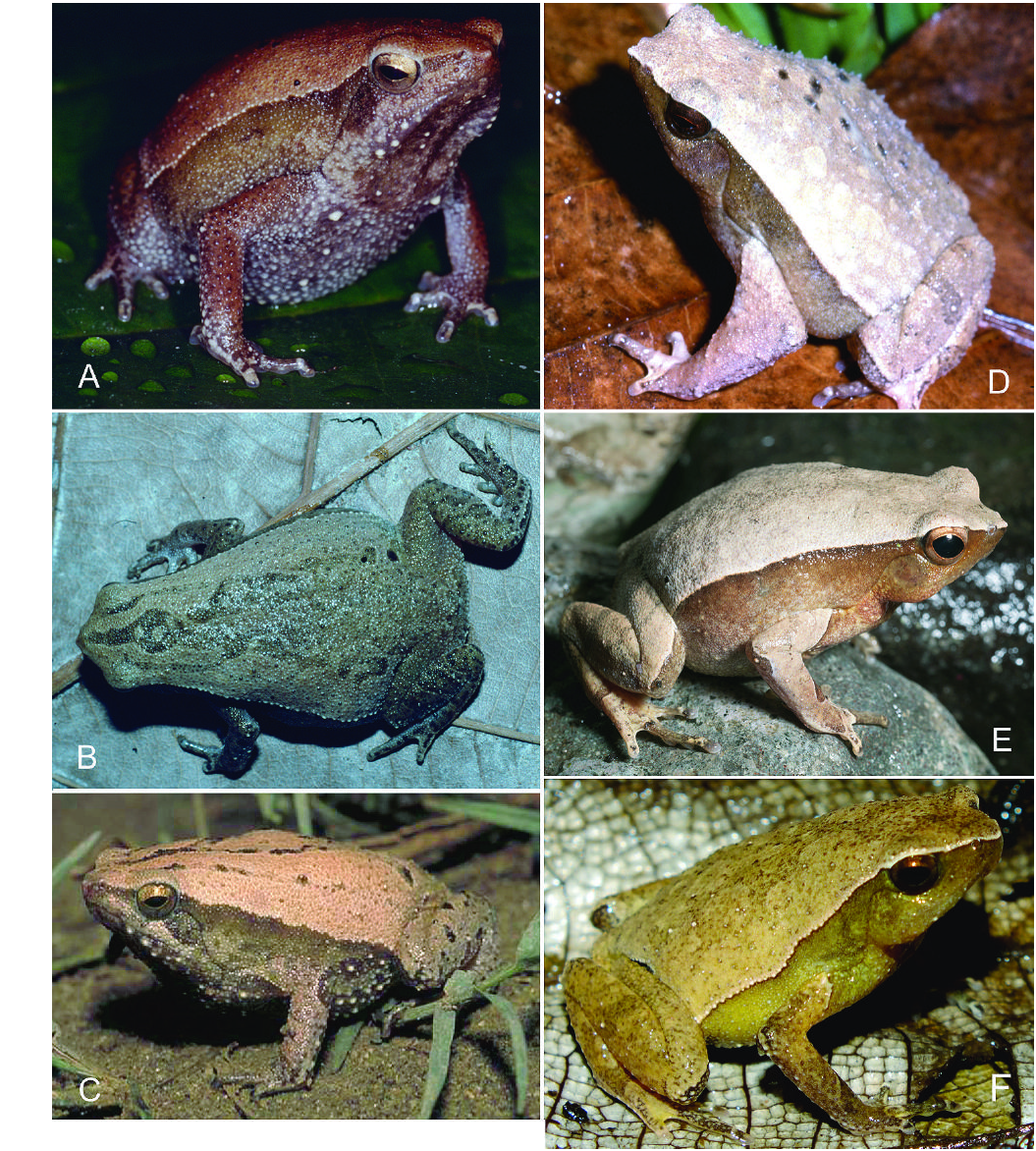
DESCRIPTION OF NEOTYPE. — Moderately robust-bodied female frog with well-developed, moderate-length fore- and hindlimbs; head ovate and continuous with body (no apparent constriction or enlargement at juncture of head and trunk). Body measurements are: SVL 34.5 [25.4]; HeadL 9.9 mm [8.1 mm]; HeadW 10.1 mm [7.9 mm]; SnEye 4.1 mm [3.2 mm]; NarEye 2.3 mm [2.0 mm]; EyeD 2.9 mm [2.6 mm]; Tymp 2.6 mm [2.3 mm]; ForarmL 8.9 mm, [7.1 mm]; HandL 8.5 mm [6.4 mm]; ThghL 14.7 mm [12.0 mm]; CrusL 12.7 mm [12.3 mm]; TarsL 8.3 mm [8.1 mm]; HndfL 13.2 mm [8.7]. Body proportions are (all values are percent): HeadL / SVL 29 [31]; HeadW / SVL 29 [30]; HeadW / HeadL 102 [96]; SnEye / HeadL 41 [41]; NarEye / HeadL 23 [25]; NarEye / SnEye 56 [63]; NarEye / SnEye 56 [63]; EyeD / HeadL 29 [33]; Tymp / EyeD 90 [89]; Forarm / SVL 28 [28]; Forarm / CrusL 67 [58]; HndlL / SVL 152 [162]; CrusL / SVL 41 [48]; CrusL / ThghL 81 [103]; TarsL / ThghL 52 [68]; HndfL / SVL 34 [34]; HndfL / ThghL 66 [73]. No vomerine teeth present. Tongue obovate and about half free. Palatal fold morphology is similar for the two specimens. Vomerine folds are smooth, straight-edged flaps behind choanae, each extending from labial edge of mouth to near midline, separated by short gap from its opposite fold. Postorbital fold is single, medial smooth edged fold, closely followed by broad buccal fold; this latter fold is strongly serrate. Each serration has shape of tri-crowned tooth, but there is no evidence of dentine or enamel on these closely packed ‘ denticles. ’ Fingers lack webbing. Both finger and toe tips are bluntly rounded. Subarticular tubercle are well developed on digits; all digits bear subarticular tubercle on proximal phalanx, third finger also with subarticular tubercle on second phalanx; large, oblong to ovate, nearly medial outer palmar tubercle; digital formula 3> 2 ≈ 1> 4. On hindfoot, each toe has one or more subarticular tubercles, one each on first, second and fifth toes, on proximal phalanx of first two toes, on penultimate phalanx of fifth toe; two tubercles on third toe, three on fourth toe (first low and elongate). Inner and outer metatarsal tubercles are present; inner is largest, nearly circular to oval; outer small (neotype) to nearly absent (juvenile) and circular. Toes moderately webbed WebIII 2 1.5 [2.5], WebIV 1 1.0 [1.5]. Digit lengths for hand differ for neotype and MCZ juvenile, toe lengths same in both, formula 4> 3> 5> 2> 1. Skin strongly glandular with dorsal skin thickened and cloak-like extending from nape to posterior end of trunk, light granular surface, thickest anteriorly forming distinct supratympanic fold over dorsal and posterior edge of tympanic annulus and swollen mass above axilla; posteriorly glandular cloak merges imperceptibly into lateral trunk skin; limbs without enlarged glandular folds; chest and abdominal skin glandular and pebble-like with scattered unpigmented ‘ pebbles’ on chest. Coloration in both is faded to near medium brown dorsum and tan venter. Juvenile (MCZ 22495) is nearly unicolor; dark inguinal spots persist with light encircling border; portions of narrow, light dorsolateral stripes remain, and face or loreal area appears nearly uniformly dark brown. Pattern is more evident in neotype (USNM 36645) although faded and does not match the longitudinal dorsal striping of other members of interlineatus-pleurostigma group, presumably owing to preservative induced fading. Dark centered inguinal ocelli and uniformly dark loreal area persist. Dorsally, head is unicolor; dorsally double vague hourglass-shape pattern extends from behind eyes to shoulder then repeated and more elongate from shoulders to mid-ilial area. Diagonal dorsolateral stripe and pattern on dorsal surface of hindlimbs are not evident. Venter is uniformly light grayish brown from tip of chin to end of body. For color in life see Fig. 11 F of an individual recently collected in western Sumatra; dorsum light brown to tannish yellow, faint nape hourglass-shaped blotch, distinct white “ dorsolateral stripe from tip of snout to inguinal, tan to yellow side of face, lemon yellow side of trunk, and no dark bars on top of thighs.
Sumber: Morphology and Systematics of Kalophrynus interlineatus-pleurostigma Populations (Anura: Microhylidae: Kalophryninae) and a Taxonomy of the Genus Kalophrynus Tschudi, Asian Sticky Frogs