Biologi & Ekologieng
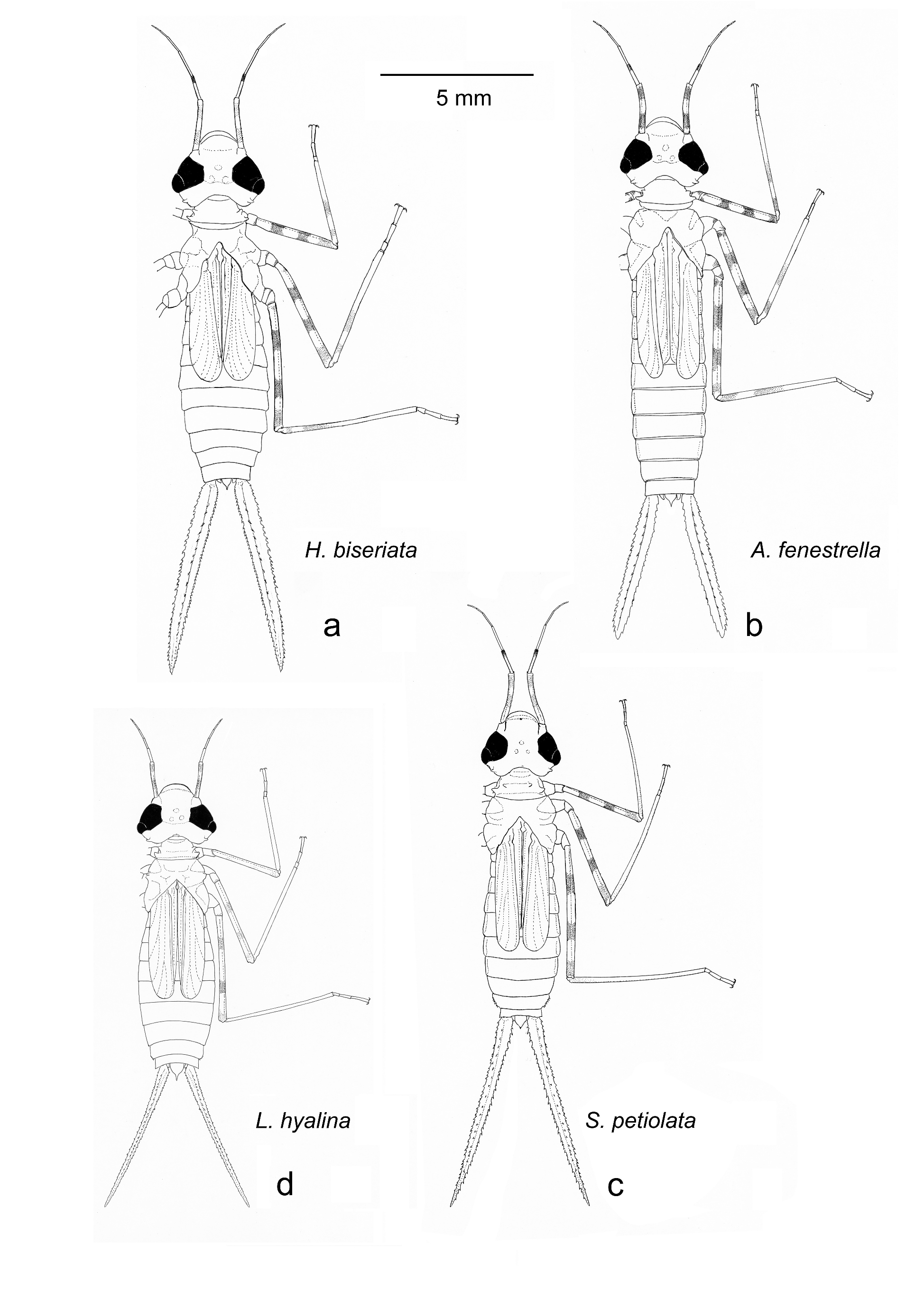
Habitus: similar to H. biseriata but obviously smaller than both that species, and S. petiolata. Abdomen slightly more swollen. Differences in pattern of mottling on head and body may be significant but are difficult to define; antennae relatively shorter than other species and lacking dark spot at apex of pedicel. Caudal gills, very thin, strongly tapered and long.
Sumber: Descriptions of larvae of four mainly DNA barcode-matched species of chlorocyphids from south-east Asia (Odonata: Chlorocyphidae) with notes on the generic and species level larval identification of Oriental region members of the family.
Deskripsieng
(Figs 4 d, 5 d, 7 d, 8 d, 9 d, 11 c, d, h, 14 e, f, 15 f, g, 16 c, e, 17 c, d, 18 d)
Sumber: Descriptions of larvae of four mainly DNA barcode-matched species of chlorocyphids from south-east Asia (Odonata: Chlorocyphidae) with notes on the generic and species level larval identification of Oriental region members of the family.
Deskripsieng
Head: sagittate in dorsal view but long axis slightly shorter in proportion to head width than in other species (Fig. 5 d) and less deep in lateral aspect (Fig. 7 d). Antennae 7 - segmented but relatively short (1.11 times maximum head width); scape with mainly longer setae; pedicel lacking dark apical mark. Labrum as in H. biseriata but slightly more rounded with only 9 – 10 setae on the ‘ moustache’. Genae with collection of very small sub-acute tubercles (Fig. 7 d). Mask short, articulation resting between posterior part of coxae of prothorax (Fig. 8 d); prementum narrow basally, gradually flared anteriorly with margins of anterior half slightly convex; lateral margins with strong recurved spines on distal 2 / 3 rd (Fig. 9 d) interspersed with short setae (Fig. 11 c); anterior median lobe as in H. biseriata but median cleft long with sides closely appressed; inner (lower) branch of palpal lobe strongly hooked (Fig. 11 c); maxillae (Fig. 12 d) very similar to H. biseriata, but two sub-basal supplementary spines on major (4 th) apical spine well separated and all three supplementary spines relatively longer and thinner (Fig. 12 h). Mandibles (Figs 14 e, f, 15 e, f) lacking supplementary denticles, right with four well defined teeth on incisor lobe with small shoulder dorsally, ventrally with subapical marginal denticle as usual; molar crest on right well developed with two small short sharp denticles, lower one with narrow chisel tip (Figs 14 e, 15 f); left incisor lobe with five regular evenly spaced teeth; left molar crest broad and raised, rather flat ending in straight edge with 9 denticles, end ones distinctly longer, (Figs 14 f, 15 e). A strong outer basal seta on both mandibles as in other three species (not visible in 14 e). Thorax: prothorax saddle-shaped with anterior and posterior flanges as in other species (Fig. 5 d), but relatively narrower and with both pairs of dorsal tubercles broad based and large. Marking (not illustrated) indistinct but always with narrow pale band pale between two anterior tubercles on prothorax. Wing sheaths slightly spatulate, not completely obscuring abdomen at sides, forewing reaching middle of S 6, hindwing almost to hindmargin of S 6 (Fig. 4 d). Legs long and thin, metafemur almost reaching hindmargin of S 7, proportions similar to H. biseriata; two rows of pectinate setae on the venter of the tarsus. Abdomen: squat and swollen medially, dark with indistinct dark mottling (not figured). Ventrolateral margin of S 9 with 6 – 9 strong, curved spines but no significant spines on venter or ventral margin (Figs 16 c, 17 c, d); S 10 with 4 – 5 strong ventrolateral spines and 4 – 6 smaller spines on hind-margin S 10 (Figs 16 c, e, 17 c, d). Male gonapophyses (Fig. 17 c, d) short and conical, well separated, arising near posterior margin S 9 and reaching beyond hind margin. Outer female gonapophyses (Figs 16 c, e) arising from near base of S 9 and extending beyond hind margin of S 10 to about level of epiproct tip (Fig. 16 e), ventral margin with series of sparse heavy spines to about level of midpoint of S 10, thence continuing slightly upward to a sharp point, aligned with inner apophyses but terminating before tip of latter (Fig. 16 e); inner apophyses smooth, curved smoothly and upward to a rounded point extending only a little beyond outer apophyses and epiproct. Epiproct, short, subconical, not obviously different from other species studied. Caudal spikes about 65 % body length, slightly swollen at base then thin and tapered almost uniformly to a point (Fig. 18 d); bearing numerous backward facing sharp curved spines, heavy setae, and also long fine setae impossible to assess accurately. Measurements (in mm): body length excluding antennae, caudal appendages and gills 9.3; lateral caudal gills 5.2; head width 2.57; prementum 1.45; palpal lobe (to tip of dorsal branch) 0.49; movable hook 0.37; maxillae base to distal hook of galeolacinea (1.15), maxillary palp (0.46); mandibles long axis (0.64); antenna 1.17, 0.45, 0.45, 0.30, 0.25, 0.15, 0.09 (total 2.86).
Sumber: Descriptions of larvae of four mainly DNA barcode-matched species of chlorocyphids from south-east Asia (Odonata: Chlorocyphidae) with notes on the generic and species level larval identification of Oriental region members of the family.