
Konservasieng
Conservation: IUCN – Vulnerable.
Sumber: Order Carnivora
Family Viverridae · Order Carnivora
Data diperbarui secara berkala dari berbagai sumber observasi biodiversitas.
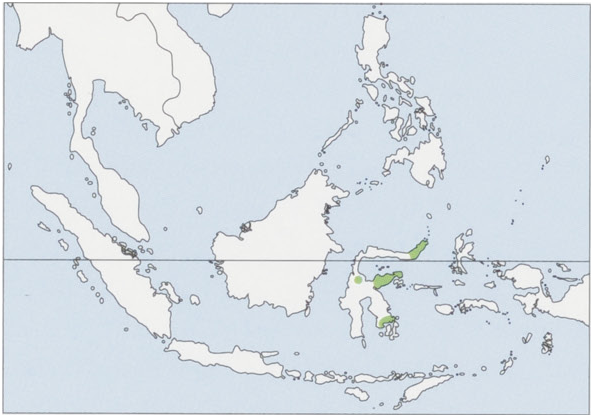
Foto: Don E. Wilson;Russell A. Mittermeier
Otoritas penamaan: (Schlegel, 1877) (1877)
Status taksonomi: ACCEPTED
Status konservasi (IUCN): VU Rentan
Dipublikasikan dalam: Prosp. Mus. Publ. vol.1877 p.[unnumbered]
Total Catatan di Indonesia
0
Provinsi Ditemukan
0
dari 38 provinsi
Catatan Pertama
0
tahun pertama tercatat
Tren Tahunan
+0%
+0.0% vs 2021
Brown Palm Civet (Macrogalidia musschenbroekii) termasuk dalam famili Viverridae, ordo Carnivora, kelas Mammalia. Berdasarkan data yang terhimpun, spesies ini telah tercatat sebanyak 15 kali di Indonesia, tersebar di 3 provinsi. Catatan pertama tercatat pada tahun 1883.
Sulawesi Utara merupakan provinsi dengan catatan observasi terbanyak untuk spesies ini, dengan 3 catatan (20.0% dari total). Data distribusi ini mencerminkan akumulasi dari berbagai kegiatan survei, penelitian, dan kontribusi citizen science. Pola distribusi yang tercatat mungkin tidak sepenuhnya menggambarkan persebaran alami spesies, karena dipengaruhi oleh intensitas pengamatan di masing-masing wilayah.
Tren observasi tahunan Macrogalidia musschenbroekii relatif stabil pada periode terakhir dibanding tahun sebelumnya, dengan catatan pertama pada tahun 1883.
Catatan deskriptif tentang Macrogalidia musschenbroekii dari sumber literatur primer (via GBIF).
Conservation: IUCN – Vulnerable.
Sumber: Order Carnivora
Distribution: Indonesia (Sulawesi).
Sumber: Order Carnivora
Habitat. Primary forest, up to 2600 m; also recorded in grassland and near farms.
Sumber: Viverridae
Movements, Home range and Social organization. Appears to be solitary: the few recorded camera-trap photographs have been of single individuals. Arboreal, but has been camera-trapped and snared on the ground. Captive animals have demonstrated that they are skilful climbers; they can walk upside down across the mesh of a cage and can ascend and descend along trunks by vertical looping (synchronous movements of the fore and hindfeet, accompanied by arching of the back as the body is contracted and extended). Sulawesi Palm Civets claw-mark smooth-barked trees; scratches extending up to 2: 7 m above the ground have been found on trees up to 65 cm in circumference. They do not appear to deposit scats on prominent logs or rocks, but simply leave them on the ground.
Sumber: Viverridae
Status and Conservation. Classified as Vulnerable on The IUCN Red List. Listed as Threatened in the 1989 IUCN Action Plan for the Conservation of Mustelids and Viverrids. Protected under Indonesian law. Recently recorded in Rawa Aopa National Park, Tanjung Peropa Wildlife Reserve, and Mangolo Recreation Forest. Possibly threatened by habitat loss and fragmentation, particularly at lower elevations; between 1985 and 1997, there were forest losses of 59 % in the northern peninsular, 72 % in the central peninsular, and 67 % in the southeastern peninsular. Known to raid villages for pigs and chickens and are sometimes killed in retaliation. Little is known aboutthis species and field surveys, ecological studies, and assessments of threats are needed.
Sumber: Viverridae
Descriptive notes. Head-body 65 - 715 cm, tail 44.5 - 54 cm, hindfoot 10.1 - 11. 1 cm, ear 3.9 - 4. 1 cm; weight 3.9 - 6. 1 kg. A large palm civet with a long tail. The coat color is light brownish-chestnut to dark brown on the upperparts; the underparts are yellowish-brown, with a reddish breast. There are lighter patches above and below the eyes, in front of the ears, and on the edge of the upper lip. The eyes are large, with light brown irises and vertical pupils; the rhinarium is large and similar to that of the Binturong. There are two longitudinal rows of indistinct dark dorsal spots on either side of the midline that converge anteriorly. The tail has seven to eleven indistinct pale yellowish rings. The feet have five digits, retractile claws, rudimentary skin sheaths over the claws (digits 2 - 5), and a fleshy web connecting the toes; the metapodial pads are large and smooth. The naked depression between the long metatarsal pads is wider distally than proximally, and is covered with coarse, horny tubercules. The feet are flexible and can be rotated to allow headfirst descents from trees. The perineal gland in the female is a shallow semi-circular depression behind the vulva; the secretion tinges the surrounding hairs an orange color. The male lacks a noticeable perineal gland, although there is a small naked area between the anus and scrotum. There are two pairs ofteats. The skull has a near parallel-sided palate and its general shape is similar to the Common Palm Civet. Dental formula: 13 / 3, C 1 / 1, P 4 / 4, M 2 / 2 = 40. The premolars and molars are larger than in other palm civets and lack shearing blades. The first upper and lower premolars are small and deciduous in old age.
Sumber: Viverridae
| # | Provinsi | Catatan | % |
|---|---|---|---|
| 1 | Sulawesi Utara | 3 | 20.0% |
| 2 | Sulawesi Tenggara | 2 | 13.3% |
| 3 | Sulawesi Selatan | 1 | 6.7% |
Jumlah catatan observasi Macrogalidia musschenbroekii di Indonesia per tahun
Macrogalidia musschenbroekii
Foto: Don E. Wilson;Russell A. Mittermeier
Macrogalidia musschenbroekii
Foto: Don E. Wilson;Russell A. Mittermeier
| Nama | Bahasa | Sumber |
|---|---|---|
| Brown Palm Civet | Inggris | Catalogue of Life |
| Brunpalmesivett | nob | Catalogue of Life |
| Celebes Palm Civet | Inggris | Catalogue of Life |
| Celebesinpalmunäätä | fin | Catalogue of Life |
| Celebespalmesivett | nob | Catalogue of Life |
| Celebespalmroller | Belanda | Catalogue of Life |
| Celebesroller | Jerman | Catalogue of Life |
| Civeta de Sulawesi | Spanyol | Catalogue of Life |
| Civeta de las Célebes | Spanyol | Catalogue of Life |
| Civeta de las Célebes | - | Viverridae |
| Civeta-de-Sulawesi | Portugis | Catalogue of Life |
| Civetta delle palme di Sulawesi | Italia | Catalogue of Life |
| Civette des Célebes | Prancis | Catalogue of Life |
| Civette des Célèbes | Prancis | Catalogue of Life |
| Giant Palm Civet | Inggris | Viverridae |
| Kjempepalmesivett | nob | Catalogue of Life |
| Sulawesi Civet | Inggris | Catalogue of Life |
| Sulawesi Palm Civet | Inggris | Integrated Taxonomic Information System (ITIS) |
| Sulawesi-Roller | Jerman | Catalogue of Life |
| Sulawesipalmesivett | nob | Catalogue of Life |
Berdasarkan data 15 observasi, Sulawesi Utara adalah provinsi dengan catatan Brown Palm Civet (Macrogalidia musschenbroekii) terbanyak — 3 observasi (20.0% dari total catatan di Indonesia). Spesies ini tersebar di 3 provinsi.
Catatan pertama Brown Palm Civet (Macrogalidia musschenbroekii) di Indonesia tercatat pada tahun 1883. Hingga kini terdapat 15 catatan dari 3 provinsi, yang dihimpun dari survei lapangan, koleksi museum, dan platform citizen science.
Menurut IUCN Red List, Brown Palm Civet (Macrogalidia musschenbroekii) berstatus "Rentan" (kode VU). Status ini mencerminkan tingkat risiko kepunahan global spesies, bukan khusus Indonesia.
Macrogalidia musschenbroekii diklasifikasikan sebagai berikut: Kingdom Animalia, Phylum Chordata, Class Mammalia, Order Carnivora, Family Viverridae, Genus Macrogalidia. Spesies ini dideskripsikan oleh (Schlegel, 1877).
4 titik observasi Macrogalidia musschenbroekii di Indonesia
Memuat peta...
Setiap titik merepresentasikan satu lokasi observasi yang tercatat. Klik titik untuk melihat detail.