Biologi & Ekologieng
Ecology Habitat and mating behaviour, including multiple mating, male guarding behaviour, female eating spermatophores and male-male competition for females, were described in detail by Preston-Mahfam (2000).
Sumber: Revision of the cricket genus Nisitrus Saussure (Orthoptera: Gryllidae: Eneopterinae) and descriptions of five new species
Deskripsieng
Figs 2 A, 5, 7 D, 8 F, 10 E, 11 E, 12 E, 13 D, 14 E, 16 D, 17 H – I, 22; Tables 1 – 2, 7
Sumber: Revision of the cricket genus Nisitrus Saussure (Orthoptera: Gryllidae: Eneopterinae) and descriptions of five new species
Deskripsieng
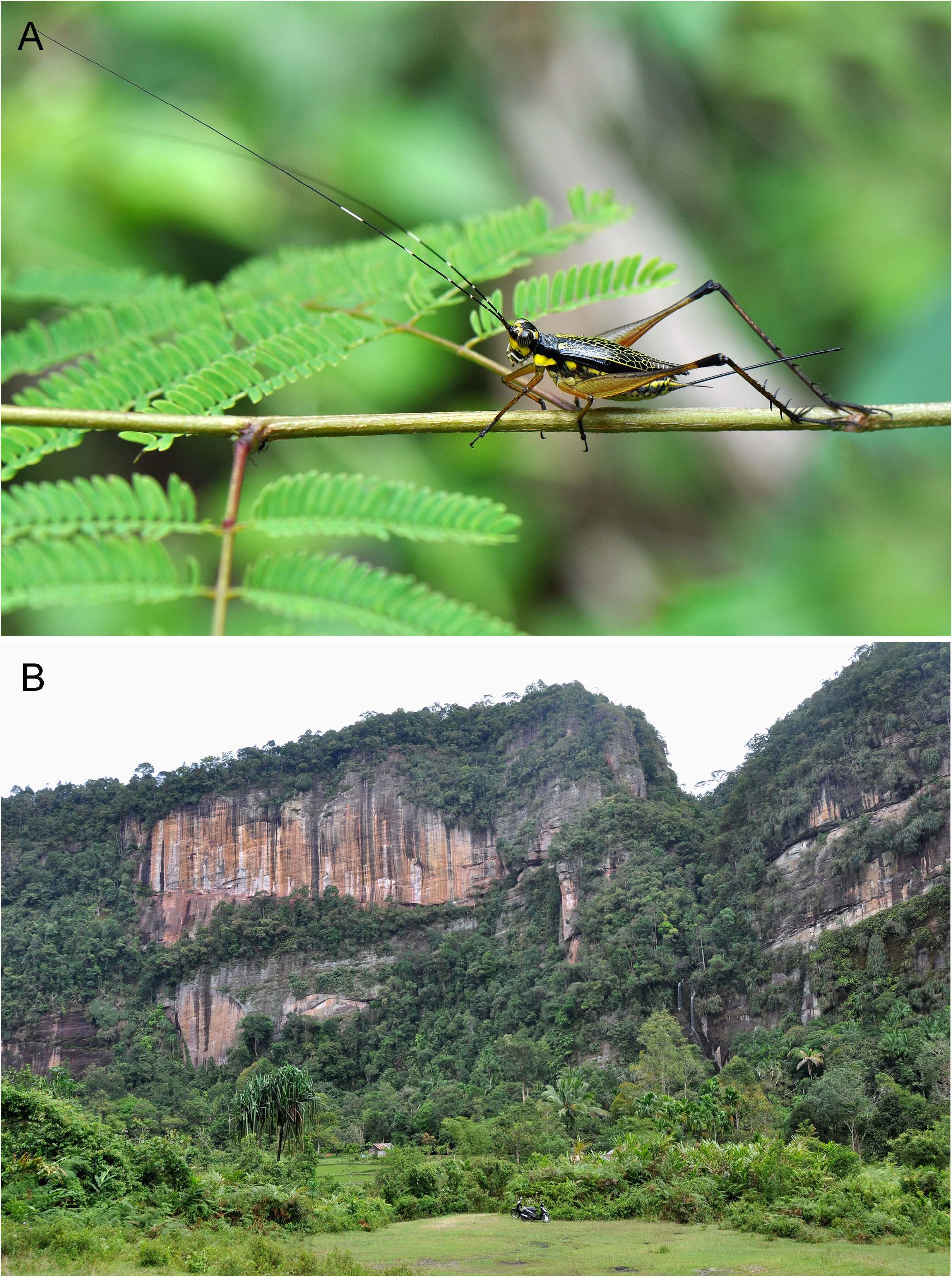
Redescription Slightly smaller than other species (Fig. 7 D). Vivid yellow, brown and black when alive (Fig. 22 A – C). Vertex variable: ranging from black with yellow margins around eyes (mostly in individuals from Sumatra) to cream-coloured with a strong longitudinal black band and one or two faint transverse black bands (forming a T- or cross-shaped black pattern; mostly in individuals from Siberut Islands and Malaysia) (Fig. 11 E); dark pattern variable between individuals, some have a narrow pattern appearing more like a longitudinal band. Scapes red brown to black. Antennae red brown (individuals from Siberut) to black (individuals from Sumatra), with wide whitish rings. Frons yellow, cream-coloured to yellow, face part of fastigium brown to dark brown or black between eyes, lighter for individuals from Siberut than from Sumatra (Fig. 10 E). Mouthparts dark brown to black in specimens from Sumatra, lighter or sometimes yellow in specimens from Siberut (Fig. 10 E). Maxillary palpi cream-coloured; apical segment black apically (Fig. 10 E). Head lateral side yellow to cream-coloured, including gena, with a black band posterior to eyes (Fig. 12 E). Pronotum dorsal disk black, covered with white setae, rectangular with lateral margin barely widening posteriorly, posterior margin substraight to faintly bisinuous (Fig. 11 E). Lateral lobes of pronotum dorsal half black, vivid yellow ventrally (cream-coloured in preserved specimens) (Fig. 12 E). Legs generally light grey brown, sometimes with some small dark spots. FIIIs brown, with a brown longitudinal stripe along ventral half (more distinct and darker in individuals from Sumatra); sometimes dorsal margin with a paler longitudinal stripe; knees dark brown to black. TIIIs brown with black spines and spurs, dark brown to black near distal end; tarsomeres dark brown to black. Hindwings hyaline brown apically; longer than FWs and surpassing cerci, forming a black tail with yellow veins exceeding FWs for less than twice the length of the pronotum. Tergites red brown, with a pale band laterally; sternites pale, sometimes with a dark brown median area. Subgenital plate with a dark median area. Male FOREWINGS. FW colouration (Fig. 13 D): dorsal field narrow, cells mostly transparent, veins varying from pale yellow to black. Basal area either infumated brown to black (individuals from Sumatra) or almost transparent (individuals from Siberut), but always with a cream-coloured triangular patch (sometimes more rounded). Chords most often with a white patch, most readily observed in individuals from Sumatra. R black, Sc projections black basally, cream-coloured or transparent apically. Lateral field transparent. FW venation (Fig. 13 D): 1 A curved, slightly angulated. Harp very small, slightly longer than wide, with one distinct straight oblique vein. c 1 long and wide, broader basally; c 2 diamond-shaped; mirror (d 1) small, longer than wide, not rounded, generally separated into two parts by a transverse vein, the anterior part triangular, about as long as posterior part, posterior part rectangular. Cell d 2 about as wide as d 1, usually subdivided by accessory veins. Apical field short, including one cell alignment posterior to mirror and a narrow apical alignment; its veins cream-coloured. Lateral field transparent, with 5 or 6 projections of Sc. Epiproct black. Subgenital plate with a dark median area. Cerci red brown. GENITALIA (Fig. 16 D). Pseudepiphallus sclerotized, stout (medium-sized but broad) compared to congeners, anterior margin somewhat broad and straight, posterior margin also straight, lateral margins faintly converging posteriorly. Posterior apex with paired lophi slightly longer than wide (at base), obtuse at apex, moderately spaced apart from one another. Rami swollen preapically, anterior apex somewhat truncated. Pseudepiphallic parameres narrow. Ectophallic fold rounded lateral sclerites appearing beanshaped to rectangular. Endophallic sclerite wide and rounded laterally, with relatively long lateral arms. Female FOREWINGS. FW colouration (Fig. 14 E): base of dorsal field with a yellow area; cells black, veins mostly vivid yellow (cream-coloured in preserved specimens). Region of CuA, M and R black, including the veins. Sc projections yellow basally, black apically. Lateral field transparent. FW venation: 6 – 7 strong longitudinal veins on dorsal field; lateral field with 6 projections of Sc. GENITALIA. Ovipositor slightly longer than FIII. Copulatory papilla conical, smaller and stout; apex folded ventrally, stout, broader than congeners, pointed; dorsal face with a sclerotized area, forming a somewhat triangular rim (Fig. 17 H – I). Juvenile (Fig. 22 D – E) Young instar with head nearly completely cream-coloured. Pronotum disk velvety black, lateral lobe with dorsal half velvety black and ventral half cream-coloured. Legs generally cream-coloured with small dark spots; tarsi darker. Abdomen with tergites velvety black dorsally, with sternites cream-coloured ventrally. Epiproct cream-coloured. Later instar resembles adult colouration. Measurements See Table 7.