
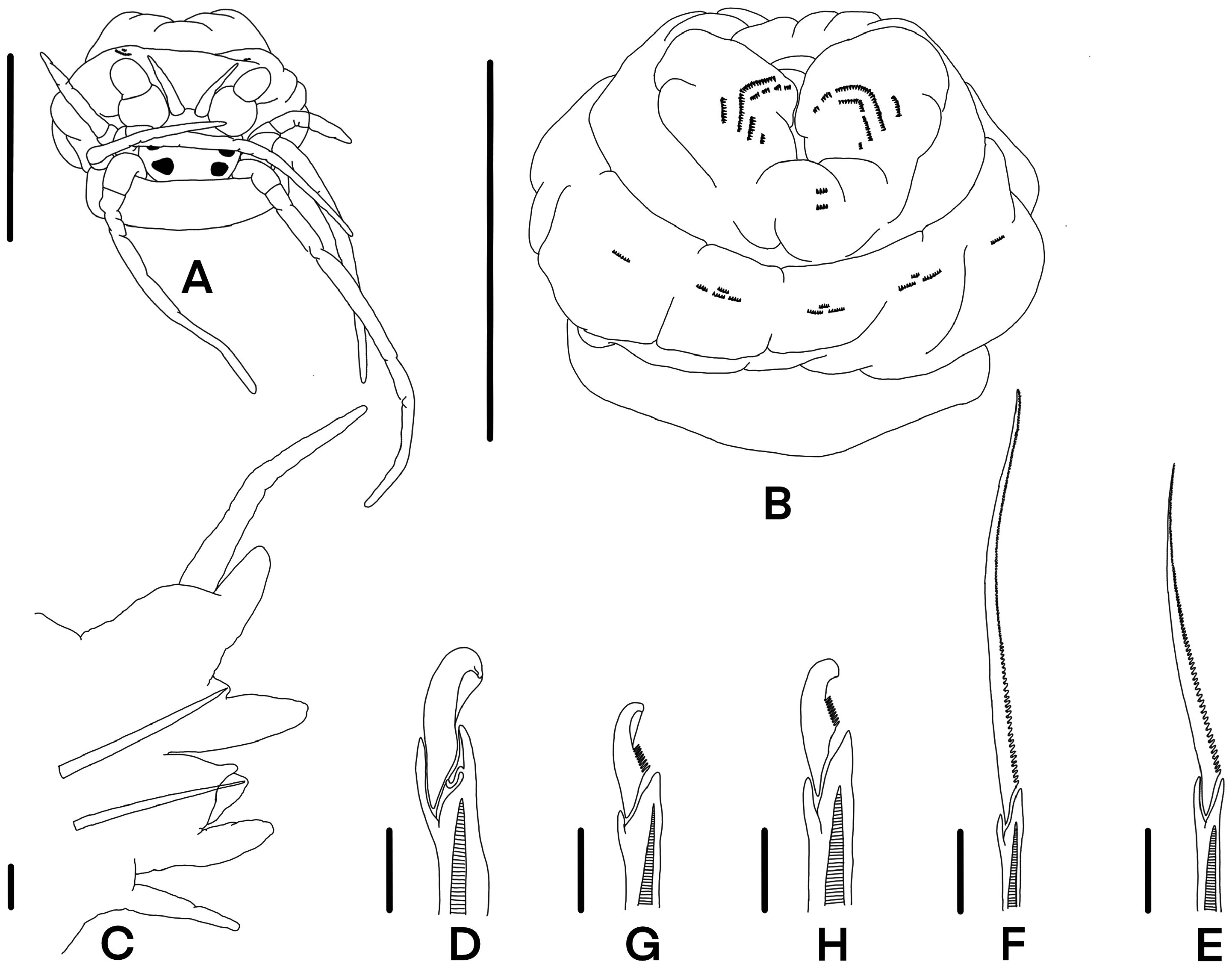
Description. Complete specimens with 31 – 46 chaetigers, body 5.3 – 30.4 mm long and 0.4 – 2.4 mm wide; cream yellow in alcohol. Incomplete specimens with 31 – 39 chaetigers, posterior end missing, remaining body 5.3 – 31.7 mm long and 0.4 – 2.3 mm wide; cream yellow in alcohol. Prostomium as long as wide. Eyes black, two pairs, outer eyes slightly larger than inner ones, in trapezoidal arrangement. Palps one pair, palpophores globose, palpostyles conical. Antennae one pair, slightly shorter than palps. Tentacular cirri four pairs with basal articulation, longest one extending to chaetiger 7 – 8. Pharyngeal jaws translucent reddish black, curved at tips, with nine teeth on each jaw. Paragnaths reddish black, pectinate bars, present on maxillary and oral rings, arranged as follows: Area I = 0, Area II = 0, Area III = 2 patches in two rows, Area IV = 4 curved rows, lateral ones shorter, Area V = 0, Area VI = two curved rows, Areas VII – VIII = 5 patches in one row at lateral and two rows at ventral (Fig. 15 A – B). Apodous segment as long as first chaetiger. First two chaetigers uniramous. Notopodia present with conical dorsal and ventral ligules in anterior chaetigers, those ligules become digitiform in posterior chaetigers. Dorsal cirri cirriform, attached near edge of dorsal parapodia, about three times longer than dorsal ligules. Neuropodia with conical ventral ligules, acicular ligules, and triangular postchaetal lobes extending to same level of acicular ligule tips; ventral ligules become digitiform in posterior chaetigers. Ventral cirri cirriform, attached basally on ventral parapodia, slightly shorter than ventral ligules (Fig. 15 C). Notochaetae present with homogomph spinigers in anterior chaetigers, homogomph spinigers and falcigers (Fig. 15 D), latter from chaetiger 13 – 17. Notopodial falcigerous blades short, smooth, curved, with a hooked tip connected to blade. Neurochaetae present with homogomph spinigers (Fig. 15 E) and heterogomph falcigers in dorsal fascicles, heterogomph spinigers (Fig. 15 F) and falcigers (Fig. 15 G – H) in ventral fascicles. All spinigerous blades short, with fine serrations. Neuropodial falcigerous blades medium size, with fine serrations and sometimes a tip connected to blade present. Acicula translucent. Pygidium with anus on dorsal side, anal cirri cirriform, as long as last one chaetiger.
Sumber: Nereididae (Annelida: Phyllodocida) from intertidal macroalgae in Western Australia