
Distribusieng
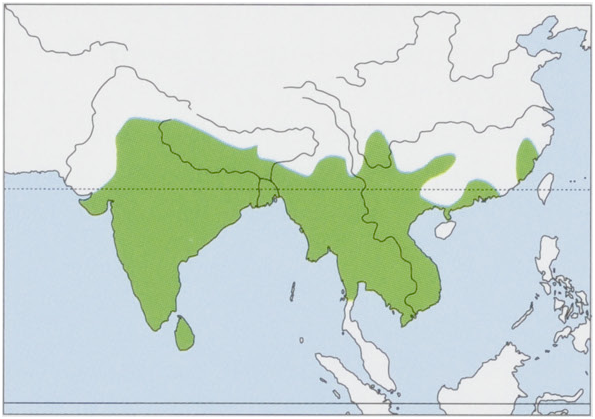
DISTRIBUTION: Sri Lanka, peninsular India north to Nepal, NE India (Assam), Burma, S China (Yunnan and Hong Kong Isl), Taiwan, Thailand, Laos, and Vietnam. Introduced into Kedah and Perlis regions of Malay Peninsula (Harrison, 1956; J. T. Marshall, Jr., 1977 a) as well as Sumatra and Java (Musser and Newcomb, 1983). Its spotty distribution may reflect other geographic introductions (Taiwan for example); " since it is commensal, large, and delicious to eat, this bandicoot may have been spread by man in comparatively recent times " (J. T. Marshall, Jr., 1977 a: 428).
Sumber: Order Rodentia - Family Muridae
Distribusieng
DISTRIBUTION: Sri Lanka; India to S. China, Vietnam, Sumatra, and Java.
Sumber: Order Rodentia (Part 5)
Biologi & Ekologieng
Habitat. Disturbed habitats including secondary rainforests, villages, rice paddies, potato crops, and wide variety of other agricultural areas from sea level to elevations of c. 1500 m.
Sumber: Muridae
Biologi & Ekologieng
Movements, Home range and Social organization. The Greater Bandicoot Rat builds burrow systems similar to those of the Lesser Bandicoot Rat (B. bengalensis). It often is observed feeding near entrances of burrows. Burrow systems usually contain several individuals of different sexes. It is very aggressive when trapped alive.
Sumber: Muridae
Konservasieng
Status and Conservation. Classified as Least Concern on The IUCN Red List. The Greater Bandicoot Rat is considered as a pestwhen densities are high. It occurs in a wide range of disturbed habitats but also in more secondary habitats. Burrows reportedly damage road and borders of agriculturalfields.
Sumber: Muridae
Deskripsieng
Descriptive notes. Head-body 188 - 350 mm, tail 146 - 280 mm, ear 27 - 33 mm, hindfoot 42 - 60 mm; weight 375 - 600 g. The Greater Bandicoot Ratis the largest species of Bandicota (externally and cranially). Hindfeet are long. Tail is 88 % of head-body length, long compared with other species of Bandicota. There are eight rows of scales / cm. Dorsal pelage is coarse, dark, and blackish brown. Skull is large and chunky. There are six pairs of mammae. Long nasal dorsally extends beyond upper incisors. Posterolateral surface of supraoccipital is greatly reduced. Upper incisors are opisthodont; and posterior cingulum is present on M' and M *.
Sumber: Muridae