Biologi & Ekologieng
Habitat. The Anoa is found in both primary and secondary lowland tropical forest, as well as in swamp and mangrove forest. In Tanjung Peropa Wildlife Reserve, riverine and lowland forests were preferred to rocky-cliff forest, because of the availability of water sources, known food plants, and fruit-bearing trees. In the past, the species was reportedly common along coasts. Anoas are also found at high elevations in mountainous areas up to 2300 m above sea level. Like other wild buffalo species, Anoas wallow and bathe in pools of water or mud. It is probable that mineral springs or licks are also required, although Anoas are reported to drink seawater, which might fulfill their mineral needs in areas withoutlicks or springs.
Sumber: Bovidae
Biologi & Ekologieng
Movements, Home range and Social organization. Very little is known about the behavior of the Anoa. They are most frequently observed singly; in Tanjung Peropa and Tanjung Amolengo Wildlife Reserve 84 % and 60 % of sightings were lone individuals (n = 38 and 40, respectively). The density data of Anoa populations in natural habitat is very limited, so it is difficult to accurately estimate population size. Data on the Anoa are available only for some conservation areas. There are an estimated 8 - 12 Anoas in Tanjung Amolengo Wildlife Sanctuary (604 ha), with a population density of 1 - 3 - 2 ind / km?; in Tanjung Peropa Wildlife Sanctuary (38,927 ha), the density was 0 - 9 ind / km * and the population was estimated at 350 individuals. In Lambusango Wildlife Sanctuary, Buton Island, the estimated population density was 0 - 25 — 0 - 33 ind / km?, and so the total population was estimated to be 150 - 200.
Sumber: Bovidae
Konservasieng
Status and Conservation. CITES Appendix I. Classified as Endangered on The IUCN Red List and fully protected under Indonesian law. The Anoa population is estimated to be less than 5000 mature individuals; its rate of decline is believed to be greater than 20 % over two generations (14 - 18 years), and no subpopulation is believed to number more than 250 mature individuals. The population size is an estimate because there is limited information, even for the largest populations. Estimating the population size is further complicated by its uncertain distribution and population structure. This species has declined throughout Sulawesi. Its decline probably began at the end of the 19 " century, with an increased decline rate from 1980 to today, precipitously in some areas. The Anoa is thought to be locally extinct in the southern and eastern part of the northern peninsula. Most populations are rapidly becoming fragmented; conservation of viable populations may soon require management of subpopulations. There has been a 50 - 95 % decline of this species in Tangkoko Nature Reserve in North Sulawesi in a ten-year period, and more recent surveys suggest it is now locally extinct. The range-wide rate of population decline is thought to be 20 % over two generations (generation length of 7 - 9 years). The relatively low reproduction rate of the Anoa means that even low levels of hunting will cause rapid reduction in population size. Recent reports indicate that hunting, mainly for food, is by far the most serious threat. Other threats include land conversion to agriculture, gold mining, and activities related to the collection of non-timber forest products. International trade in live animals or body parts is not thought to present a serious threat. The total forested area remaining on Sulawesi in 1985 was estimated to be 42 - 49 % of the land area of the island. The loss of lowland forest between 1985 and 1997 was estimated to be 89 %. Recently it has been said that Sulawesi’s lowland forest has already been reduced to statistical insignificance. The genetic subpopulations each occur in a number of protected areas. Lore Lindu National Park, Bogani Nani-Wartabone National Park, and Tanjung Peropa Nature Reserve on Sulawesi, and Lambusango Wildlife Reserve on Buton Island are large and important protected areas thought to hold a significant population of each genetic subpopulation. There are also likely to be important populations in unprotected forested areas, for example the Verbek and Abuki mountains in south-eastern Sulawesi. Current conservation planning aims to protect populations of each of these subpopulations. A back-up population of Anoas exists in conservation breeding institutions. There are 150 Anoas in captivity, but the breeding program has been greatly hindered by taxonomic confusion. The Anoa requires the following conservation actions: protection from hunting, prevention of habitat loss at a minimum of ten priority sites, complete genetic studies to better determine the subpopulation boundaries and taxonomy ofthis species, and determination of the status of remaining populations.
Sumber: Bovidae
Deskripsieng
Descriptive notes. Head-body 122 - 188 cm, shoulder height 60 - 100 cm; weight less than 300 kg. This is the smallest of the extant wild cattle species. Anoas are stocky, short limbed, and thick necked. Young Anoas are generally reported to have a thick covering of yellowish-brown, woolly hair, but there is much variation; newborn calves in zoos have brown or black pelage. Adults are also variable in color but are predominantly brown or black. Males are usually darker than females. Both sexes have horns (horn length, 146 - 373 mm). Anoas are reputed to have exceptionally thick hides. The groin is usually pale-colored to white. The forelegs sometimes are white to yellowish-white from knee to hoof, and the hindlegs have conspicuous white spots above the hooves. There are also white facial markings and often white throat markings.
Sumber: Bovidae
Distribusieng
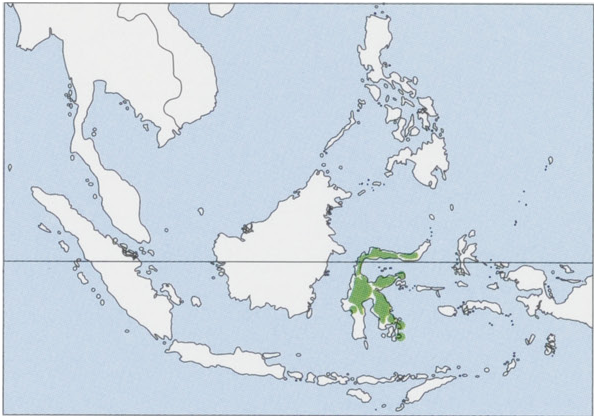
Distribution. The Anoa is endemic to Sulawesi and Buton Is, with no records from other small neighboring islands.
Sumber: Bovidae
Konservasieng
STATUS: CITES - Appendix I; U. S. ESA and IUCN - Endangered.
Sumber: Order Artiodactyla