Biologi & Ekologieng
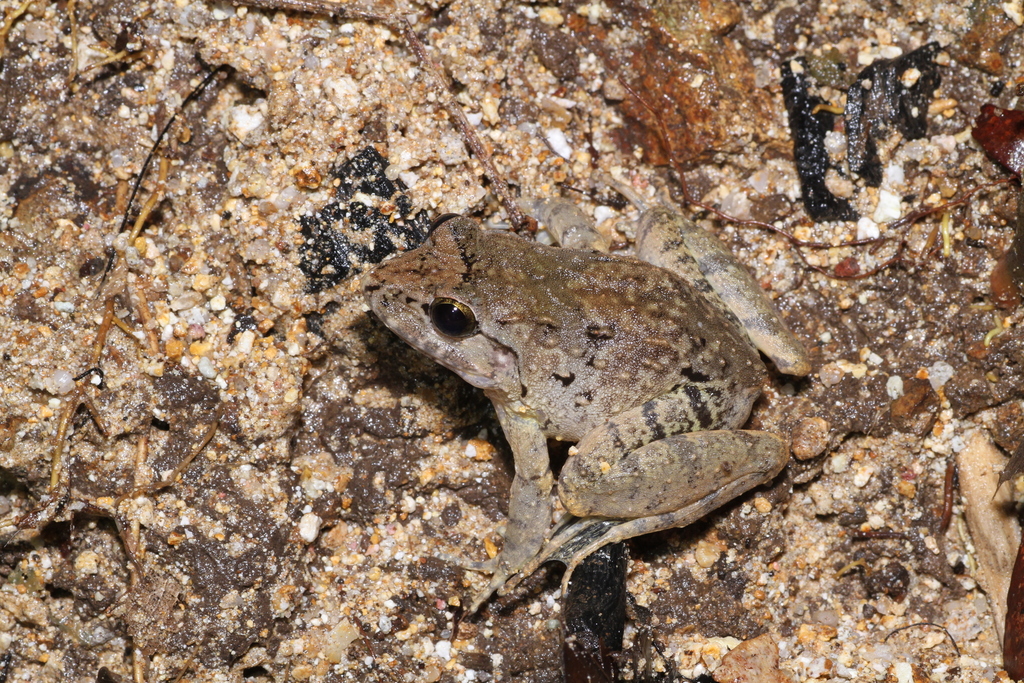
Natural history Limnonectes larvaepartus occurs in natural and disturbed forest habitats of Sulawesi, generally in sympatry with at least one, and sometimes as many as five other Limnonectes species. In the western Central Core of Sulawesi, we have always found L. larvaepartus living in sympatry with a much larger species that has been referred to in the literature as L. sp. D (2,3). Whereas L. sp. D is generally found on rocks in fast-moving streams or within a meter of water on the banks of fastflowing streams, L. larvaepartus is usually found further from the stream (2 – 10 meters from water) on rocky substrates, in leaf-litter, or secluded in grassy vegetation. Because we have observed that L. sp. D predates other frogs, including other Limonectes, it is possible that L. larvaepartus avoids large streams in response to predation pressure from larger Limnonectes species. Male L. larvaepartus typically call from the margins of seeps, puddles, or small pools away from the main stream. Notably, we have found many males calling from small pools that were already inhabited by L. larvaepartus tadpoles (Fig. 2 c), with as many as three size-classes of tadpoles represented. It is unclear whether some or all of the observed tadpoles were sired by the accompanying male. We have furthermore collected at least one pregnant female from a small stream-side puddle already inhabited by tadpoles of two size classes, again suggesting the possibility that individual pools may be visited repeatedly by the same adult males and females during the reproductive season.
Sumber: A Novel Reproductive Mode in Frogs: A New Species of Fanged Frog with Internal Fertilization and Birth of Tadpoles
Deskripsieng
Description of the holotype An adult male (Fig. 1) 48 mm SVL, body moderately robust, head not broader than body, head about 65 % longer than wide, length 45 % of snout-vent length, snout 17 % of snout-vent length, moderately pointed, projecting above lower jaw, nostril lateral, closer to tip of snout than to eye, lore essentially straight, canthus rostralis distinct, eye about equal to snout length, pupil diamond-shaped, upper eyelid with tubercles; interorbital region smooth, width 69 % of internarial distance, tympanum moderate, slightly wider than interorbital distance, supratympanic fold distinct, extending from posterior corner of eye to supraaxillary region, in contact with tympanic annulus, temporal muscle slightly enlarged; odontoid process 2.1 mm. Dentigerous process of vomer distinct, angled anterolaterally, approximately at 45 o angle, posterior ends separated by distance approximately equal to one-third diameter of choanae. Limbs relatively slender, tibia width at thickest part 7.5 mm; femur length 52 % of snout-vent length, heels moderately overlapping when placed perpendicular to body axis; tibia length 64.9 % of foot length, 48.9 % of snout-vent length; foot length 71 % of snout-vent length; tarsal fold indistinct, only evident as a ridge; toe discs moderately expanded, circum-marginal groove horseshoe-shaped, pointed anteriorly. Plantar surface of foot smooth, subarticular tubercle rounded, relative length of toes 4.3.5.2.1. Inner metatarsal tubercle prominent, elongate, ovoid with a sharp spade like ventral edge; outer metatarsal tubercle absent; hind foot webbing full, extending to toe discs, slightly emarginated. Manus length 51.3 % of foot length, fingers slender, terminal discs slightly expanded, length formula 3.1 $ 4 $ 2, with slight differences in length, subarticular tubercle rounded, convex; supernumerary tubercles absent; inner and outer metacarpal tubercles enlarged, nuptial pads and webbing absent, forearm muscle not enlarged. See Table 1 for measurements and variation. Coloration The dorsal coloration is highly variable, typically brownish-grey, but can be darker brown on the dorsolateral region, and some individuals are reddish-brown or golden-tan (see Fig. 2). ~ 23 % of specimens have a bold mid-dorsal stripe. The venter is either yellowish or cream colored, with the upper end of the tibia usually bearing a prominent dark spot. A light bar is often present in the interorbital region, and the coloration of the snout to interorbital region may be lighter than the remainder of the dorsum. The tympanum is often masked in black leaving only the lower rim sharing the predominant body coloration. The gular region is usually darker in males and may have a finely mottled wedge-shaped melanic patch. The dorsal half of the iris is golden-orange in coloration in at least some individuals (we do not know of exceptions, but have not documented iris coloration for most specimens). Limnonectes larvaepartus doi: 10.1371 / journal. pone. 0115884. t 001 Eggs and tadpoles Females produce ~ 100 non-pigmented eggs (see [15]), though the most we have observed is 55, which possibly represents the contents of just one oviduct. The eggs lack a jelly-coat and reach at least ~ 3 mm in diameter. These eggs develop within the oviducts into pigmented tadpoles that reach at least Gosner stage 35 prior to parturition (see [16] for staging). The gut is initially provisioned with substantial yolk (Fig. 2 b), and developing tadpoles prematurely removed from the oviducts at approximately stage 21 progressed to approximately stage 25 over the course of two weeks in a water bottle without supplemental food, suggesting plasticity in terms of the timing of parturition. A detailed description of the tadpole is provided in the accompanying paper by Kusrini et al. [15].