Biologi & Ekologieng
Habitat. Wide variety of habitats, including rainforests, wet and dry sclerophyllous forests, monsoon forests, open woodland, paperbark (Melaleuca, Myrtaceae) forests, and open grassland. Radio-tracked Australian Long-fingered Bats foraged predominantly along a forested ridgeline and also extensively used wetlands. Limited foraging oc-curred in open pastures and pine plantations. All known roosts are underground, predominantly in limestone caves but also in lava tunnels, coastal cliff rock crevices, and man-made tunnels. In the Northern Territory, a colony of more than 5000 Australian Long-fingered Bats occupy a large steel grain silo in an unused shed.
Biologi & Ekologieng
Movements, Home range and Social organization. Australian Long-fingered Bats have large home ranges, and they can travel long distances, with lactating females repeatedly moving 23 - 25 km from a maternity cave to foraging areas. One radio-tracked male was found 35 km from his day roost. Populations are organized like those of other species of Miniopterus. Each population has a main refuge where the maternity colony is formed and several secondary refuges within a radius of 100 - 300 km of the main one that are used by non-breeding individuals or outside the breeding period. Movements among populations are infrequent and represent less than 1 % in the more than 2000 movements recorded from marked bats in New South Wales, Victoria, and South Australia. Longest movement detected was 1300 km. Maternity colonies are mostly made up of females that come to these refuges in October-November from secondary roosts. When nursing ends in March, the colony breaks, with adult females leaving first and then young. Maternity colonies are formed by both sexes in subspecies bassanii. These maternity colonies usually have several thousand individuals but can exceed 10,000 individuals. In the case of bassanii, the maternity colony of Naracoorte has reached 100,000 - 200,000 individuals.
Konservasieng
Status and Conservation. Not assessed on The IUCN Red List. The Australian Longfingered Bats was included in Schreibers’s Long-fingered Bat (M. schreibersii), which is classified as Near Threatened. Subspecies orianae and oceanensis of the Australian Longfingered Bat probably do not have important conservation problems, but subspecies bassanii was listed as critically endangered under Australian Environment Protection and Biodiversity Conservation Act in 2007. There are three maternity caves of bassanii: one near Warrnambool, one near Cape Bridgewater (both in Victoria), and one near Naracoorte in South Australia. In the last 50 years, the population near Naracoorte has declined from 100,000 - 200,000 individuals estimated in 1963 to 25,000 - 35,000 in 2011. The Warrnambool population is thought to have declined from 15,000 to 10,000 individuals over the same period.
Deskripsieng
Descriptive notes. Head-body 47 - 63 mm, tail 43 - 58 mm, ear 7 - 2 - 13 - 5 mm, forearm 43 - 2 - 49 - 7 mm; weight 8: 6 - 16 g for nominotypical orianae. Other two subspecies are somewhat larger (forearm 43 - 3 - 50 - 6 mm), and all three subspecies differ in measurements of their skulls and skeletons. Dorsal pelage of the Australian Long-fingered Bat is dark brown, slightly lighter on venter. It occasionally has a reddish morph. Subspecies orianae is paler. Wing membranes are very dark, almost black. Ears are small, and tragus (3 - 4 - 7 - 3 mm) is somewhat curved and rounded at tip.
Distribusieng
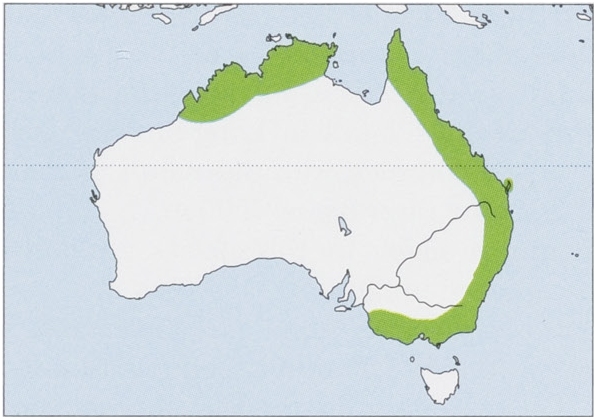
Subspecies and Distribution. M. o. orianaeThomas, 1922 — NEWesternAustraliaandNNorthernTerritory. M. o. bassanuCardinal & Christidis, 2000 — SESouthAustralia (RobeandNaracoorteStoPortMacDonnell) andSWVictoria. ItsdistributionisextendingacrosstheborderlineintoSWVictoria, toHeywood, Portland, Hamilton, andWarrnambool, withthemostElocalityyetfoundatPomborneit, nearCamperdown. M. o. oceanensis Maeda, 1982 — E Australia from Cape York in Queensland (including Fraser I) to Castlemaine in Victoria. Distribution of bassanii and oceanensis overlap in W Victoria, with both subspecies recorded from four caves in the Otways / Camperdown / Lorne area.