
Konservasieng
Conservation: CITES – Appendix III (India); IUCN – Lower Risk (lc).
Sumber: Order Carnivora
Family Viverridae · Order Carnivora
Data diperbarui secara berkala dari berbagai sumber observasi biodiversitas.
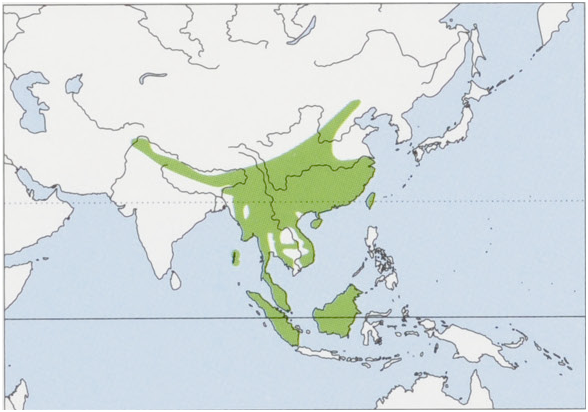
Foto: Don E. Wilson;Russell A. Mittermeier
Otoritas penamaan: (C.E.H.Smith, 1827) (1827)
Status taksonomi: ACCEPTED
Status konservasi (IUCN): LC Risiko Rendah
Dipublikasikan dalam: In Griffith et al., Anim. Kingdom vol.2 p.281
Total Catatan di Indonesia
0
Provinsi Ditemukan
0
dari 38 provinsi
Catatan Pertama
0
tahun pertama tercatat
Tren Tahunan
-0%
-25.0% vs 2025
Musang Bulan (Paguma larvata) termasuk dalam famili Viverridae, ordo Carnivora, kelas Mammalia. Berdasarkan data yang terhimpun, spesies ini telah tercatat sebanyak 137 kali di Indonesia, tersebar di 10 provinsi. Catatan pertama tercatat pada tahun 1865.
Lampung merupakan provinsi dengan catatan observasi terbanyak untuk spesies ini, dengan 11 catatan (8.0% dari total). Data distribusi ini mencerminkan akumulasi dari berbagai kegiatan survei, penelitian, dan kontribusi citizen science. Pola distribusi yang tercatat mungkin tidak sepenuhnya menggambarkan persebaran alami spesies, karena dipengaruhi oleh intensitas pengamatan di masing-masing wilayah.
Tren observasi tahunan Paguma larvata menunjukkan penurunan signifikan (-25%) pada periode terakhir dibanding tahun sebelumnya, dengan catatan pertama pada tahun 1865.
Catatan deskriptif tentang Paguma larvata dari sumber literatur primer (via GBIF).
Conservation: CITES – Appendix III (India); IUCN – Lower Risk (lc).
Sumber: Order Carnivora
Distribution: Bangladesh, Burma, Cambodia, China (Hainan north to Hopei, Shanxi and the vicinity of Beijing), India (and S Andaman Isls), Indonesia (Kalimantan, Sumatra), Japan (introduced), Laos, Malaysia (Sabah, Sarawak, West), Nepal, Pakistan, Singapore, Taiwan, Thailand, Vietnam.
Sumber: Order Carnivora
DISTRIBUTION: India and Nepal, China north to Hopei and Shansi; vic. Peking; Hainan Isl. (China); Taiwan; Thailand; Malaya; Vietnam; Sumatra; N. Borneo; Viper Isl. (S. Andaman Isis.).
Sumber: Order Carnivora
Habitat. Primary evergreen and deciduous forest, and in disturbed habitats. Found up to 2500 m. In Thailand, a radio-collared female moved in an area that constituted 67 % dry evergreen forest, 30 % mixed deciduous forest, and 3 % dry deciduous dipterocarp forest.
Sumber: Viverridae
Movements, Home range and Social organization. Solitary and arboreal, but does spend some time on the ground. In Thailand, an adult male had a home range of 5 - 9 km ® and an adult female had a home range of 3 - 7 km? the mean daily movement was 840 m for the male and 620 m for the female. In southeastern China, the resting home ranges of three adult males were 1 - 8, 3 - 5 and 4 - 1 km? and 1 - 9 and 2 - 9 km? for two adult females; the mean distance moved between consecutive daybed locations was 429 m for males and 404 m for females.
Sumber: Viverridae
Status and Conservation. Classified as Least Concern on The IUCN Red List. Masked Palm Civets may be threatened by habitat loss and degradation, hunting, the food trade, and the SARS epidemic. They are traded throughout South-east Asia and are commonly sold in food markets and restaurants in China, Vietnam, and Laos. They are farmed on a large scale in China for the meat trade. In the 1960 s, the annual take from the wild was 80,000 to 100,000 in China. During the 1990 s, civet farming developed intensively, as wild populations became scarce. By 2003, there were 660 farms in China holding 40,000 Masked Palm Civets. The SARS-like coronavirus has been isolated in this species and it may have played a role in the recent SARS epidemic (although there is no evidence that it is the natural reservoir of this virus); it is yet unclear what the ramifications will be of any recent control methods for this disease. The impacts of habitat loss and degradation on Masked Palm Civet populations are largely unknown, but on Borneo, it was found that the overall density ofcivet species in logged forest was significantly lower than in primary forest. May also be at risk from snare trapping; on Sumatra, they are commonly caught in snares set for Muntjac. Field surveys, ecological studies, and monitoring of threats are needed.
Sumber: Viverridae
Nama-nama ilmiah lain yang pernah digunakan untuk Paguma larvata dalam literatur taksonomi.
| Nama Sinonim | Otoritas | Status |
|---|---|---|
| Gulo larvatus | C.E.H.Smith, 1827 | SYNONYM |
| Paradoxurus larvatus | (Smith, 1827) | SYNONYM |
| # | Provinsi | Catatan | % |
|---|---|---|---|
| 1 | Lampung | 11 | 8.0% |
| 2 | Sumatera Barat | 9 | 6.6% |
| 3 | Jambi | 3 | 2.2% |
| 4 | Sumatera Selatan | 3 | 2.2% |
| 5 | Bali | 3 | 2.2% |
| 6 | Aceh | 2 | 1.5% |
| 7 | Sumatera Utara | 2 | 1.5% |
| 8 | Riau | 1 | 0.7% |
| 9 | Nusa Tenggara Barat | 1 | 0.7% |
| 10 | Kalimantan Timur | 1 | 0.7% |
Jumlah catatan observasi Paguma larvata di Indonesia per tahun
Paguma larvata
Foto: Don E. Wilson;Russell A. Mittermeier
Paguma larvata
Foto: Don E. Wilson;Russell A. Mittermeier
| Nama | Bahasa | Sumber |
|---|---|---|
| Civeta de las Palmeras Enmascarada | Spanyol | Catalogue of Life |
| Civeta-Mascarada | Portugis | Catalogue of Life |
| Civetta delle palme mascherata | Italia | Catalogue of Life |
| Civette masquée | Prancis | Catalogue of Life |
| Civette palmiste à masque | Prancis | Catalogue of Life |
| Cầy vòi mốc | vie | Catalogue of Life |
| Gem-faced Civet | Inggris | Catalogue of Life |
| Gem-faced civet | Inggris | Phthiraptera.myspecies.info |
| Gemaskerde Larvenroller | Belanda | Catalogue of Life |
| Guo zi li | - | Phthiraptera.myspecies.info |
| Himalayan Palm Civet | Inggris | Catalogue of Life |
| Hua mian li | - | Phthiraptera.myspecies.info |
| Larvenroller | Jerman | Catalogue of Life |
| Masked Palm Civet | Inggris | Order Carnivora |
| Masked palm civet | Inggris | Phthiraptera.myspecies.info |
| Maskepalmemår | nob | Catalogue of Life |
| Maskepalmeruller | dan | Catalogue of Life |
| Musang Bulan | Indonesia | Catalogue of Life |
| Musang Lamri | Melayu | Catalogue of Life |
| Paguma | Spanyol | Catalogue of Life |
Berdasarkan data 137 observasi, Lampung adalah provinsi dengan catatan Musang Bulan (Paguma larvata) terbanyak — 11 observasi (8.0% dari total catatan di Indonesia). Spesies ini tersebar di 10 provinsi.
Catatan pertama Musang Bulan (Paguma larvata) di Indonesia tercatat pada tahun 1865. Hingga kini terdapat 137 catatan dari 10 provinsi, yang dihimpun dari survei lapangan, koleksi museum, dan platform citizen science.
Menurut IUCN Red List, Musang Bulan (Paguma larvata) berstatus "Risiko Rendah" (kode LC). Status ini mencerminkan tingkat risiko kepunahan global spesies, bukan khusus Indonesia.
Di Indonesia dan Malaysia, Paguma larvata dikenal dengan beberapa nama lokal: Musang Bulan. Penamaan dapat berbeda antardaerah dan bahasa.
Ya, Paguma larvata memiliki 2 nama sinonim ilmiah, di antaranya: Gulo larvatus, Paradoxurus larvatus. Nama sinonim adalah nama-nama lain yang pernah digunakan untuk spesies yang sama dalam literatur taksonomi.
Paguma larvata diklasifikasikan sebagai berikut: Kingdom Animalia, Phylum Chordata, Class Mammalia, Order Carnivora, Family Viverridae, Genus Paguma. Spesies ini dideskripsikan oleh (C.E.H.Smith, 1827).
62 titik observasi Paguma larvata di Indonesia
Memuat peta...
Setiap titik merepresentasikan satu lokasi observasi yang tercatat. Klik titik untuk melihat detail.