
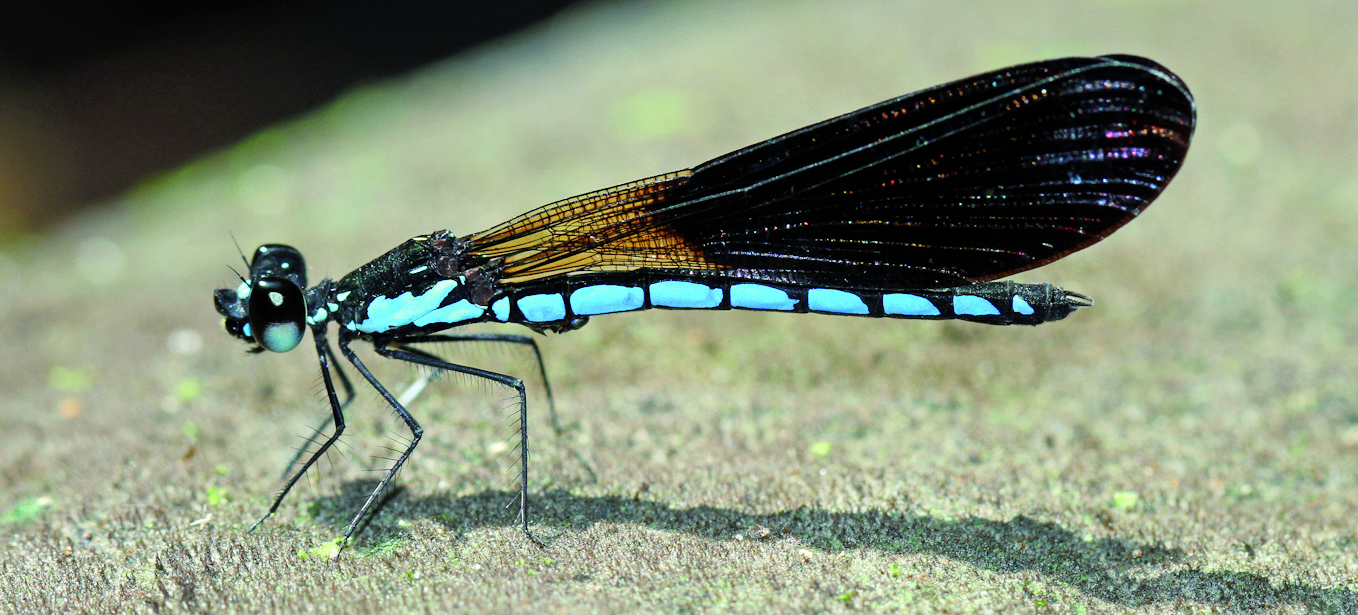
Description Male Head (Figs 25, 30 – 33) — Labium shiny black; labrum swollen, shiny black with stout setae; mandibles predominantly blue with narrow black border; anteclypeus and postclypeus black; frons, vertex, occiput and post-ocular area dull black, but frons with a pair of large sub-quadrangular blue spots, anteriorly with irregular margin, vertex with small oval spots next to the lateral ocelli; post-ocular spots small, creamy white. Thorax — Pronotum (Fig. 26) black; median lobe black with purple sheen, anterior lobe with a paired, oval creamy spot, placed distinctly from lateral corner; lateral lobes with large crescent-shaped blue or bluish white mark; propleuron with oblong bluish white mark, anteriorly wider than posteri- orly. Synthorax (Fig. 27). Mesopreepisternum with oval pale blue spot. Syn- thorax black, rather dull, but laterally shiny, with extensive blue markings as follows: mesepisternum anteriorly with sub-triangular marking, approximately three times as long as wide, covering approximately 1 / ₅ of mesepister- num; blue marking of mesepimeron covering anterior third, shape irregu- lar, tapering anteriorly, wider posteriorly and connected to blue marking of metepisternum; blue marking covering most of metepisternum, just leav- ing sub-rectangular black marking dorso-posteriorly and triangular black marking ventro-posteriorly; metepimeron anteriorly black with large blue transverse marking, leaving small triangular black spot dorso-posterior- ly, which connects to the ventro-posterior spot on metepisternum; mesokatepisternum with small, triangular blue spot in posterior corner against coxa. Legs — Dull black, but inner side of mid and hind tibiae white, covering ca the distal ⅔ of the mid legs, and the distal half of the hind legs; femora and tibiae with long stout setae; fore tibiae with a comb of about eight short setae. Wings — Fore wing clear in basal part with brownish tinge up to level of nodus; hind wing with similar pattern up to level of Ax 10; distal part of wings dark brownish black, dark parts of underside of fore wing anteriorly with blue metallic sheen, remainder with golden sheen; hind wing rather dull, tip with blue sheen; pterostigma of fore and hind wings brown. Abdomen (Fig. 28) — Dorsally black, intersegmental annulae black, sides of tergites with large blue spots as follows: S 1 with a posterior sub-quadrangu- lar spot, covering ¾ of segment, tapering anteriorly; S 2 with large rectangu- lar spot, anteriorly somewhat elongate, leaving a narrow black border ante- riorly; S 3 with large spot covering side of tergite almost completely, slightly tapering posteriorly; S 4 with spot as on S 3, but marking more strongly tapering posteriorly and not quite reaching the posterior margin; markings on S 5 – S 9 increasingly smaller and more tapered posteriorly on dorsal side, marking on S 9 about half the length of segment and sub-quadrangular, acute posteriorly; S 10 and anal appendages black. Female Head (Fig. 29) — Labium shiny black, labrum swollen, shiny black with stout setae; mandibles with squarish creamy white spot with narrow black borders, the apex black; anteclypeus black, shiny; remainder of head dor- sally velvet black, genae with large squarish creamy white spot, extending dorsally along the eyes as a narrow creamy stripe to the level of the lateral ocelli; frons with small, yellowish, irregular paired spot; vertex with small yellowish spots latero-posteriorly of lateral ocelli; post-ocular spots small, creamy white. Thorax — Pronotum black, rather shiny; anterior lobe laterally with cream- ish oval spot; median and posterior lobes black; lateral lobes with large, round creamish spot, dorsally tapered. Mesopreepisternum with rectangu- lar cream spot. Synthorax black, rather dull and slight purple sheen; mesepisternum with very thin ante-humeral stripe, both ends somewhat wider; all pale markings on synthorax creamy white; mesepimeron with short pale stripe in dorsoposterior corner; long pale stripe from posterior corner of mesokatepister- num and ventro-anterior corner of mesepimeron, running over ventral part of metepisternum over metathoracic spiracle, continuing on posterior half of metepimeron; this stripe with irregular margins and approximately ten times as long as high. Legs — Dull black, trochanters of mid and hind legs partly creamish. Wings — With brownish tint on transparent parts. Fore wing with dark opaque distal patch, extending from Px 15 to Px 23, somewhat further dis- tad in the middle of wing; wing tip opaque white; pterostigma covering ca six underlying cells, proximal half brown, distal half white; hind wing also with brownish black distal patch, wider than in that in fore wing, with more distinct bluish metallic sheen, covering wing between level of Px 12 to pterostigma; wing tip opaque white; pterostigma of fore wing basal ² / ₅ grey- brown, distal part grey-white, but darker against the veins; pterostigma of hind wing basal ⅓ grey-brown, rest as in fore wing; we have observed sig- nificant variation in this character. Abdomen — Black, with pale markings on sides of tergites as follows: S 1 with small subcircular spot posteriorly, S 2 with a short line medio-anteri- orly and an even shorter marking below it, and a larger oval spot close to posterior margin; S 3 – S 4 with L-shaped marking running along anterior margin of segment, extending medially over tergite, and a sub-circular spot posteriorly (very small on S 4), ventrally a short longitudinal mark- ing, ca 3 – 4 times longer than wide (these markings continue on S 3 – S 7); narrow anterior stripes along anterior margin of S 5 – S 7; rest of abdomen black. Measurements Males: Measurements of specimens from Dumoga-Bone National Park [mm] — Hind wing length (n = 5) x = 23.5 (22.5 – 24.5); hind wing width (n = 5) x = 6.0 (6.0 – 6.0); abdomen length (including appendages) (n = 5) x = 20.0 (19.0 – 20.5). Specimens from Luwuk — Hind wing length (n = 5) x = 24.5 (23.5 – 25.5); hind wing width (n = 5) x = 5.5 (5.0 – 6.0); length abdomen (including appendages) (n = 5) 19.5 (19.0 – 20.5). Females: Measurements of specimens from north-eastern Sulawesi [mm] — Hind wing length (n = 5) x = 25.5 (24.5 – 26.0); hind wing width (n = 5) x = 5.5 (5.5 – 6.0); abdomen (including appendages) (n = 5) x = 18.5 (18.0 – 20.0). Geographical variation Rhinocypha frontalis is quite a variable species, especially in size, but also in the size of the blue spots on the frons (Figs 30 – 33); both characters are geo- graphically correlated. We treat only the populations of the Sangihe Islands as a separate, new species. Specimens from the south-western peninsula dif- fer clearly from those of northern Sulawesi, and we describe these as a sepa- rate subspecies. We have also studied a few specimens with extensive blue markings on the synthorax, as in R. frontalis (see Fig. 42), collected near Madjene [ca 3 ° 33 ’ S, 118 ° 57 ’ E), 08 – 10 - xi- 1939, by J. J. van der Starre. How- ever, they agree in all other characters with R. monochroa. For a further dis- cussion, see the remarks on variation of R. monochroa of these specimens. Rhinocypha frontalis is absent from (geographical) central Sulawesi, where Rhinocypha is rather uncommon, particularly at higher altitudes, and replaced by R. phantasma, R. flavipoda sp. nov. and R. virgulata sp. nov. It is, however, locally abundant at some sites on the Banggai peninsula, in the south-eastern peninsula of Sulawesi, and on Buton (see also LIEFTINCK 1935: 177). As previously observed by Lieftinck (l. c.), specimens from Bu- ton do not differ from those of the northern peninsula. Specimens from Sabang (north of Palu) (Fig. 31), and also those collected in the Banggai peninsula (Fig. 32), have a tendency to smaller blue patches on the frons, which are anteriorly rather irregular. Specimens collected in the south-east- ern peninsula are closer to the typical form (Fig. 33).
Sumber: The Odonata of Sulawesi and adjacent islands. Part 8. Revision of the genus Rhinocypha Rambur, 1842 (Chlorocyphidae)