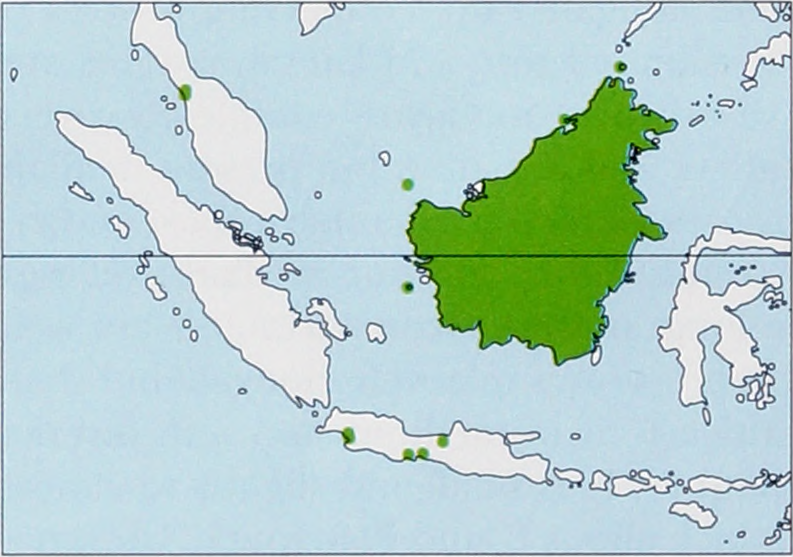
Details. Sella so slightly constricted as to be almost parallelmargined from base to summit; in some individuals the constriction is completely obsolete; height of sella about 3 mm.; width at base, at middle, and at summit: 2, 1 ’ 8, and 1 ' 7 mm. Lancet almost cuneate, or the lateral margins but slightly concave, never abruptly narrowed at the middle (as in Rh. rouXi); length of lancet about 4 ' 2 mm. Ears and wings quite as in Rh. celebensis. Plagiopatagium inserted on tarsus, or as much as 1 ' 5 mm. above the tarsal joint. Colour. There is an extreme dark phase and an extreme red phase, connected by several intermediate stages. (1) Dark phase. — ♀, Banguey Isl. (Brit. Mus.); two ♂, Pulo Sarutu (Un. St. Nat. - Mus.); all of them full-grown, but with unworn teeth; distal epiphyses of metacarpals in two of them ossified, in one not completely so; in alcohol, unfaded. General impression of upper side: brown. The true colour is a deep brown shade of “ drab ”; base of hairs next to “ broccoli-brown. ” Under side between “ wood-brown ” and “ broccoli-brown. ” The individuals are not precisely, but almost, alike in tinge. (2) Intermediate stage, nearer to “ dark phase. ” — ♂ ad., ♀ ad., Labuan (B. M.); ♂ ad., N. W. Borneo (B. M.); teeth either quite unworn, or almost unworn; distal epiphyses of metacarpals ossified; in alcohol, unfaded. Upper side “ russet, ” base of hairs but slightly lighter. Under side “ wood-brown. ” (3) Intermediate stage, nearer to “ red phase. ” — ♀ ad., Sirhassen (U. N. S. M.); ♂ ad., ♀ ad., Karimata (U. N. S. M.); teeth either quite unworn, or very slightly worn; distal epiphyses of metacarpals ossified; in alcohol, unfaded. Much like the foregoing, but also the under side of the body “ russet. ” (4) Extreme red phase. — ♂ ad., Sirhassen (B. M.); teeth unworn; epiphyses ossified; in alcohol, unfaded. Much like the extreme red phase of Rh. rouXi: not far from “ cadmium orange ” above; “ orange ” beneath. As proved by the above, these differences in colour are independent of the geographical habitat and of the sex of the individuals, seemingly also of the age. So far as the present material goes, the only “ phase ” in which a quite young, though full-grown, individual occurs (epiphyses not quite ossified) is the dark phase; but it may be accidental: the individual which represents the extreme red phase is, at all events, only a few months older (teeth unworn). Skull. As in Rh. celebensis, but with broader nasal swellings (5 ' 4 mm., on an average). Dentition. p 3 almost always completely external, but in one skull (out of eleven) half in row. Cingula of p 2 and p (in contact (six), or very slightly separated (four), or distinctly separated (one), p 2 always in the tooth-row; cusp very small. In four individuals there is an extremely narrow interspace between p 2 and p 1 (the former place of p 3).