Biologi & Ekologieng
Habitat. Various forested habitats, such as upper and lower montane forests, hill forests, heathlands, lowland rainforests, monsoon forests, dry sclerophyll woodlands, and Melaleuca (Myrtaceae) swamps from sea level up to elevations of ¢. 3000 m. The Southern Blossom Bat occurs sympatrically with the Moss-forest Blossom Bat in moss forests in New Guinea, and it is often found in association with plantations and gardens, especially when foraging.
Sumber: Pteropodidae
Biologi & Ekologieng
Movements, Home range and Social organization. Southern Blossom Bats primarily roost alone or in mother-young pairs. They typically do not roost in the same place every day, selecting a different roost every morning that is typically within 50 m of the previous roost. They roost near forest edges in winter and deep within forests where it is cooler in summer. While foraging throughout the night, they will travel up to 4 km from their roosts to feeding areas, which can take 2 - 3 hours to get to because individuals sample other food sources along the way. They make the samejourney back to their roosting area early in the morning. They are highly territorial of their feeding areas and chase off conspecifics in their foraging area. Males seem to be more aggressive in their home ranges and apparently fly closer to the ground more often than females. Males seem to be more localized than females based on recapture rates. Near Crater Mountain Volcano in Papua New Guinea, nearly all recaptured individuals were males (recapture rate was 10 - 3 %). Foraging areas are generally c. 13 ha, and they use the same general area every night. Densities are 1 - 18 ind / ha and depend largely on availability of nectar rather than pollen. Sex ratio at Crater Mountain over a 14 - month period was 0 - 71: 0 - 29; bias toward males might have been due to sampling bias relative to where females foraged and flew because mist nets were 4 m aboveground.
Sumber: Pteropodidae
Konservasieng
Status and Conservation. Classified as Least Concern on The IUCN Red List. The Southern Blossom Bat seems to be highly adaptable and tolerant of habitat modification and does not seem to face any major threats. Nevertheless, south of Fraser Island in Queensland, it is locally threatened by drainage of Melaleuca (Myrtaceae) swamps. Additional research on its taxonomy could result in designation of new species with smaller distributions and populations that could be threatened.
Sumber: Pteropodidae
Deskripsieng
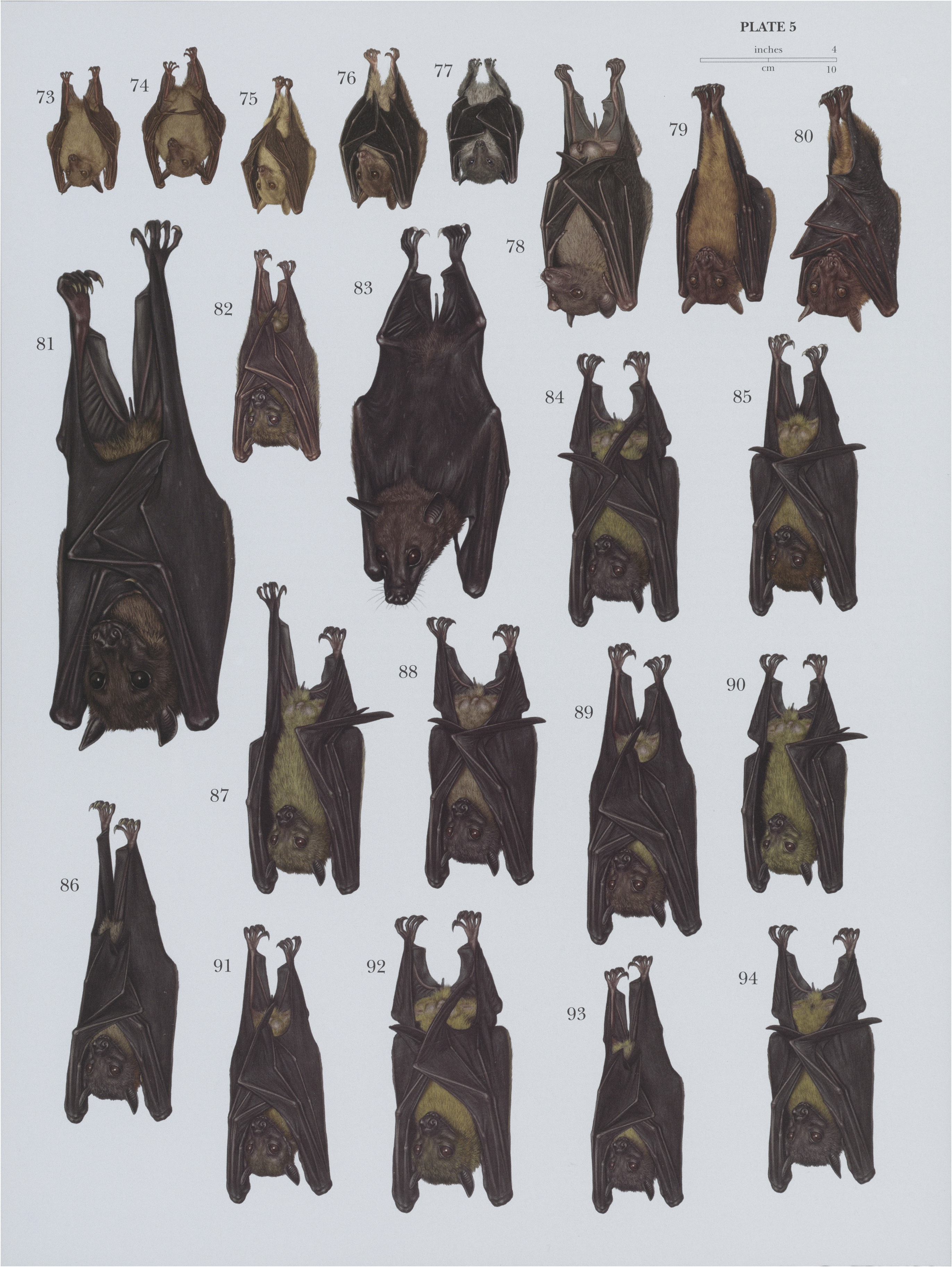
Descriptive notes. Head — body 55 - 80 mm (tailless), ear 9 - 17 mm, hindfoot 7 - 4 - 15 mm, forearm 38 - 48 mm; weight 13 - 23 - 5 g. Syconycteris is very similar to Macroglossus but can be distinguished byits lack of uropatagium (strip of fur remains in its place) and I, being larger than I, with no gap between them. There is considerable variation in cranial dimensions, pelage color, and size throughout the distribution of the Southern Blossom Bat. Head and muzzle are elongated, with raised forward-facing nostrils. Fur is somewhat woolly and shorter than in the Moss-forest Blossom Bat (S. Zobbit). Dorsal pelage varies from light brown to fawn to reddish brown; ventral pelage is lighter and whiter or creamier. Young are grayer overall. Eyes are large, with dark reddish brown irises; ears are elongated, with bluntly rounded tips, and colored like dorsum. Wings and digits are dark brownish; second digit of wing has a claw. There is no uropatagium, but there is a strip of longer fur along inside of legs where uropatagium would be present; calcar is absent. Skull is elongated, with long rostrum (shorter than in Macroglossus), and jaws and dentition are much more robust than in species of Macroglossus. Dental formula for species of Syconycterisis 12 / 2, C 1 / 1, P 3 / 3, M 2 / 3 (x 2) = 34. Molars and premolars are largely reduced, narrow, and linear with flat tops; upper incisors are uniformly large and procumbent; M * and M, are completely missing in some populations (e. g. subspecies naias); and I, are much larger than I, and do not have any gaps between them.
Sumber: Pteropodidae
Konservasieng
Conservation: IUCN / SSC Action Plan (1992) – Not Threatened. IUCN 2003 – Lower Risk (lc).
Sumber: Order Chiroptera - Family Pteropodidae
Distribusieng
Distribution: E Queensland and New South Wales (Australia); New Guinea, Aru Isl, Trobriand Isls, D'Entrecasteaux Isls, Kai Isls, Ambon, Seram, Haruku, and Boano Isls. (Indonesia), Bismarck Arch., including Manus (Papua New Guinea).
Sumber: Order Chiroptera - Family Pteropodidae