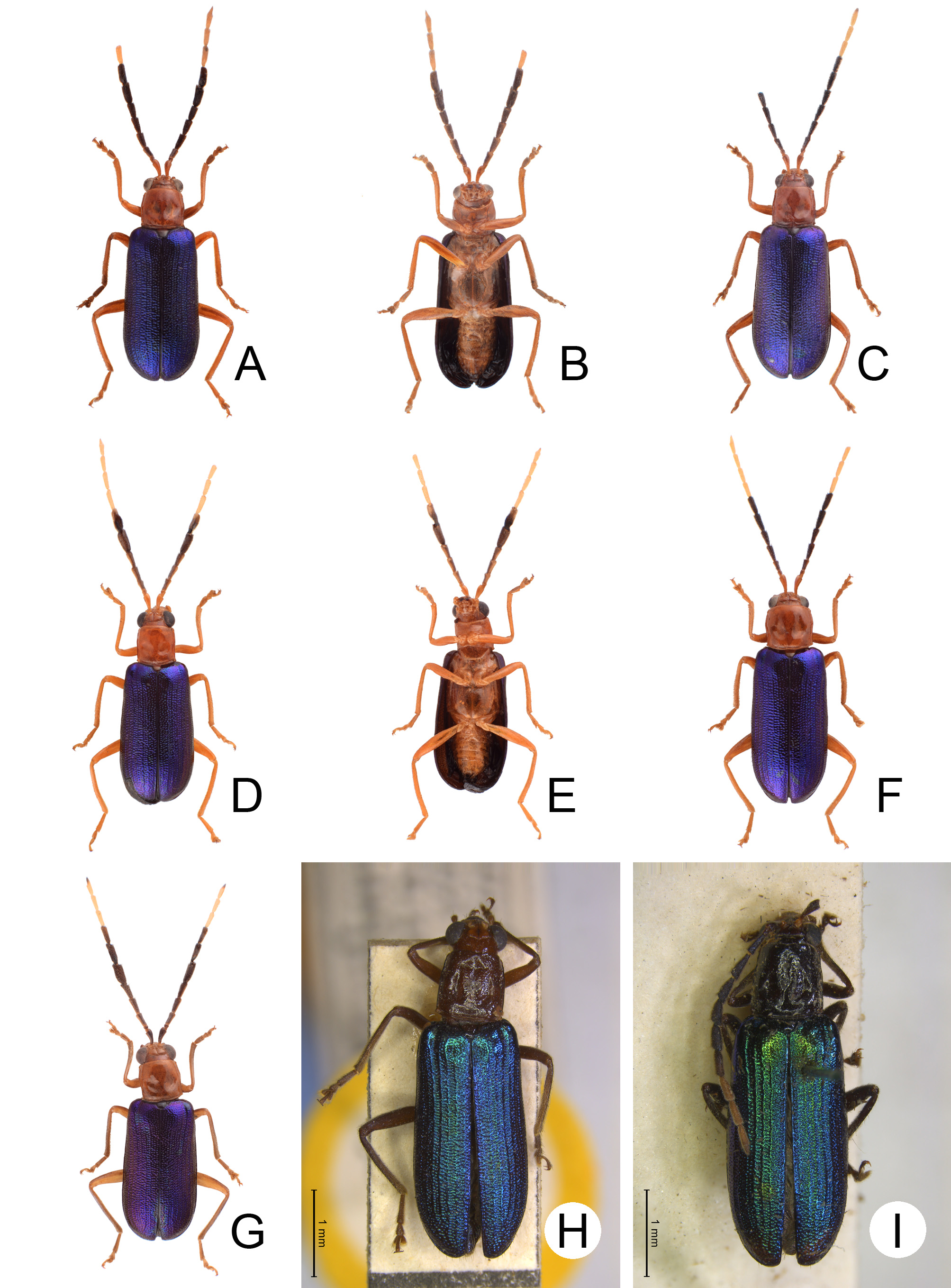
Redescription. Length 6.4 – 7.4 mm, width 2.4 – 2.7 mm. General color (Figs 1 D – 1 F) reddish brown; antennomeres III – VII black, VIII – XI white or pale yellow; elytra metallic purple. Antennae filiform in males, but antennomeres V slightly broadened apically, VI and VII strongly swollen and dorsoventrally flattened, VI subapically slightly narrowed, VII subapically moderately narrowed, ventral surface smooth without setae (Fig. 3 A), length ratios of antennomeres I – XI 1.0: 0.3: 0.8: 0.8: 0.8: 1.2: 1.2: 1.0: 0.9: 0.8: 1.1, length to width ratios of antennomeres I – XI 3.4: 1.1: 2.9: 2.9: 2.5: 2.4: 2.4: 3.7: 3.6: 3.2: 4.7; filiform in females (Fig. 3 B), length ratios of antennomeres I – XI 1.0: 0.4: 0.6: 0.8: 0.7: 0.9: 1.0: 0.9: 0.8: 0.8: 1.0, length to width ratios of antennomeres I – XI 3.2: 1.7: 2.6: 3.1: 2.9: 3.8: 4.0: 3.9: 3.7: 3.6: 4.3. Elytra elongate and parallel-sided, 2.1 x longer than wide; disc with dense, coarse punctures, arranged into longitudinal rows, those surrounding scutellum relatively smaller; with one weak longitudinal ridge between two longitudinal rows of punctures, basally abbreviated. Tarsomeres I of front legs not modified in males. Aedeagus (Figs 3 C – 3 E) slender, 6.4 x longer than wide; apex lanceolate, with median, deep, narrow notch, from apex to apical 1 / 4; sides widest at apical 1 / 4, gradually narrowed towards basal 1 / 4; tectum well sclerotized, abruptly narrowed near apex, apex acute; straight in lateral view, slightly curved near base; triangular sclerites small; internal sac with one median elongate sclerite, apex acute, basally connected with laterally flattened sclerite, covered with stout setae. Gonocoxae (Fig. 3 G) elongate, widest at apical 1 / 6, both gonocoxae combined together from basal 1 / 3 to apical 1 / 6; apices narrowly rounded, each gonocoxa with eight setae along outer margin from apex to apical 1 / 6; with one pair of short lateral processes at basal 2 / 5. Ventrite VIII (Fig. 3 F) elongate and well sclerotized; disc with several long setae laterally and near apical margin, and with dense, short setae along apical margin; spiculum extremely slender. Receptacle of spermatheca (Fig. 3 H) strongly swollen; pump slender and strongly curved; proximal spermathecal duct deeply inserted into receptacle, narrow and short. Variation. Some specimens from Sumatra and most of specimens from West Malaysia have black antennomeres VIII in males but more or less blackish in females (Fig. 1 G).