
Konservasieng
PROTECTED STATUS: CITES - Appendix II as Order Primates.
Sumber: Order Primates
Family Cercopithecidae · Order Primates
Data diperbarui secara berkala dari berbagai sumber observasi biodiversitas.
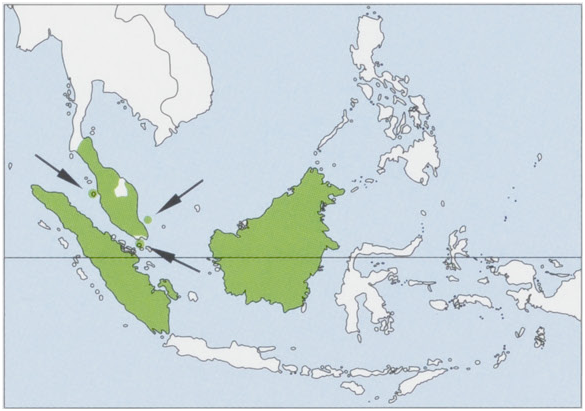
Foto: Russell A. Mittermeier;Anthony B. Rylands;Don E. Wilson
Otoritas penamaan: (Linnaeus, 1766) (1766)
Status taksonomi: ACCEPTED
Status konservasi (IUCN): EN Terancam Punah
Dipublikasikan dalam: Syst. Nat., 12th ed. vol.1 p.35
Total Catatan di Indonesia
0
Provinsi Ditemukan
0
dari 38 provinsi
Catatan Pertama
0
tahun pertama tercatat
Tren Tahunan
-0%
-40.0% vs 2025
beruk (Macaca nemestrina) termasuk dalam famili Cercopithecidae, ordo Primates, kelas Mammalia. Berdasarkan data yang terhimpun, spesies ini telah tercatat sebanyak 637 kali di Indonesia, tersebar di 13 provinsi. Catatan pertama tercatat pada tahun 1821.
Sumatera Utara merupakan provinsi dengan catatan observasi terbanyak untuk spesies ini, dengan 177 catatan (27.8% dari total). Data distribusi ini mencerminkan akumulasi dari berbagai kegiatan survei, penelitian, dan kontribusi citizen science. Pola distribusi yang tercatat mungkin tidak sepenuhnya menggambarkan persebaran alami spesies, karena dipengaruhi oleh intensitas pengamatan di masing-masing wilayah.
Tren observasi tahunan Macaca nemestrina menunjukkan penurunan signifikan (-40%) pada periode terakhir dibanding tahun sebelumnya, dengan catatan pertama pada tahun 1821.
Catatan deskriptif tentang Macaca nemestrina dari sumber literatur primer (via GBIF).
PROTECTED STATUS: CITES - Appendix II as Order Primates.
Sumber: Order Primates
DISTRIBUTION: Malay Peninsula; Sumatra; Borneo; Bangka Isl.; Burma; Thailand; Yunnan (China) (SW); Laos; Junk Seylon; Mergui Archipelago.
Sumber: Order Primates
Habitat. Highest densities are found in lowland and hill dipterocarp rainforests. Although Sunda Pig-tailed Macaques occur from sea level to 1900 m, they prefer the higher elevations and dry ground at the foot of hills and slopes. They are present in lowland and swamp forest in Peninsular Malaysia. They are not regular residents of swamp forest in Sumatra but may enter freshwater swamps during months of lowest rainfall when many tree species are flowering or fruiting. They frequently occur adjacent to agricultural land, including hillside farms, and on fringes of urban environments. They may travel together, sometimes simultaneously, with Long-tailed Macaques (M. fascicularis) in lowland primary and secondary forest and degraded habitats.
Sumber: Cercopithecidae
Movements, Home range and Social organization. Sunda Pig-tailed Macaques are wide ranging, with home ranges of at least 100 - 300 ha, parts of which may be used infrequently. Considerable home range overlap was reported in western Sumatra. Daily movements are ¢. 600 m in north Sumatra. Groups are multimale-multifemale. The adult male-female sex ratio has been found to vary from 1: 8 in 13 groups of 15 - 55 individuals (average 24) to 1: 2 - 7 (including adult and subadult mature males) in three groups of 49 - 81 individuals. Females remain in natal groups, and males emigrate at 5 - 6 years old. Both solitary adult and subadult males have been observed. Dominance hierarchies exist in both sexes. Adult males are dominant over females and may attack them at feeding sites, although groups of females (perhaps kin) may attack lower ranking males. Censuses in west-central Sumatra in 1996 - 1999 yielded density estimates of 1 - 7 groups / km? in lowland forest, 1 - 5 groups / km? in hill dipterocarp forest, 0 - 7 groups / km * in montane forest, and 0 - 8 groups / km? in submontane forest. Average group size was 10 - 5 individuals (range 1 - 20) in hill dipterocarp forest, seven individuals (range 6 - 8) in montane forest, 9 - 5 individuals in submontane forest, and 8 - 5 individuals (range 1 - 13) in lowland forest.
Sumber: Cercopithecidae
Status and Conservation. CITES Appendix II. Classified as Vulnerable on The IUCN Red List. The Sunda Pig-tailed Macaque has become seriously threatened and its populations fragmented by human encroachment and habitat loss, from legal and illegal logging, traditional and modern monoculture crop plantations such as oil palm, land clearance for agriculture and new settlements / transmigration, forest fires and drought (as have occurred in Kalimantan), and hunting for the illegal pet trade. Lowland forest 1 s most seriously threatened by a variety of human activities. Tropical rainforest, especially in lowlands, has disappeared rapidly in Sumatra, with most land being converted to commercial timber concessions, cultivated lands, and human settlements. The spread of oil palm plantations is one of the greatest threats to forests in Indonesia and Malaysia. From 1967 to 2000, the area under cultivation in oil palm in Indonesia expanded from less than 2000 km ® to more than 30,000 km ®. Indonesian production of crude palm oil was expected to reach a new high of 22 - 4 million tons in 2010, up 1 - 7 million tons in 2009. Production of palm oil is a major industry in Peninsular Malaysia, where Sunda Pig-tailed Macaques experienced an estimated decline of 43 - 7 % from 80,000 individuals in 1957 to 45,000 in 1975. Sabah and Sarawak have become the two big Malaysian oil palm states. Ultimately, the great majority of Sabah’s forest may consist of logged dipterocarp forest. There are many instances of conflict between humans and Sunda Pig-tailed Macaques, which has caused them to be regarded as a crop pest by farmers. Sunda Pig-tailed Macaques are found throughout Sarawak, for example, and can survive in logged forest but are hunted intensely for food and sport, and especially as crop pests in many areas. Along with the Long-tailed Macaque, they account for more than 2 % of mammals hunted in Sarawak and appear to be held at low density because of hunting. The Sunda Pig-tailed Macaque is naturally rare, and its groups are highly mobile so local populations are vulnerable to extirpation by hunting around farms. Trading of Sunda Pig-tailed Macaques for export by quota still occurs in Indonesia, and Sumatra is the main source. They are used as models for biomedical studies, including HIV / Aids research. Lower densities of Sunda Pig-tailed Macaques were recorded in Sumatra during surveys between 1996 and 1999 than those observed in the 1970 s. From 1977 to 1979, Peninsular Malaysia was the principal supplier of Sunda Pig-tailed Macaques to the United States, the world’s largest user of primates, supplying ¢. 970 individuals; imports from Indonesia totaled 570 individuals between 1976 and 1980. During 1978 - 2011, for which a record of international trade is available, more than 11,000 Sunda Pig-tailed Macaques may have been exported, with the United States being the major recipient. Numbers exported from Malaysia in 1977 - 1984 were significantly less. A total ban on the export of primates went into effect in Malaysia on 15 June 1984.
Sumber: Cercopithecidae
Descriptive notes. Head-body 53.2 - 73.8 cm (males) and 43.4 - 57.6 cm (females), tail 16 - 24 cm (males) and 13 - 25 cm (females); weight 10 - 13.6 kg (males) and 5.4 - 7.6 kg (females). The Sunda Pig-tailed Macaque is sexually dimorphic, males being a little less than twice the weight of females. Pelage of the trunk is yellowish-brown agouti to golden-brown agouti, including lateral surfaces of trunk and limbs and dorsal surface of appendages. There is a variably developed blackish mid-dorsal streak or patch that becomes more or less indistinct in the scapular region. Dorsal hairs are longest (7 - 9 cm) at the scapula in adult males. Indistinct dark streaks frequently occur on posterior surfaces of shanks. Underparts are thinly haired, whitish to ocherous-buff anteriorly, often becoming darker (buffy to pale brown) on the abdomen. Crown hairs are short and blackish, and they radiate to form a whorl at the top of the head. Crown patch is broad in front and extendslaterally on the supraorbital region as far as outer angles of the eyes. Cheek hairs are relatively short, pale at the base, and blackish at the tips, forming a pair of dark streaks or sideburns. The Sunda Pig-tailed Macaque has a long muzzle of pale brownish skin, thinly covered with inconspicuous short whitish hairs. Tail is thin, sharply defined blackish dorsally and pale ochrerous-buft ventrally; elongated terminal hairs frequently form an inconspicuous tuft. Tail is carried arched rearward and tip directed downward. Neonates are black. At about three months old, infant pelage changes to transitional brown and then to a tan agouti similar to adults.
Sumber: Cercopithecidae
Nama-nama ilmiah lain yang pernah digunakan untuk Macaca nemestrina dalam literatur taksonomi.
| Nama Sinonim | Otoritas | Status |
|---|---|---|
| ? brachyurus | Hamilton Smith, 1842 | SYNONYM |
| Macaca brachyurus | (Hamilton Smith, 1842) | SYNONYM |
| Macaca broca | Miller, 1906 | SYNONYM |
| Macaca carpolegus | (Raffles, 1821) | SYNONYM |
| Macaca fusca | (Shaw, 1800) | SYNONYM |
| Macaca libidinosus | I.Geoffroy Saint-Hilaire, 1826 | SYNONYM |
| Macaca longicruris | (Link, 1795) | SYNONYM |
| Macaca maimon | (de Blainville, 1839) | SYNONYM |
| Macaca nemestrina nucifera | Sody, 1936 | SYNONYM |
| Macaca nucifera | Sody, 1936 | SYNONYM |
| Macaca platypygos | (Schreber, 1774) | SYNONYM |
| Macacus brachyurus | (Hamilton Smith, 1842) | SYNONYM |
| # | Provinsi | Catatan | % |
|---|---|---|---|
| 1 | Sumatera Utara | 177 | 27.8% |
| 2 | Riau | 37 | 5.8% |
| 3 | Jambi | 37 | 5.8% |
| 4 | Aceh | 25 | 3.9% |
| 5 | Lampung | 23 | 3.6% |
| 6 | Sumatera Barat | 20 | 3.1% |
| 7 | Kalimantan Tengah | 14 | 2.2% |
| 8 | Kalimantan Timur | 13 | 2.0% |
| 9 | Kalimantan Selatan | 7 | 1.1% |
| 10 | Kalimantan Barat | 5 | 0.8% |
| 11 | Sumatera Selatan | 1 | 0.2% |
| 12 | Bengkulu | 1 | 0.2% |
| 13 | Jawa Tengah | 1 | 0.2% |
Jumlah catatan observasi Macaca nemestrina di Indonesia per tahun
Macaca nemestrina
Foto: Russell A. Mittermeier;Anthony B. Rylands;Don E. Wilson
Macaca nemestrina
Foto: Russell A. Mittermeier;Anthony B. Rylands;Don E. Wilson
| Nama | Bahasa | Sumber |
|---|---|---|
| Macaca Cola De Cerdo | Spanyol | Catalogue of Life |
| Macaco de cola de cerdo meridional | - | Cercopithecidae |
| Macaque a queue de cochon | Prancis | Catalogue of Life |
| Macaque À Queue De Cochon | Prancis | Catalogue of Life |
| Pig-tailed Macaque | Inggris | Cercopithecidae |
| Pigtail Macaque | Inggris | Catalogue of Life |
| Pigtailed Macaque | - | Phthiraptera.myspecies.info |
| Sidlicher Schweinsaffe | Jerman | Catalogue of Life |
| Southern Pig-tailed Macaque | Inggris | Integrated Taxonomic Information System (ITIS) |
| Sunda Pig-tailed Macaque | Inggris | Catalogue of Life |
| Sundaland Pig-tailed Macaque | Inggris | Cercopithecidae |
| Sundaland Pigtail Macaque | Inggris | Catalogue of Life |
| Südlicher Schweinsaffe | Jerman | Catalogue of Life |
| beruk | Indonesia | Catalogue of Life |
| southern pig-tailed macaque | Inggris | The Paleobiology Database |
Berdasarkan data 637 observasi, Sumatera Utara adalah provinsi dengan catatan beruk (Macaca nemestrina) terbanyak — 177 observasi (27.8% dari total catatan di Indonesia). Spesies ini tersebar di 13 provinsi.
Catatan pertama beruk (Macaca nemestrina) di Indonesia tercatat pada tahun 1821. Hingga kini terdapat 637 catatan dari 13 provinsi, yang dihimpun dari survei lapangan, koleksi museum, dan platform citizen science.
Menurut IUCN Red List, beruk (Macaca nemestrina) berstatus "Terancam Punah" (kode EN). Status ini mencerminkan tingkat risiko kepunahan global spesies, bukan khusus Indonesia.
Di Indonesia dan Malaysia, Macaca nemestrina dikenal dengan beberapa nama lokal: beruk. Penamaan dapat berbeda antardaerah dan bahasa.
Ya, Macaca nemestrina memiliki 12 nama sinonim ilmiah, di antaranya: ? brachyurus, Macaca brachyurus, Macaca broca. Nama sinonim adalah nama-nama lain yang pernah digunakan untuk spesies yang sama dalam literatur taksonomi.
Macaca nemestrina diklasifikasikan sebagai berikut: Kingdom Animalia, Phylum Chordata, Class Mammalia, Order Primates, Family Cercopithecidae, Genus Macaca. Spesies ini dideskripsikan oleh (Linnaeus, 1766).
150 titik observasi Macaca nemestrina di Indonesia
Memuat peta...
Setiap titik merepresentasikan satu lokasi observasi yang tercatat. Klik titik untuk melihat detail.