Biologi & Ekologieng
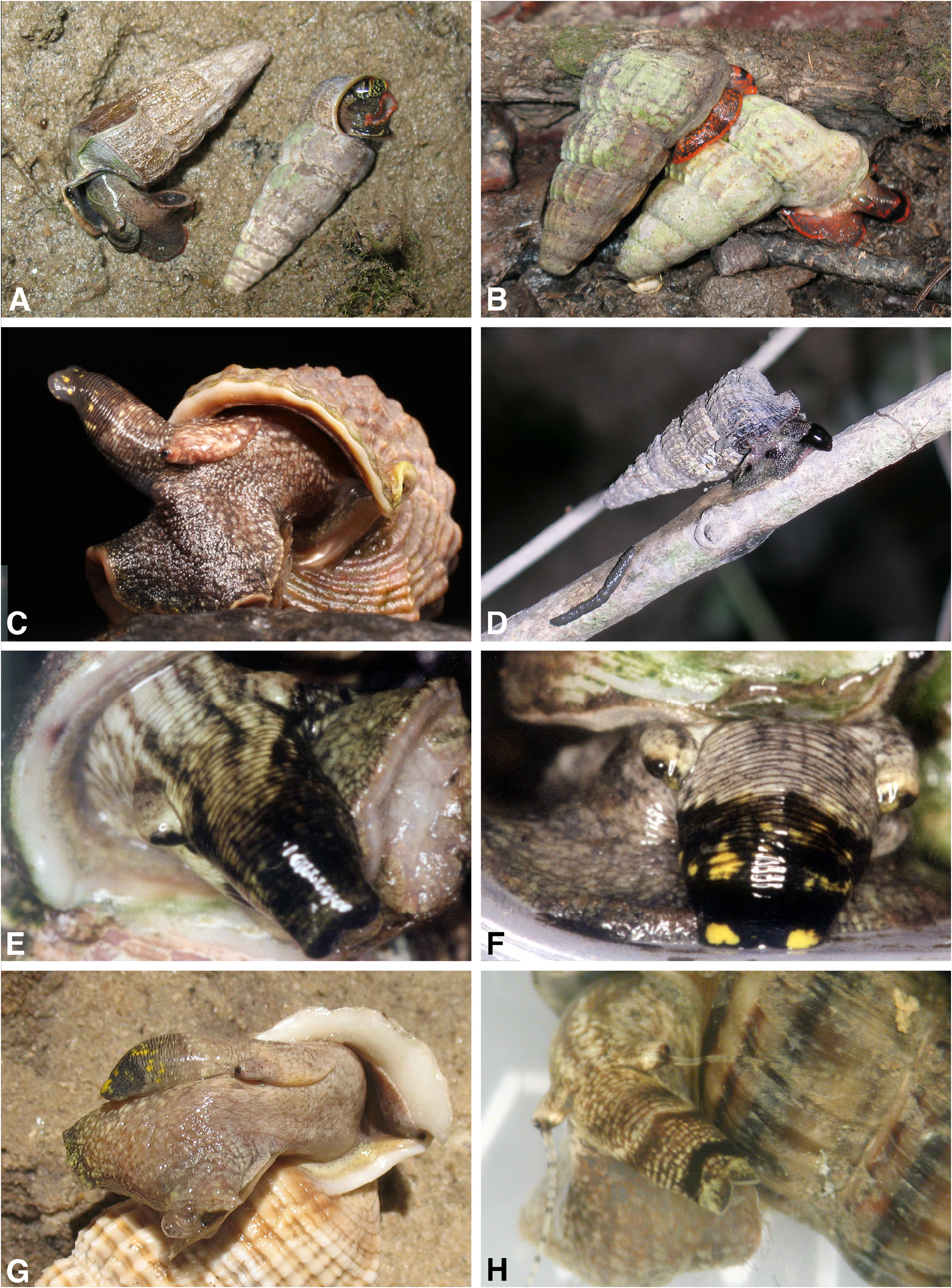
Habitat and ecology. In Rhizophora and Bruguiera forest, Avicennia parkland and landward fringes of mangrove forests, on firm mud and on trunks and stilt roots up to 1 – 1.5 m above the ground; in fully marine and estuarine areas. It has been recorded from the Rajang River at Sibu, Sarawak (Hamli et al. 2013), 60 km from the open sea. Several authors have observed that C. obtusa rests on branches, roots and trunks of trees, and descends to feed on firm mud below as the tide recedes, before climbing again during the ebb tide (Sreenivasan & Natarajan 1986; Ahmed & Mahmud 2007); according to Berry (1972) descent to the forest floor occurs during neap tides in Malaysia. In Malaysia and Thailand the animals are often found close to the ground on the bases of trees and on firm mud among tree roots (pers. obs.), but presumably climb higher to avoid submersion during spring tides. In Bangladesh the snails are said to be often found partly buried in the mud with the top of the spire projecting (Ahmed & Mahmud 2007). Densities of 2 – 10 / m 2 have been recorded in Sundarbans (Subba Rao et al. 1983, 1995; Dey 2006). It was rare in a mangrove forest at Phuket, Thailand, perhaps as a result of collection for food by local people (Frith, Tantanasiriwong & Bhatia 1976). According to the growth rate estimated by Sreenivasan & Natarajan (1986) in India, 13 mm is achieved at the end of the first year and maximum size of 26 mm after 4 years. Houlihan (1979) measured an air / water respiration rate ratio of 5.5 at 28 ° C and reported 50 % death after submersion for 48 h, also at 28 ° C.
Sumber: The genus Cerithidea Swainson, 1840 (Gastropoda: Potamididae) in the Indo-West Pacific region
Deskripsieng
Shell (Fig. 8): H = 31.3 – 57.2 mm. Shape relatively broad, elongated conical (H / B = 1.78 – 1.91, SH = 2.20 – 2.59); decollate, 5 – 7 whorls remaining; spire whorls rounded, suture distinct; spire profile straight to slightly convex; periphery rounded, not marked by cord or keel; solid. Adult lip strongly thickened and flared; apertural margin planar in side view; strong anterior projection adjacent to canal. Sculpture on spire of slightly opisthocline curved (opisthocyrt) axial ribs, occasionally bifurcating posteriorly (adapically), usually weaker and more distant on final 0.3 whorl; ribs prominent, rounded, interspaces 1 – 2 times width of ribs, 14 – 37 ribs on penultimate whorl; occasionally 1 – 2 varices on spire; spire whorls with 5 spiral cords, intersecting with axial ribs to give reticulate sculpture, increasing by interpolation of narrower cords to 6 – 9 spiral cords above periphery on final whorl; base with 10 – 13 cords, only slightly narrower than those above periphery and not separated from them. Ventrolateral varix a slightly to moderately thickened rib at 200 – 270 °. Surface with fine spiral microstriae on periostracum. Colour: fawn, usually a broad dark brown band from shoulder to periphery and another on base; aperture white, pale brownish within. Animal (Fig. 2 B): Head and base of tentacles grey with pale yellow spots; snout dark grey with 3 transverse bands of orange red, the 2 posterior bands wavy or interrupted and with a broad black band between; eyes with black surround and red ring; tentacles pinkish grey, darker at base; sides of foot dark grey with red spots and red margin; mantle cream (red colour fading to dark pink in ethanol-preserved specimens.) Range (Fig. 9): Bay of Bengal, Malay Peninsula, S Vietnam, Sumatra, Java, Borneo. Records: India: Pichavaram, Tamilnadu (Sreenivasan & Natarajan 1986; Subba Rao 2003); Godavari Estuary, Andhra Pradesh (Subba Rao, 2003); Port Canning, West Bengal (NHMUK 1893.12.2.119). Bangladesh: R. Ganges (ZMB). Burma: Moulmein, Salween R. (NHMUK 1954.6.2.2). Thailand: Ko Nok, Satun Prov. (NHMUK; MNHN; RMNH; AM C. 079263; USNM 777316); Kanchanadit, Surat Thani Prov. (NHMUK 20100436; USNM 828815); Ban Tamrua, Chonburi Prov. (USNM 776723). Malaysia: Klang, Selangor (NHMUK; USNM 661023; ANSP 267498); Kuantan, Pahang (AM C. 124490); Simunjan, Sarawak (ZMB 112.764). Singapore: Pulau Ubin (NHMUK 20130239). Cambodia: Kampot (Morlet 1889). Vietnam: Vung Tau (ANSP 330753); Long Hai (NHMUK); Khanh Hoa (Thach 2005). Indonesia: Pulau Weh, Sumatra (RMNH); Pulau Bangka (AM C. 009036); Tanjung Priok, Java (RMNH); Pasuruan, Java (RMNH); Banjarmasin, Kalimantan (RMNH); 14 km N Mahakan R., Kalimantan (AM C. 410364). Lamarck (1822) gave the type locality as “ Mers de Timor ” but, at this early date, this might refer to a wider region than the island of Timor. There are in addition four museum records from Timor (RMNH; ANSP 18055; ZMB), but all are old and are considered unreliable; the locality may have been copied from Lamarck, or ships returning to Europe from Timor may also have acquired specimens from Java or elsewhere. Three species of Potamididae were listed from the mangroves of Timor by Studer (1889), but C. obtusa was not among them. The Australian C. reidi and C. anticipata have sometimes been misidentified as C. obtusa (see their respective Synonymies). Houbrick (1986: 284), while distinguishing all three, also noted that C. obtusa “ does not appear to be common in Australia, although there are some reliable records from Queensland ”. In fact there is no evidence that C. obtusa occurs in Australia. Among other authors, von Martens (1897 a, b) included Australia and Madagascar in the recorded distribution; Brandt (1974) included Madagascar, Philippines and Australia; and Poutiers (1998) also mentioned Madagascar. Its incorrect occurrence in Madagascar can be traced to the record by Kiener (1841 – 1842), who was later quoted by von Martens (1880) and Dautzenberg (1923, 1929). The distribution in India has been said to include the Andaman and Nicobar islands (Subba Rao 2003; Subba Rao et al. 1992), but this is unsubstantiated; occurrence of Cerithidea there could refer to C. andamanensis. Records of shells outside its natural range could possibly be a consequence of its widespread use as food in Southeast Asia.
Sumber: The genus Cerithidea Swainson, 1840 (Gastropoda: Potamididae) in the Indo-West Pacific region