
Biologi & Ekologieng
Habitat. Disturbed and degraded forests and more frequently secondary habitats and coastal forests from sea level up to elevations of 800 m.
Sumber: Pteropodidae
Family Pteropodidae · Order Chiroptera
Data diperbarui secara berkala dari berbagai sumber observasi biodiversitas.
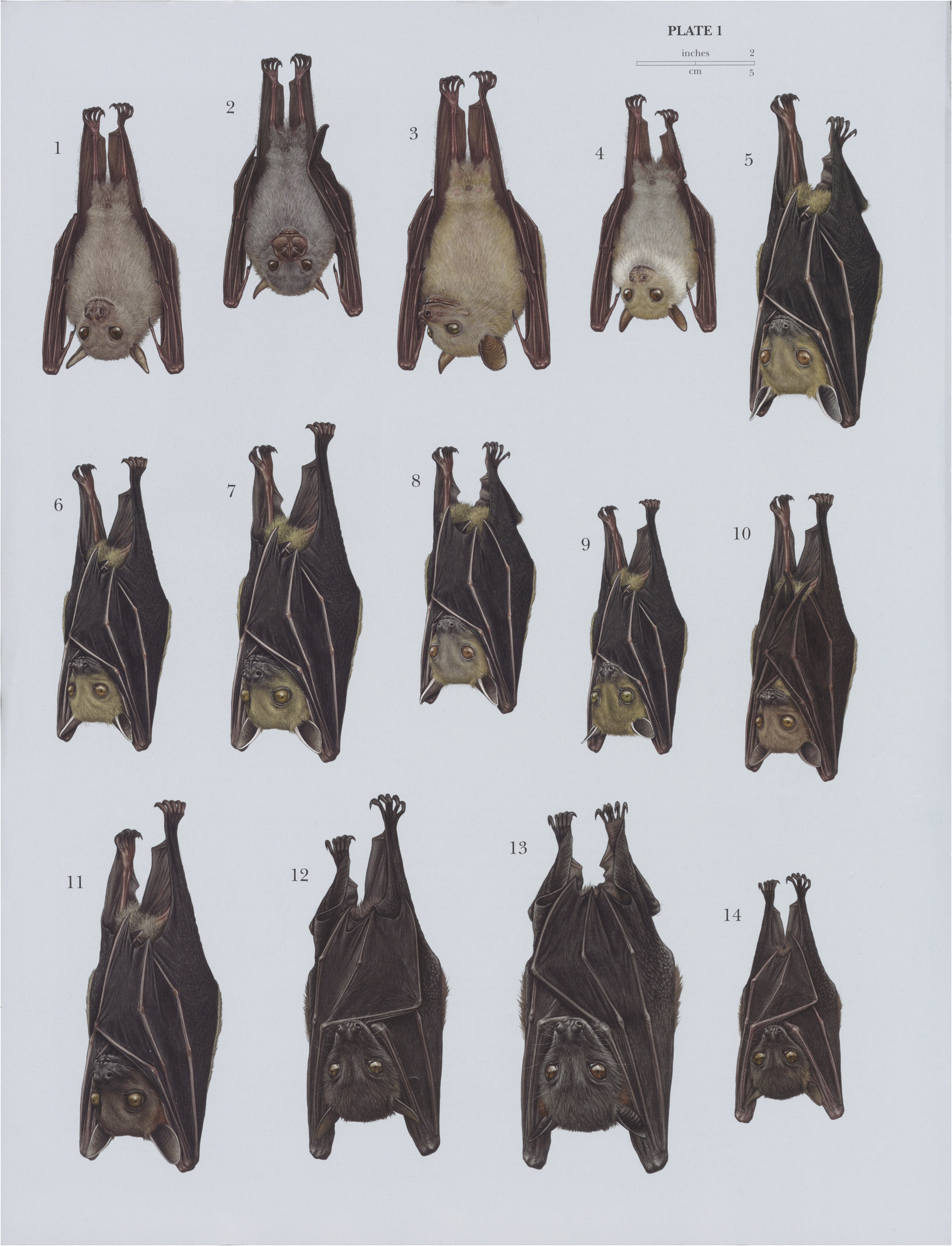
Foto: Don E. Wilson;Russell A. Mittermeier
Otoritas penamaan: (Temminck, 1825) (1825)
Status taksonomi: ACCEPTED
Status konservasi (IUCN): LC Risiko Rendah
Dipublikasikan dalam: Monogr. Mamm. vol.1 p.198
Total Catatan di Indonesia
0
Provinsi Ditemukan
0
dari 38 provinsi
Catatan Pertama
0
tahun pertama tercatat
Tren Tahunan
+0%
+0.0% vs 2016
Codot Besar (Cynopterus titthaecheilus) termasuk dalam famili Pteropodidae, ordo Chiroptera, kelas Mammalia. Berdasarkan data yang terhimpun, spesies ini telah tercatat sebanyak 862 kali di Indonesia, tersebar di 7 provinsi. Catatan pertama tercatat pada tahun 1821.
Sumatera Utara merupakan provinsi dengan catatan observasi terbanyak untuk spesies ini, dengan 45 catatan (5.2% dari total). Data distribusi ini mencerminkan akumulasi dari berbagai kegiatan survei, penelitian, dan kontribusi citizen science. Pola distribusi yang tercatat mungkin tidak sepenuhnya menggambarkan persebaran alami spesies, karena dipengaruhi oleh intensitas pengamatan di masing-masing wilayah.
Tren observasi tahunan Cynopterus titthaecheilus relatif stabil pada periode terakhir dibanding tahun sebelumnya, dengan catatan pertama pada tahun 1821.
Catatan deskriptif tentang Cynopterus titthaecheilus dari sumber literatur primer (via GBIF).
Habitat. Disturbed and degraded forests and more frequently secondary habitats and coastal forests from sea level up to elevations of 800 m.
Sumber: Pteropodidae
Movements, Home range and Social organization. No information.
Sumber: Pteropodidae
Status and Conservation. Classified as Least Concern on The IUCN Red List. Population trend is stable, but the Indonesian Short-nosed Fruit Bat is uncommon and not known to occur in any protected area.
Sumber: Pteropodidae
Descriptive notes. Wendie 114 - 127 mm, tail 9 - 12 - 5 mm, ear 18 - 23 mm, hindfoot 14 - 19 mm, forearm 74 - 5 - 84 mm; weight 76 - 84 g. The Indonesian Short-nosed Fruit Bat is medium to large in size, with white ear rims and inconspicuous white wing digits. Muzzle is moderately short, bare skin is dark brown, nostrils are barely tubular, philtrum is marked, and two large triangular pads occur on lowerlip. Eyes are moderately large; iris is chestnut to olive-brown. Ears are long, dark brown, and narrowly edged in white. Pelage of head is dark grayish brown, extending into nape and dorsum where it is longer and with reddish, sometimes olive tinge; pelage becomes woollier over upper one-half of well-developed uropatagium; and calcar is short. Ruff is intense reddish orange to rich russet, with long and stiff hairs that continue up to ear bases and almostjoin on sides of back; ruff is much paler and less extended in females. Center of belly is gray, often washed with tawny-olive, and base of forearm and ventral upper one-half of uropatagium are lightly haired in dull cream to light brownish gray. Genitals are dark. Wing membranes are grayish brown; index claw is present; and dorsally, wing digits are whitish, more notable in phalanges. Juveniles lack ruff and are grayer overall, with grayish brown dorsum and slate-gray underparts. Skull lacks basicranial deflection. Laterally, rostrum is moderately short, forehead slopes, frontal profile is flat, braincase is rounded, zygomatic rootis slightly above upper alveolar line, and zygoma is moderately strong and arched posteriorly. Dorsally, rostrum is wide; paranasal recesses are inflated, reaching postorbital foramen; postorbital process is short; braincase is oval, with sharp low sagittal and nuchal crests. Ventrally, palate is wide anteriorly and flat; post-dentalis long and converges posteriorly; palatine spine is inconspicuous, joined to sphenoidal crest; and ectotympanic is wide anteriorly and edged internally with long entotympanic. Mandible is well developed, coronoid is steeply ascending, tip is squared, condyle is above lower alveolar line, and angle is well marked. Upper incisors are long and thin; C! is moderately long but bulky, with marked accessory inner cusp; P! is a spicule; and posterior cheekteeth are rather strong, rectangular in outline, and decreasing in height posteriorly. Lower incisors are long, with bifid cutting edge; P has triangular crown; C, is tall and straight, with accessory inner cusp; posterior cheekteeth are tall and decrease in height posteriorly, rectangular in outline; flat surface cusps often occur on M; and M, is peg-like. Chromosomal complement has 2 n = 34 and FN = 58, with eleven submetacentric pairs, two subtelocentric pairs, three small acrocentric pairs of autosomes. X-chromosome is subtelocentric and medium-sized, and Y-chromosomeis acrocentric and small.
Nama-nama ilmiah lain yang pernah digunakan untuk Cynopterus titthaecheilus dalam literatur taksonomi.
| Nama Sinonim | Otoritas | Status |
|---|---|---|
| Cynopterus titthaecheileus | (Temminck, 1825) | SYNONYM |
| # | Provinsi | Catatan | % |
|---|---|---|---|
| 1 | Sumatera Utara | 45 | 5.2% |
| 2 | Jawa Barat | 13 | 1.5% |
| 3 | Bali | 12 | 1.4% |
| 4 | Jawa Tengah | 4 | 0.5% |
| 5 | Sumatera Barat | 2 | 0.2% |
| 6 | Jawa Timur | 2 | 0.2% |
| 7 |
Jumlah catatan observasi Cynopterus titthaecheilus di Indonesia per tahun
Cynopterus titthaecheilus
Foto: Don E. Wilson;Russell A. Mittermeier
Cynopterus titthaecheilus
Foto: Don E. Wilson;Russell A. Mittermeier
| Nama | Bahasa | Sumber |
|---|---|---|
| Codot Besar | Indonesia | Catalogue of Life |
| Cyndptero de Indonesia | - | Pteropodidae |
| Cynoptére de Temminck | Prancis | Pteropodidae |
| Indonesian Short-nosed Fruit Bat | Inggris | Order Chiroptera - Family Pteropodidae |
| Indonesian short-nosed fruit bat | Inggris | The Paleobiology Database |
| Indonesien-Kurznasenflughund | Jerman | Pteropodidae |
| Indonesischer Kurznasenflughund | Jerman | Catalogue of Life |
| Krótkonosek indonezyjski | pol | Catalogue of Life |
| kaloň bogorský |
Berdasarkan data 862 observasi, Sumatera Utara adalah provinsi dengan catatan Codot Besar (Cynopterus titthaecheilus) terbanyak — 45 observasi (5.2% dari total catatan di Indonesia). Spesies ini tersebar di 7 provinsi.
Catatan pertama Codot Besar (Cynopterus titthaecheilus) di Indonesia tercatat pada tahun 1821. Hingga kini terdapat 862 catatan dari 7 provinsi, yang dihimpun dari survei lapangan, koleksi museum, dan platform citizen science.
Menurut IUCN Red List, Codot Besar (Cynopterus titthaecheilus) berstatus "Risiko Rendah" (kode LC). Status ini mencerminkan tingkat risiko kepunahan global spesies, bukan khusus Indonesia.
Di Indonesia dan Malaysia, Cynopterus titthaecheilus dikenal dengan beberapa nama lokal: Codot Besar. Penamaan dapat berbeda antardaerah dan bahasa.
Ya, Cynopterus titthaecheilus memiliki 1 nama sinonim ilmiah, di antaranya: Cynopterus titthaecheileus. Nama sinonim adalah nama-nama lain yang pernah digunakan untuk spesies yang sama dalam literatur taksonomi.
Cynopterus titthaecheilus diklasifikasikan sebagai berikut: Kingdom Animalia, Phylum Chordata, Class Mammalia, Order Chiroptera, Family Pteropodidae, Genus Cynopterus. Spesies ini dideskripsikan oleh (Temminck, 1825).
Sumber: Pteropodidae
Conservation: IUCN / SSC Action Plan (1992) – Not Threatened. IUCN 2003 – Lower Risk (lc).
Sumber: Order Chiroptera - Family Pteropodidae
Distribution: Sumatra, Java, Bali, Lombok, Timor, and adjacent small islands.
Sumber: Order Chiroptera - Family Pteropodidae
| Banten |
| 2 |
| 0.2% |
| ces |
| Catalogue of Life |
| sumatrankoirankuono | fin | Catalogue of Life |
| ค้างคาวขอบหูขาวอินโดนีเซีย | tha | Catalogue of Life |
| スマトラコバナフルーツコウモリ | Jepang | Catalogue of Life |
88 titik observasi Cynopterus titthaecheilus di Indonesia
Memuat peta...
Setiap titik merepresentasikan satu lokasi observasi yang tercatat. Klik titik untuk melihat detail.