
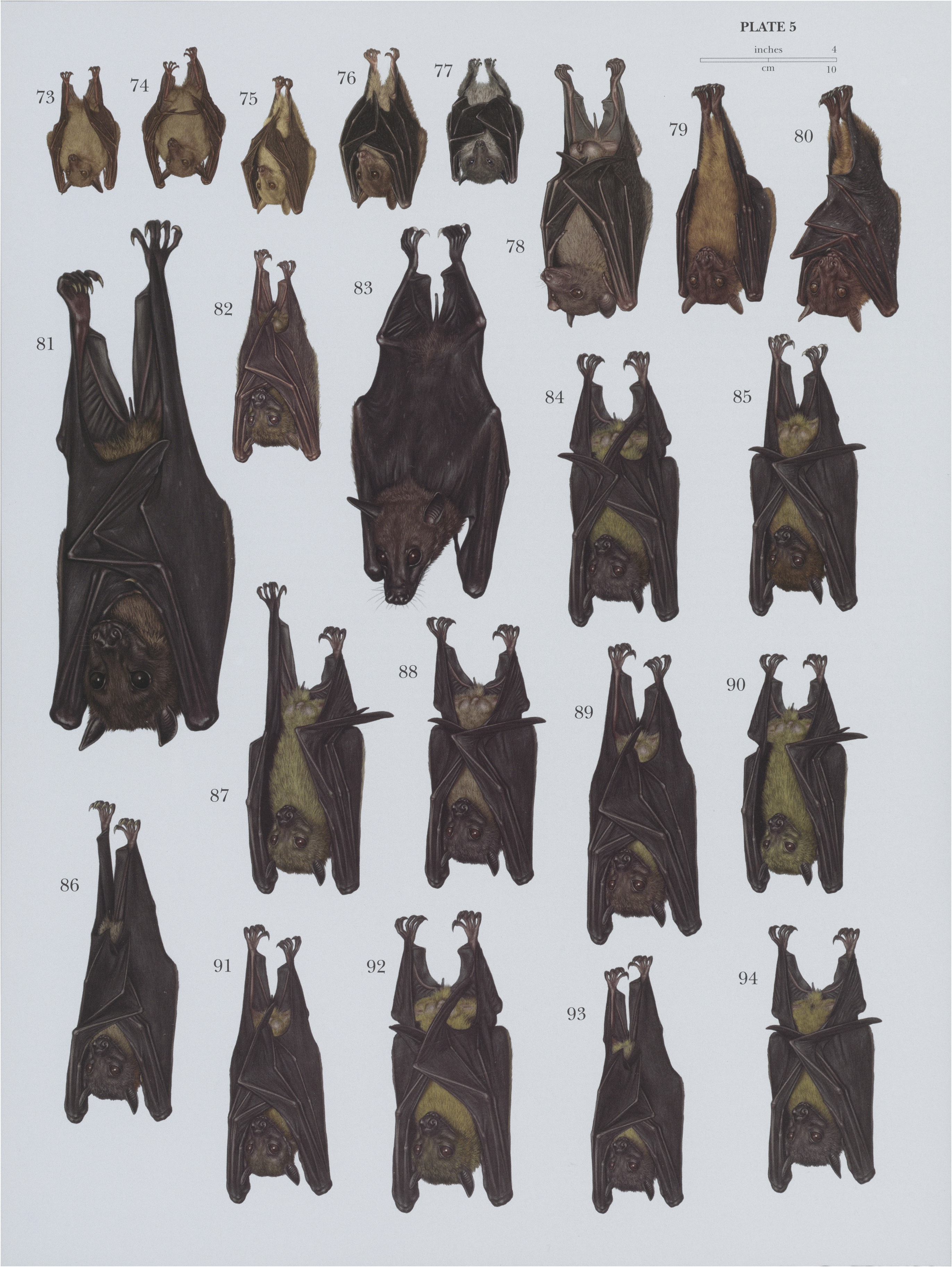
DISTRIBUTION: Bismarck Arch.; New Guinea; Aru Isis.; Batanta, Mysol, and Waigeo Isis, (off W. New Guinea); Molucca Isis.; N. Queensland.
Sumber: Order Chiroptera
Family Pteropodidae · Order Chiroptera
Data diperbarui secara berkala dari berbagai sumber observasi biodiversitas.

Foto: Don E. Wilson;Russell A. Mittermeier
Otoritas penamaan: (Quoy & Gaimard, 1830) (1830)
Status taksonomi: ACCEPTED
Status konservasi (IUCN): LC Risiko Rendah
Dipublikasikan dalam: In d'Urville, Voy...de Astrolabe, Zool. vol.1(L'Homme, Mamm. Oiseaux) p.86
Total Catatan di Indonesia
0
Provinsi Ditemukan
0
dari 38 provinsi
Catatan Pertama
0
tahun pertama tercatat
Tren Tahunan
-0%
-50.0% vs 2024
Kubu Maluku (Dobsonia moluccensis) termasuk dalam famili Pteropodidae, ordo Chiroptera, kelas Mammalia. Berdasarkan data yang terhimpun, spesies ini telah tercatat sebanyak 240 kali di Indonesia, tersebar di 5 provinsi. Catatan pertama tercatat pada tahun 1863.
Papua Barat merupakan provinsi dengan catatan observasi terbanyak untuk spesies ini, dengan 109 catatan (45.4% dari total). Data distribusi ini mencerminkan akumulasi dari berbagai kegiatan survei, penelitian, dan kontribusi citizen science. Pola distribusi yang tercatat mungkin tidak sepenuhnya menggambarkan persebaran alami spesies, karena dipengaruhi oleh intensitas pengamatan di masing-masing wilayah.
Tren observasi tahunan Dobsonia moluccensis menunjukkan penurunan signifikan (-50%) pada periode terakhir dibanding tahun sebelumnya, dengan catatan pertama pada tahun 1863.
Catatan deskriptif tentang Dobsonia moluccensis dari sumber literatur primer (via GBIF).
DISTRIBUTION: Bismarck Arch.; New Guinea; Aru Isis.; Batanta, Mysol, and Waigeo Isis, (off W. New Guinea); Molucca Isis.; N. Queensland.
Sumber: Order Chiroptera
Habitat. Commonly coastal lowlands high into montane habitats in primary and secondary tropical moist forests, and highly disturbed areas such as village gardens and fruit plantations from sea level up to elevations of ¢. 2700 m. The Moluccan Nakedbacked Fruit Bat is rare in dry woodlands and savannas. It has a larger distribution and occupies more varied habitats and elevational range than any other species of Dobsonia (but it might be a species complex, and if so, distributions of individual taxa not yet differentiated and their preferred habitat would be different).
Sumber: Pteropodidae
Movements, Home range and Social organization. Moluccan Naked-backed Fruit Bats are highly gregarious, but roosting groups vary from solitary individuals to groups of tens, hundreds, or thousands of individuals. They will cohabit caves with Beaufort’s Naked-backed Fruit Bat (D. beauforti). Group size in tree hollows and tree crowns including coconut trees are limited to small numbers. In Australia, colonies are relatively small, approaching a maximum of 100 individuals and have been found in caves, dark areas under large boulders, old mines, abandoned houses, and dense vegetation. It exhibits extremely high thermal conductances that can be 180 % of that expected for a mammal of its body weight. Such exceptionally high thermal conductance is facilitated by naked-backed wing condition and likely assists in efficiently dumping heat in this largebodied species that roosts clumped together. Preference for roosting at interior limits of cool caves also facilitates heat dumping to cool air in cave interiors. Naked-backed wing morphology is related to its ability to fly with amazing maneuverability at low speeds, including its ability to hover and fly backward. As they search for a place to roost when approaching a cluster of roosting conspecifics, they are able to hover, repeatedly reverse direction, and then move forward slowly to land by swinging feet upward to grab onto rock. They also fold wings and dive up to 300 m to approach a particular cave entrance. If disturbed at the roost by a predator, they are highly vociferous; otherwise there are only occasional antagonistic with vocalizations coupled with wing boxing between individuals that attemptto displace each other from mates or favored roost positions. Potential predators include large pythons such as the amethystine python (Morelia amethistina) that will enter caves to feed on bats. Physiological responses to environmental temperature variation of Moluccan Naked-backed Fruit Bats appear adaptive to cave dwelling and avoidance of predation. These responses include maintenance of constant high body temperature (mean = 36 - 8 ° C), high minimum thermal conduction (mean = 180 % of mammalian mass-specific standard), and high basal metabolic rate (BMR, mean = 145 % of mammalian standard). Maintenance of high body temperature and high BMR might facilitate rapid growth and care of young (including milk production) and ability to fly instantaneously in response to a predator. High minimal termal conductance (largely through highly vascularized naked-backed wings) facilitates heat loss for a largebodied bat that otherwise might overheat in crowded roosting clusters. Large colony size also might raise cave air temperatures, making excess body heat more difficult to unload. Large colonies of Moluccan Naked-backed Fruit Bats often have infestations of large fur-dwelling bat flies including Megastrebla parvior and M. gigantea. Terrestrial leeches often hang from cave ceilings and drop on Moluccan Naked-backed Fruit Bats.
Sumber: Pteropodidae
Status and Conservation. Classified as Least Concern on The IUCN Red List (but excluding magna). The Moluccan Naked-backed Fruit Bat has a very large distribution and is perhaps the most abundant fruit bat in New Guinea, and there is no indication that the population is in decline. Informal protection by local landowners sometimes provides conservation of populations, such as at Omeru Village, Madang Province, Papua New Guinea, where local people offer an ecotourism experience to view a colony estimated to be 10,000 individuals on walls of a large sinkhole. Indigenous people hunt it for local consumption, but hunts often are restricted to provide for holiday feasts and special occasions by local custom. In some places, farmers and villagers consider it a pest for raiding fruit trees such as papaya. Villagers in New Guinea will set large fishing hooks inside fruit to snag raiding bats.
Sumber: Pteropodidae
Descriptive notes. Head-body 185 - 210 mm, tail 25 - 30 mm, ear 27 - 35 mm, forearm 120 - 146 mm; weight 490 - 500 g for subspecies moluccensis; head — - body 191 - 254 mm, tail 21 - 42 mm, ear 28 - 41 mm, hindfoot 30 - 47 mm, forearm 136 - 162 mm; weight 325 — 600 g for subspecies magna. There is sexual dimorphism in body weight within magna, with males up to 600 g but females only up to a maximum of 525 g. Sample sizes are inadequate to know if sexual dimorphism in nominotypical moluccensis occurs. The Moluccan Naked-backed Fruit Bat is the largest species of Dobsonia. Wings attach along midline of back and cover dorsal fur beneath. Fur is uniformly medium brown to gray-brown on face and dorsum. Ventral fur is pale gray-brown. Flight membranes are black. Ears are long and narrow, rising well above crown of head. Inner surfaces of pinna are well ribbed along basal one-half. Shortly tubular nostrils diverge and extend slightly beyond snout. Eyes are large and produce “ eye shine ” when light is focused on them in a dark cave; irises are brown. Claws of feet and thumbs are pale tan or whitish. Index claw (second digit of wing) is absent. There are two pairs of musk-producing sebaceous glands, one pair that runs from base of ears down and forward toward corners of mouth and another thatlies ventro-laterally on shoulders near anteriorjunction of wing patagia to the body. These glands are most prominent in adult males during breeding season but observable on females. There is a well-marked anterointernal basal ledge on upper and lower third premolars and a posterior basal ledge on second upper and lower premolars and third upper premolar. There is a median-surface ridge in M' and M ,, often present in P * and M. Anterointernal corner of Mis not differentiated as a distinct cusp or ledge. Pineal gland is large compared with other mammals of its body weight, which fluctuates in size and control of hormonal activity associated with seasonal cycles of reproduction.
Sumber: Pteropodidae
Conservation: IUCN / SSC Action Plan (1992) – Not Threatened. IUCN 2003 – Lower Risk (lc).
Sumber: Order Chiroptera - Family Pteropodidae
Nama-nama ilmiah lain yang pernah digunakan untuk Dobsonia moluccensis dalam literatur taksonomi.
| Nama Sinonim | Otoritas | Status |
|---|---|---|
| Hypoderma moluccensis | Quoy & Gaimard, 1830 | SYNONYM |
| # | Provinsi | Catatan | % |
|---|---|---|---|
| 1 | Papua Barat | 109 | 45.4% |
| 2 | Maluku | 19 | 7.9% |
| 3 | Nusa Tenggara Timur | 14 | 5.8% |
| 4 | Papua | 4 | 1.7% |
| 5 | Maluku Utara | 1 | 0.4% |
Jumlah catatan observasi Dobsonia moluccensis di Indonesia per tahun
Dobsonia moluccensis
Foto: Don E. Wilson;Russell A. Mittermeier
Dobsonia moluccensis
Foto: Don E. Wilson;Russell A. Mittermeier
| Nama | Bahasa | Sumber |
|---|---|---|
| Bare-backed Fruit Bat | Inggris | Pteropodidae |
| Bare-backed Fruit Bat / New Guinea Naked-backed Fruit Bat (magna) | Inggris | Pteropodidae |
| Dobsonia de las Molucas | - | Pteropodidae |
| Gołogrzbietek molucki | pol | Catalogue of Life |
| Kubu Maluku | Indonesia | Catalogue of Life |
| Moluccan Naked-backed Fruit Bat | Inggris | Catalogue of Life |
| Molukken-Nacktrickenflughund | Jerman | Catalogue of Life |
| Molukken-Nacktrückenflughund | Jerman | Catalogue of Life |
| New Guinea Naked-backed Fruit Bat | Inggris | Pteropodidae |
| Roussette des Molugues | Prancis | Pteropodidae |
| isokaljuselkä | fin | Catalogue of Life |
| kaloň amboinánský | ces | Catalogue of Life |
| kaloň novoguinejský | ces | Catalogue of Life |
| magna | Inggris | Catalogue of Life |
| オオケナシフルーツコウモリ | Jepang | Catalogue of Life |
Berdasarkan data 240 observasi, Papua Barat adalah provinsi dengan catatan Kubu Maluku (Dobsonia moluccensis) terbanyak — 109 observasi (45.4% dari total catatan di Indonesia). Spesies ini tersebar di 5 provinsi.
Catatan pertama Kubu Maluku (Dobsonia moluccensis) di Indonesia tercatat pada tahun 1863. Hingga kini terdapat 240 catatan dari 5 provinsi, yang dihimpun dari survei lapangan, koleksi museum, dan platform citizen science.
Menurut IUCN Red List, Kubu Maluku (Dobsonia moluccensis) berstatus "Risiko Rendah" (kode LC). Status ini mencerminkan tingkat risiko kepunahan global spesies, bukan khusus Indonesia.
Di Indonesia dan Malaysia, Dobsonia moluccensis dikenal dengan beberapa nama lokal: Kubu Maluku. Penamaan dapat berbeda antardaerah dan bahasa.
Ya, Dobsonia moluccensis memiliki 1 nama sinonim ilmiah, di antaranya: Hypoderma moluccensis. Nama sinonim adalah nama-nama lain yang pernah digunakan untuk spesies yang sama dalam literatur taksonomi.
Dobsonia moluccensis diklasifikasikan sebagai berikut: Kingdom Animalia, Phylum Chordata, Class Mammalia, Order Chiroptera, Family Pteropodidae, Genus Dobsonia. Spesies ini dideskripsikan oleh (Quoy & Gaimard, 1830).
94 titik observasi Dobsonia moluccensis di Indonesia
Memuat peta...
Setiap titik merepresentasikan satu lokasi observasi yang tercatat. Klik titik untuk melihat detail.