Biologi & Ekologieng
Habitat. A variety of forest habitats at elevations of 200 - 1370 m, ranging from mature primary forests to disturbed forests. Food and Feeding. The Least Horseshoe Bat probably forages for insects by perchhunting; it has been observed foraging among clumps of bamboo and small limestone boulders. Five fecal samples in Beijing consisted of Diptera (45 % by volume), Lepidoptera (42 %), and Coleoptera (13 %). Breeding. Very little is known about its breeding biology, but pregnant females were captured in mid-May, and lactating females in mid-June in Guangxi. Activity patterns. Least Horseshoe Bats usually roost in caves by day, although roosts have also been recorded in the roofs of bungalows. They emerge from their day roosts to forage through the night, and have been observed leaving their roosts in early evening (18: 00 h) in Myanmar, dispersing by 18: 30 h. Search call shape is FM / CF / FM, with a peak F of 105 - 2 - 109 - 7 kHz in Beijing and 111 - 2 kHz in Guangxi, 108 - 9 - 114 - 1 kHz in Cambodia (start frequencies of 95 — 111 kHz and end frequencies of 95 - 105 kHz), and 92 - 5 kHz in Peninsular Malaysia; and a call duration of 20 — 50 milliseconds (mean of 40 milliseconds) in China and 14 - 7 - 34 - 1 milliseconds in Cambodia (interpulse interval of 18 - 2 - 38 - 6 milliseconds). Movements, Home range and Social organization. Day roosts vary from a few individuals to thousands. In north-western Thailand, Least Horseshoe Bats were observed roosting in clusters of 55 - 1500 individuals in a cave.
Sumber: Rhinolophidae
Konservasieng
Status and Conservation. Classified as Least Concern on The IUCN Red List. The Least Horseshoe Bat is widespread and appears to be common throughout much of its distribution. However, the species as currently constituted may well comprise a group of several species with smaller distributions; once the taxonomy is clarified further, the conservation status of the different forms may change.
Sumber: Rhinolophidae
Deskripsieng
Descriptive notes. Head-body 30 - 42 mm, tail 13 - 26 mm, ear 13 — 20 mm, hindfoot 6 - 8 mm, forearm 33 - 41 - 6 mm; weight 3 - 3 - 8 g. Dorsal pelage is dark brown to smoky gray or cinnamon brown, and ventral pelage grayish white or reddish, matching dorsum but paler. Ears are medium-sized. Noseleaf has variable lancet that ranges from elongate with concave sides to short and nearly triangular with parallel sides; connecting process is generally triangular (or hom-shaped, curving forward in some individuals); sella is slightly constricted medially, gradually narrowing to widely rounded tip; horseshoe is relatively wide (6 - 8 mm) with small median emargination, and lacks lateral leaflets. There are three mental grooves on lower lip. Baculum is very large for horseshoe bat, has distinct but weak dorsal bend at tip and base, roughly cylindrical shaft, thin, rounded, and laterally widened tip, and wide basal cone with deep emargination. Skull is moderately robust (zygomatic breadth is usually subequal to mastoid breadth but can be either slightly larger or smaller); anterior median swellings are very small; posterior swellings are more or less well inflated; rostral profile is nearly straight or slightly sloping posteriorly; sagittal crest is weakly to moderately developed; frontal depression is shallow or nearly straight; supraorbital crests are inconspicuous and low. C 1 is moderately long; P 2 is well developed and in the tooth row, separating C 1 from P 4; P 3 is minute to mediumsized and usually extruded from the tooth row; P 2 and P 4 are variably separated or in contact. Chromosomal complement has 2 n = 62 and FN = 63 (Hainan) or 64 (Thailand).
Sumber: Rhinolophidae
Distribusieng
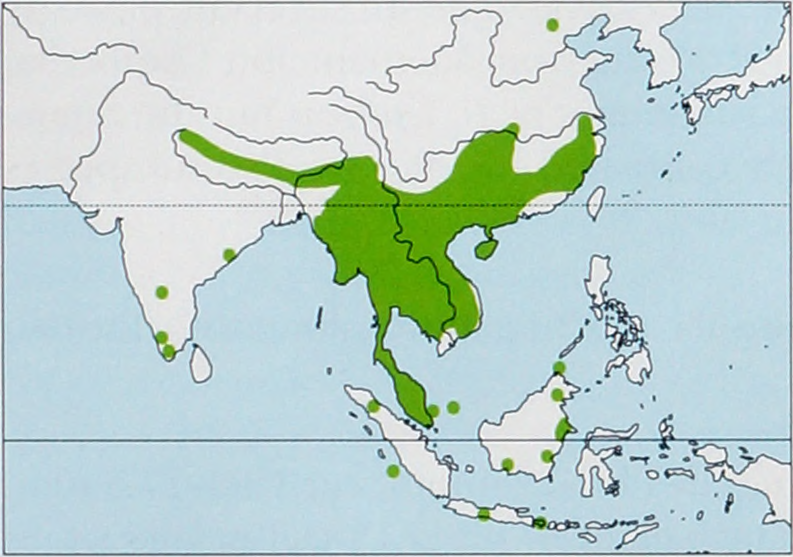
Recorded at: Kedah: Ulu Muda Forest Reserve [57]; Pahang: Pulau Tioman (DWNP-M- 08077, DWNP-M- 08080, DWNP-M- 08083); Johor: Gunung Ledang State Park (DWNP-M- 08076, DWNP-M- 08078, DWNP-M- 08079, DWNP-M- 08081, DWNP-M- 08082); Negeri Sembilan: Berembun Forest Reserve [101].
Sumber: A checklist of the bats of Peninsular Malaysia and progress towards a DNA barcode reference library
Distribusieng
Records from Borneo Sabah: Maliau Basin (Yasuma and An- dau, 2000). EastKal: Sungai Karangan (Sangkulirang peninsula); Gunung Kom- beng (Yasuma, 1994); Sungai Lesan PF (M. J. Struebig, unpublished data).
Sumber: Bats of the Sangkulirang limestone karst formations, East Kalimantan - a priority region for Bornean bat conservation
Konservasieng
Conservation: IUCN 2003 and IUCN / SSC Action Plan (2001) – Lower Risk (lc).
Sumber: Order Chiroptera - Family Rhinolophidae