
Fig. 13 (Engl. Pond Slider; Geo. წითელყურა კუ, tsitelk’ura ku)
Sumber: An Annotated Checklist of the Amphibians and Reptiles of Georgia with DNA Barcoding Data and Taxonomic Remarks
Family Emydidae
Data diperbarui secara berkala dari berbagai sumber observasi biodiversitas.
Foto: Tarkhnishvili, David;Iankoshvili, Giorgi;Seropian, Armen;Kachlishvili, Nino;Todua, Mariami
Otoritas penamaan: (Thunberg In Schoepff, 1792) (1792)
Status taksonomi: ACCEPTED
Status konservasi (IUCN): LC Risiko Rendah
Total Catatan di Indonesia
0
Provinsi Ditemukan
0
dari 38 provinsi
Catatan Pertama
0
tahun pertama tercatat
Tren Tahunan
-0%
-62.5% vs 2025
Kura-kura Brazil (Trachemys scripta) termasuk dalam famili Emydidae, kelas Testudines. Berdasarkan data yang terhimpun, spesies ini telah tercatat sebanyak 22 kali di Indonesia, tersebar di 8 provinsi. Catatan pertama tercatat pada tahun 2011.
Bali merupakan provinsi dengan catatan observasi terbanyak untuk spesies ini, dengan 9 catatan (40.9% dari total). Data distribusi ini mencerminkan akumulasi dari berbagai kegiatan survei, penelitian, dan kontribusi citizen science. Pola distribusi yang tercatat mungkin tidak sepenuhnya menggambarkan persebaran alami spesies, karena dipengaruhi oleh intensitas pengamatan di masing-masing wilayah.
Tren observasi tahunan Trachemys scripta menunjukkan penurunan signifikan (-63%) pada periode terakhir dibanding tahun sebelumnya, dengan catatan pertama pada tahun 2011.
Catatan deskriptif tentang Trachemys scripta dari sumber literatur primer (via GBIF).
Fig. 13 (Engl. Pond Slider; Geo. წითელყურა კუ, tsitelk’ura ku)
Sumber: An Annotated Checklist of the Amphibians and Reptiles of Georgia with DNA Barcoding Data and Taxonomic Remarks
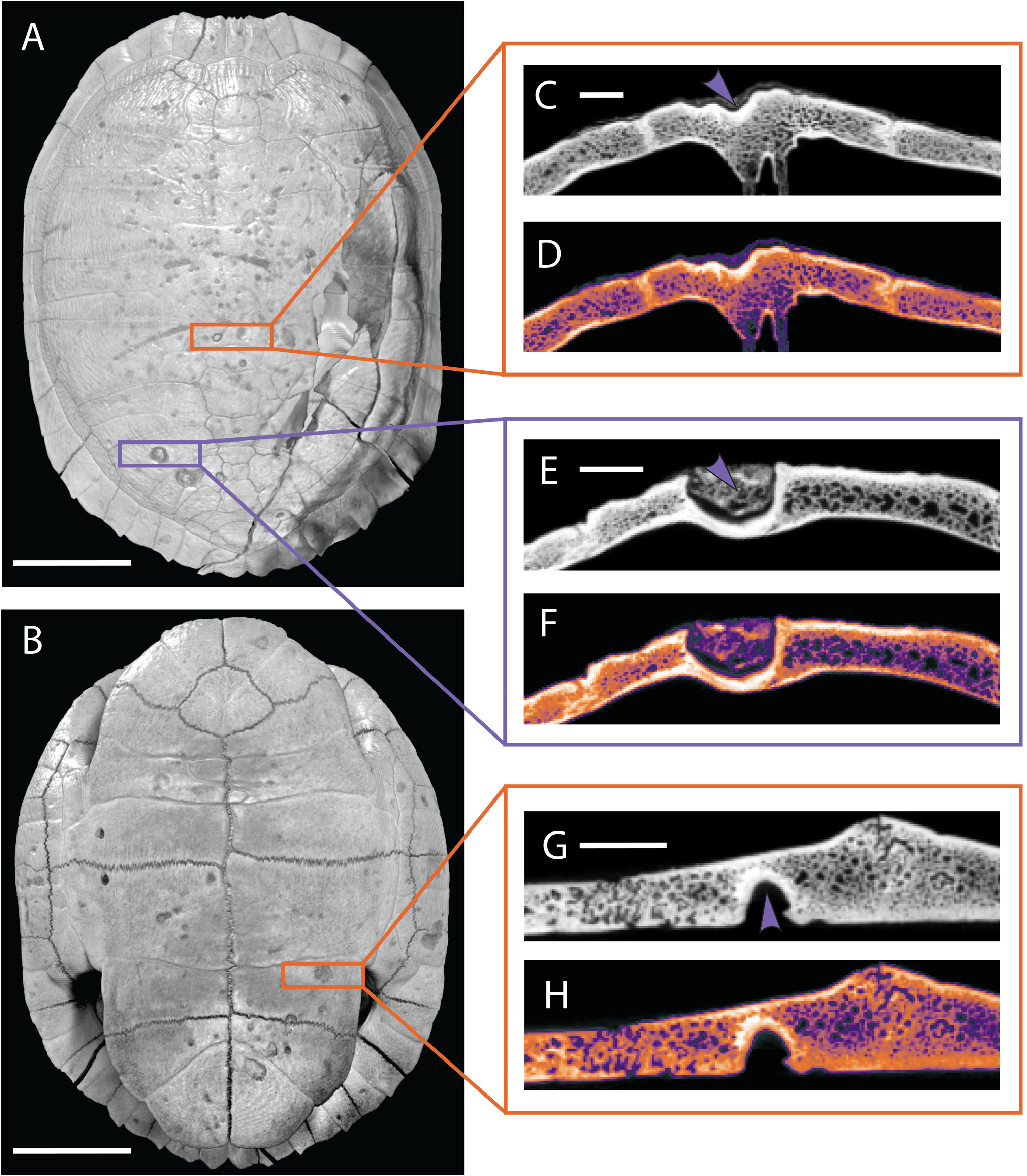
The modern bite marked specimen (Figure 1: SAAF Trachemys) is 24.5 cm long and 19 cm wide. Some of the keratinous scutes are still in place, especially on the carapace, which obscures some of the underlying individual tooth marks in the bone (Figure 1 A). A line of serial bite marks is associated with a radiating fracture that extends from midline on the posterior margin of the carapace anteriorly roughly two-thirds the length of the shell, angling to the right and terminating roughly halfway between the shell’s midline and its right lateral margin. Smaller, associated fractures radiate from this main break, one propagating posterolaterally towards the right margin of the shell and others forming a concentric, depressed region along the right margin of the longest fracture. A 44.61 mm by 15.19 mm D-shaped fragment of the carapace was displaced and lost some time prior to collection. Four individual tooth marks (widths of 3.59 mm, 4.87 mm, 5.03 mm, 6.11 mm) are visible along the margin of this break, but the fracture, the ventral displacement of the right margin along that break, and the missing fragment of bone make reliable measurements of each tooth mark problematic. A single, bisected puncture (7.41 mm long by 4.70 mm wide) is present roughly 3.5 cm from the shell’s right margin and 4.5 cm posterior to the anteriormost edge. This rounded, slightly fusiform puncture is approximately aligned with the others, 5 cm anterior to the termination of the break. On the plastron, four additional punctures occur 2 cm medial to the right bridge (Figure 1 B). The anteriormost and posteriormost of these serial marks are shallow pits, and the two centrally situated marks are deeper bisected punctures, measuring from anterior to posterior 4.33 mmby 3.07 mm and 4.63 mm by 3.16 mm (Figure 8 A). The spacing between these four marks, again progressing anterior to posterior and measured from the center of each depression, are: 17.53 mm, 19.18 mm, and 18.70 mm. The positions of these serial marks suggest they were formed concurrently with the serial marks on the carapace because they are aligned with one another on opposing sides of the shell. The size and spacing of these serial marks are consistent with the dentition of the crocodylian that had shared the turtle’s enclosure: Mecistops cataphractus. An additional bisected pit (2.98 mm by 2.48 mm) is present along the plastron’s midline roughly 6 mm to the right of the suture. At least three additional marks, two punctures and one pit, are present near the posterior edge of the plastron. The pit, measuring 3.70 mm by 1.97 mm with no obvious bisection, is located just posterior to the right bridge of the shell and may be associated with the serial bite marks described above. The two punctures are situated on the left side of the plastron. The larger of these is broadly oval shaped with an apparent drag-out mark. Taken together, the total maximum length of that mark is 7.84 mm by 4.32 mm wide. The second puncture is positioned roughly 13 mm lateral to the first and measures 3.90 mm by 3.41 mm with an incomplete bisection in the form of a single notch associated with the impacting tooth’s carina on the anterior margin of the long axis of the trace. There are regions of this plastron that may also preserve shell disease (Figure 1 B), one sub-rounded area roughly 29 mm medial to the anteriormost of the serial marks, one 22 mm posterior to the set of two punctures, and a clustering of circular depressions along the right side of the midline, from the center of the plastron towards the posterior margin of the shell. All affected areas are sub-rounded and lack obvious crushing or impact trauma. As such, we tentatively identify these as shell disease, which does commonly affect this taxon (Garner et al., 1997; Zonneveld and Bartels, 2022). Internal morphologies show that marks appear V- or U-shaped in cross section, tapering to a rough point. A thick band of compressed cortical bone underlies all punctures (Figure 1 C- 1 H). These bands are visible in plain CT data, and variation in bone density is further highlighted in the LUT heatmap, where compressed regions are consistently expressed as a lighter color than the rest of the surrounding bone tissue (Table 3). Breakage and fracture points also show signs of bone compression, but not to the extent found with individual V-shaped marks. An extreme case in SAAF shows a large, U-shaped puncture located on the carapace exhibiting significant bone compression, enough so that the internal arch of the carapace is bowing inwards. This puncture is surrounded by a thick line of white and bright orange when viewed in LUT heatmap settings.
Nama-nama ilmiah lain yang pernah digunakan untuk Trachemys scripta dalam literatur taksonomi.
| Nama Sinonim | Otoritas | Status |
|---|---|---|
| ? scripta | Schoepff, 1792 | SYNONYM |
| Chrysemys elegans | Bergounioux, 1958 | SYNONYM |
| Chrysemys scripta | (Schoepff, 1792) | SYNONYM |
| Emys cumberlandensis | Holbrook, 1840 | SYNONYM |
| Emys elegans | Wied, 1839 | SYNONYM |
| Emys holbrooki | Gray, 1844 | SYNONYM |
| Emys sanguinolenta | Gray, 1855 | SYNONYM |
| Emys troosti | Holbrook, 1836 | SYNONYM |
| # | Provinsi | Catatan | % |
|---|---|---|---|
| 1 | Bali | 9 | 40.9% |
| 2 | DKI Jakarta | 5 | 22.7% |
| 3 | Jawa Barat | 2 | 9.1% |
| 4 | Jawa Timur | 2 | 9.1% |
| 5 | Jambi | 1 | 4.5% |
| 6 | Kepulauan Riau | 1 | 4.5% |
| 7 |
Jumlah catatan observasi Trachemys scripta di Indonesia per tahun
Trachemys scripta
Foto: Tarkhnishvili, David;Iankoshvili, Giorgi;Seropian, Armen;Kachlishvili, Nino;Todua, Mariami
Trachemys scripta
Foto: Drumheller, Stephanie K.;Maddox, Hannah;Stocker, Michelle R.;Noto, Christopher R.
Trachemys scripta
Foto: Drumheller, Stephanie K.;Maddox, Hannah;Stocker, Michelle R.;Noto, Christopher R.
Trachemys scripta
Foto: Figueroa, Alex;Low, Martyn E. Y.;Lim, Kelvin K. P.
| Nama | Bahasa | Sumber |
|---|---|---|
| Buchstaben-Schmuckschildkröte | Jerman | List of Invasive Alien Species of Union concern |
| Buchstabenschmuckschildkröte | Jerman | Catalogue of Life |
| Common Slider | Inggris | Checklist of Vermont Species |
| Common slider turtle | Inggris | Catalogue of Life |
| Cumberland Slider | - | Catalogue of Life |
| Cumberland Slider Turtle | Inggris | Catalogue of Life |
| Cumberland-Schmuckschildkröte (troosti) | Jerman | Catalogue of Life |
| Gelbwangenschmuckschildkröte (T. s. scripta) | Jerman | Catalogue of Life |
Berdasarkan data 22 observasi, Bali adalah provinsi dengan catatan Kura-kura Brazil (Trachemys scripta) terbanyak — 9 observasi (40.9% dari total catatan di Indonesia). Spesies ini tersebar di 8 provinsi.
Catatan pertama Kura-kura Brazil (Trachemys scripta) di Indonesia tercatat pada tahun 2011. Hingga kini terdapat 22 catatan dari 8 provinsi, yang dihimpun dari survei lapangan, koleksi museum, dan platform citizen science.
Menurut IUCN Red List, Kura-kura Brazil (Trachemys scripta) berstatus "Risiko Rendah" (kode LC). Status ini mencerminkan tingkat risiko kepunahan global spesies, bukan khusus Indonesia.
Di Indonesia dan Malaysia, Trachemys scripta dikenal dengan beberapa nama lokal: Kura-kura Brazil. Penamaan dapat berbeda antardaerah dan bahasa.
Ya, Trachemys scripta memiliki 12 nama sinonim ilmiah, di antaranya: ? scripta, Chrysemys elegans, Chrysemys scripta. Nama sinonim adalah nama-nama lain yang pernah digunakan untuk spesies yang sama dalam literatur taksonomi.
Trachemys scripta diklasifikasikan sebagai berikut: Kingdom Animalia, Phylum Chordata, Class Testudines, Family Emydidae, Genus Trachemys. Spesies ini dideskripsikan oleh (Thunberg In Schoepff, 1792).
Sumber: Differentiating convergent pathologies in turtle shells using computed tomographic scanning of modern and fossil bone
Singapore conservation status. Not Applicable. Conservation priority. None, non-native species. IUCN conservation status. Least Concern [2011].
Sumber: Singapore’s herpetofauna: updated and annotated checklist, history, conservation, and distribution
(Figure 8 G; Punggol Point Jetty)
Sumber: Singapore’s herpetofauna: updated and annotated checklist, history, conservation, and distribution
Occurrence. Ubiquitous. Common.
Sumber: Singapore’s herpetofauna: updated and annotated checklist, history, conservation, and distribution
| Emys vittata | Gray, 1831 | HETEROTYPIC_SYNONYM |
| Pseudemys elegans | Force, 1928 | SYNONYM |
| Pseudemys grayi | — | SYNONYM |
| Pseudemys scripta | (Schoepff, 1792) | SYNONYM |
| DI Yogyakarta |
| 1 |
| 4.5% |
| 8 | Kalimantan Timur | 1 | 4.5% |
| Hicotea; Icotea; Jicotea |
| Spanyol |
| Catalogue of Life |
| Icotea | Spanyol | Catalogue of Life |
| Jicotea de orejas rojas | Spanyol | Catalogue of Life |
| Korytnačka písmenková | slk | Catalogue of Life |
| Kura-kura Brazil | Indonesia | Catalogue of Life |
| Kırmızı Yanaklı Su Kaplumbağası | tur | Catalogue of Life |
| Nordamerikanische Buchstaben-Schmuckschildkröte | Jerman | Catalogue of Life |
| Nordamerikansk terrapin | dan | Catalogue of Life |
| Pond Slider | Inggris | Martha's Vineyard species checklist |
| Popisana sklednica | slv | Catalogue of Life |
| Punakõrv-ilukilpkonn | est | Catalogue of Life |
| Raštuotasis vėžlys | lit | Catalogue of Life |
22 titik observasi Trachemys scripta di Indonesia
Memuat peta...
Setiap titik merepresentasikan satu lokasi observasi yang tercatat. Klik titik untuk melihat detail.