Deskripsieng
Additional specimen: AMS I. 34501010 (1: 15.6), off Wailiti, 11 km NW Sao Wisata Resort, Flores, Indonesia, 08 ° 34.3 ’ S, 122 ° 11.7 ’ E.
Sumber: Ecsenius caeruliventris and E. shirleyae, two new species of blenniid fishes from Indonesia, and new distribution records for other species of Ecsenius
Deskripsieng
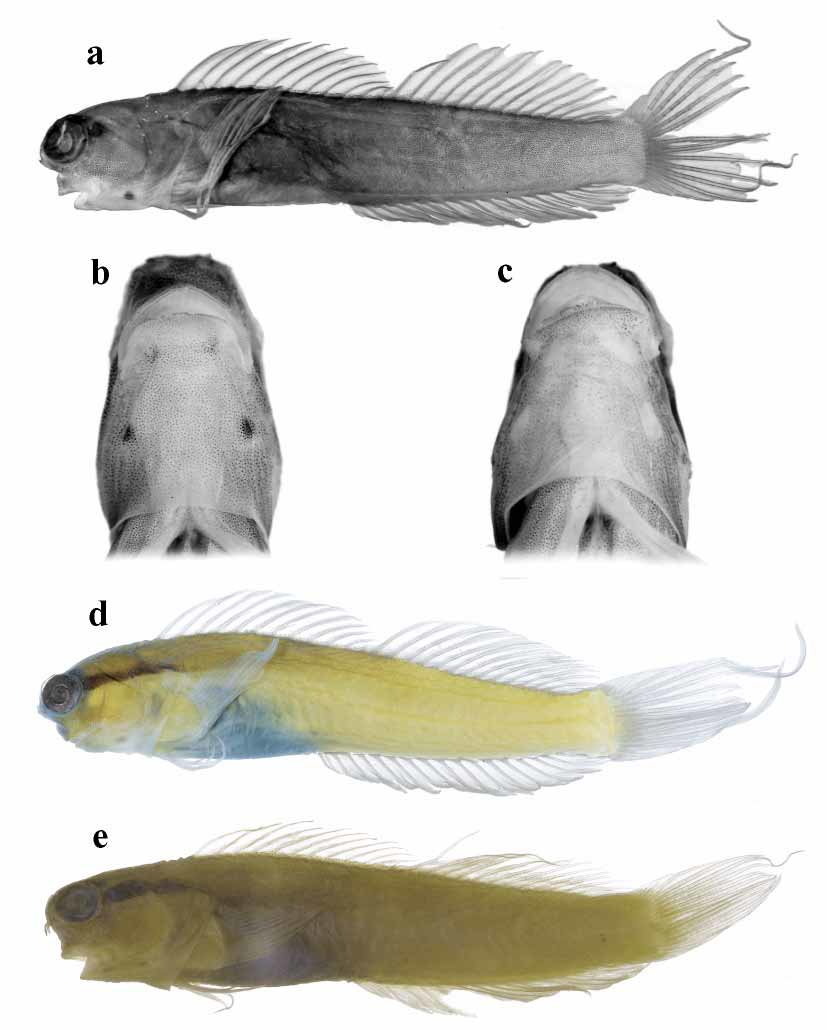
Description (only differentiating characters or characters not otherwise mentioned in the introduction, identification key, and Table 1 are discussed). Preserved specimens (Figure 1 d) are most notable for the black stripe extending across the head posteriorly from the postorbital margin at about the three o’clock position. The stripe may extend for a variable, usually short, distance, onto the body anteriorly. On each side of the ventral surface of the head of the male holotype there are two pairs of dark spots similar to those of E. caeruliventris, although the halo is not evident (presence or absence of the spots varies in other males). The body is not so darkly dusky anteriorly as in E. caeruliventris. The fins are similar to those of E. caeruliventris, except that an immaculate stripelike basal area in the segmentedray portion of the dorsal fin is not evident. Females are generally more pale than males, and the dark spots on the ventral head surface are absent or replaced by one or two pairs of larger, pale spots (Figure 1 c) in the positions occupied by the dark spots of the male. In life (Figure 2 b), the most obvious color markings are the bluish abdominal area, a horizontal pair of white stripes extending through the orbit dorsal and ventral to the pupil, a pair of small white spots in the interorbital region anteriorly, a fine, white midpredorsal stripe (all of these white stripes may be very faintly tinged with yellow), the black stripe extending posteriorly from the orbit margined ventrally by a bright white stripe, which continues well out onto the body. The head and body are brownish dorsal to the black stripe, and may show indications of a few broad, slightly darker bands anteriorly; posteriorly the body is similar to E. caeruliventris. Comparisons. Within the Prooculis group, Ecsenius shirleyae appears to be most similar to E. bimaculatus Springer, from which it differs mainly in lacking the two black abdominal spots and in that some individuals have a bluish abdomen. It is similar to E. caeruliventris and E. bandanus in having a bluish abdomen (at least in some specimens), in having broad, faintly dusky bands on the body, and in lacking distinct dark spots or stripes on the entire body. It differs from both species in having a dark postorbital stripe that frequently extends well out onto the body and in having the stripe margined below by a white stripe that also extends well out onto the body. It further differs from E caeruliventris in that the blue of the abdomen is not as strongly manifested, and from E. bandanus in that the pale markings on the head and eye are bright white (or very faintly tinged with yellow) rather than bright yellow, and that the head portion of the dark postorbital stripe is generally less deep (depth measurement is difficult because margins of the stripe are not sharply demarcated, but the difference is usually apparent when specimens of equal size are compared).