Dipublikasikan dalam: J. Asiat. Soc. Bengal vol.15 p.183
Total Catatan di Indonesia
0
Provinsi Ditemukan
0
dari 38 provinsi
Catatan Pertama
0
tahun pertama tercatat
Tren Tahunan
+0%
+0.0% vs 2012
Cantor's Leaf-nosed Bat (Hipposideros galeritus) termasuk dalam famili Hipposideridae, ordo Chiroptera, kelas Mammalia. Berdasarkan data yang terhimpun, spesies ini telah tercatat sebanyak 243 kali di Indonesia, tersebar di 7 provinsi. Catatan pertama tercatat pada tahun 1884.
Kepulauan Bangka Belitung merupakan provinsi dengan catatan observasi terbanyak untuk spesies ini, dengan 87 catatan (35.8% dari total). Data distribusi ini mencerminkan akumulasi dari berbagai kegiatan survei, penelitian, dan kontribusi citizen science. Pola distribusi yang tercatat mungkin tidak sepenuhnya menggambarkan persebaran alami spesies, karena dipengaruhi oleh intensitas pengamatan di masing-masing wilayah.
Tren observasi tahunan Hipposideros galeritus relatif stabil pada periode terakhir dibanding tahun sebelumnya, dengan catatan pertama pada tahun 1884.
Informasi Tambahan
Catatan deskriptif tentang Hipposideros galeritus dari sumber literatur primer (via GBIF).
Distribusieng
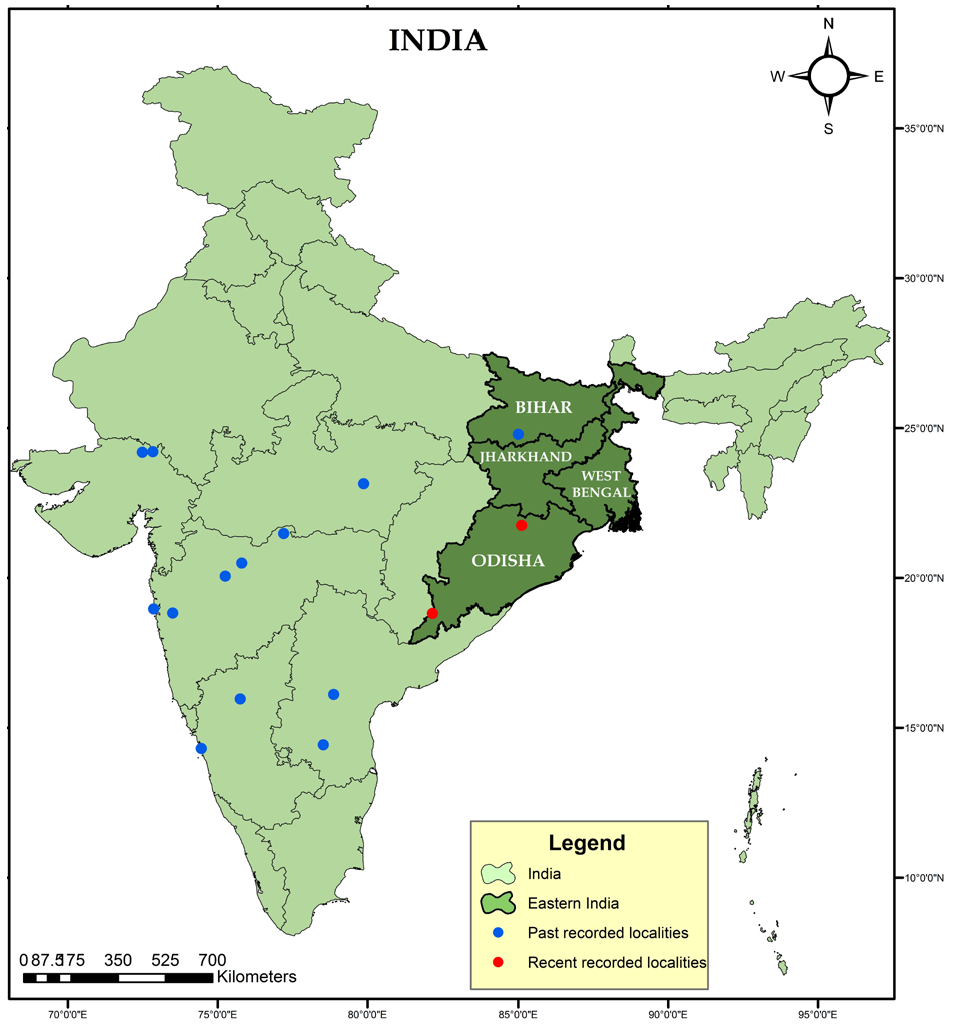
Occurrence of this microchiropteran species from Odisha has presumably been overlooked by previous workers. The lack of systematic surveys in many parts of Odisha and the Eastern Ghats has resulted in a biased understanding of distribution of many species across the Indian subcontinent, which is evident from the recent faunal inventories (Mohapatra et al. 2010, 2014; Agarwal et al. 2013; Debata et al. 2013; Palei 2014). In the present note herewith we are reporting occurrence of the species for the first time from Odisha from two localities namely Bonai and Gupteswar area with additional distribution records in eastern India. We recommend that the chiropteran diversity of Odisha be assessed, and targeted surveys be carried out for further inventories, particularly in the Eastern Ghats.
Sumber: Additional records of Cantor’s Leaf-Nosed Bat Hipposideros galeritus Cantor, 1846 (Mammalia: Chiroptera: Hipposideridae) in eastern India: Odisha
Konservasieng
Conservation: IUCN 2003 and IUCN / SSC Action Plan (2001) – Lower Risk (lc).
Sumber: Order Chiroptera - Family Hipposideridae
Distribusieng
Distribution: Sri Lanka and India through SE Asia (including Burma, Thailand, and Peninsular Malaysia) to Java and Borneo; Sanana Isl (Sula Group, Moluccas Isls). A record from Bali is possibly erroneous; see Kock and Dobat (2000).
Sumber: Order Chiroptera - Family Hipposideridae
Sinonim Ilmiah
Nama-nama ilmiah lain yang pernah digunakan untuk Hipposideros galeritus dalam literatur taksonomi.
Foto: Tu, Vuong Tan;Furey, Neil M.;Koyabu, Daisuke;Arai, Satoru;Görföl, Tamás;Ngon, Lam Quang;Nojiri, Taro;Fukui, Dai;Csorba, Gábor;Balvín, Ondřej;Tuan, Le Quang;Tuan, Tran Anh;Hang, Chu Thi;Hanh, Le Minh;Thi, Van Anh Le;Thien, Huynh Huu;Hassanin, Alexandre
Hipposideros galeritus
Foto: Tu, Vuong Tan;Furey, Neil M.;Koyabu, Daisuke;Arai, Satoru;Görföl, Tamás;Ngon, Lam Quang;Nojiri, Taro;Fukui, Dai;Csorba, Gábor;Balvín, Ondřej;Tuan, Le Quang;Tuan, Tran Anh;Hang, Chu Thi;Hanh, Le Minh;Thi, Van Anh Le;Thien, Huynh Huu;Hassanin, Alexandre
Hipposideros galeritus
Foto: Tu, Vuong Tan;Furey, Neil M.;Koyabu, Daisuke;Arai, Satoru;Görföl, Tamás;Ngon, Lam Quang;Nojiri, Taro;Fukui, Dai;Csorba, Gábor;Balvín, Ondřej;Tuan, Le Quang;Tuan, Tran Anh;Hang, Chu Thi;Hanh, Le Minh;Thi, Van Anh Le;Thien, Huynh Huu;Hassanin, Alexandre
Hipposideros galeritus
Foto: Tu, Vuong Tan;Furey, Neil M.;Koyabu, Daisuke;Arai, Satoru;Görföl, Tamás;Ngon, Lam Quang;Nojiri, Taro;Fukui, Dai;Csorba, Gábor;Balvín, Ondřej;Tuan, Le Quang;Tuan, Tran Anh;Hang, Chu Thi;Hanh, Le Minh;Thi, Van Anh Le;Thien, Huynh Huu;Hassanin, Alexandre
Hipposideros galeritus
Foto: Tu, Vuong Tan;Furey, Neil M.;Koyabu, Daisuke;Arai, Satoru;Görföl, Tamás;Ngon, Lam Quang;Nojiri, Taro;Fukui, Dai;Csorba, Gábor;Balvín, Ondřej;Tuan, Le Quang;Tuan, Tran Anh;Hang, Chu Thi;Hanh, Le Minh;Thi, Van Anh Le;Thien, Huynh Huu;Hassanin, Alexandre
Hipposideros galeritus
Foto: Don E. Wilson;Russell A. Mittermeier
Hipposideros galeritus
Foto: Don E. Wilson;Russell A. Mittermeier
Hipposideros galeritus
Foto: FAISAL ALI ANWARALI KHAN;VICKI J. SWIER;SERGIO SOLARI;PETER A. LARSEN;BESAR KETOL;WAHAP MARNI;SIVANATHAN ELLAGUPILLAY;MAKLARIN LAKIM;MOHAMMAD TAJUDDIN ABDULLAH;ROBERT J. BAKER
Hipposideros galeritus
Foto: Thomas, Nikky M.;Duckworth, J. W.;Douangboubpha, Bounsavane;Williams, Meredith;Francis, Charles M.
Nama Vernakular
Nama
Bahasa
Sumber
Barong Penang
-
Catalogue of Life
Cantor's Leaf-nosed Bat
Inggris
Catalogue of Life
Cantor's Roundleaf Bat
Inggris
Hipposideridae
Cantor's roundleaf bat
Inggris
Integrated Taxonomic Information System (ITIS)
Cantor-Rundblattnase
Jerman
Catalogue of Life
Cantora Patanak Chamchika
ben
Catalogue of Life
Cantor’s Leaf-nosed Bat
Inggris
Hipposideridae
Hiposidérido de Cantor
-
Hipposideridae
Phyllorhine de Cantor
Pertanyaan Umum
Berdasarkan data 243 observasi, Kepulauan Bangka Belitung adalah provinsi dengan catatan Cantor's Leaf-nosed Bat (Hipposideros galeritus) terbanyak — 87 observasi (35.8% dari total catatan di Indonesia). Spesies ini tersebar di 7 provinsi.
Catatan pertama Cantor's Leaf-nosed Bat (Hipposideros galeritus) di Indonesia tercatat pada tahun 1884. Hingga kini terdapat 243 catatan dari 7 provinsi, yang dihimpun dari survei lapangan, koleksi museum, dan platform citizen science.
Menurut IUCN Red List, Cantor's Leaf-nosed Bat (Hipposideros galeritus) berstatus "Risiko Rendah" (kode LC). Status ini mencerminkan tingkat risiko kepunahan global spesies, bukan khusus Indonesia.
Ya, Hipposideros galeritus memiliki 1 nama sinonim ilmiah, di antaranya: Phyllorhina galerita. Nama sinonim adalah nama-nama lain yang pernah digunakan untuk spesies yang sama dalam literatur taksonomi.
Hipposideros galeritus diklasifikasikan sebagai berikut: Kingdom Animalia, Phylum Chordata, Class Mammalia, Order Chiroptera, Family Hipposideridae, Genus Hipposideros. Spesies ini dideskripsikan oleh Cantor, 1846.
Biologi & Ekologi
eng
Echolocation: The constant frequency (CF) component of echolocation calls emitted by our bats ranged between 84 – 85 kHz (Table 2; Appendix 4). As tabulated in Srinivasulu et al. (2025) and our own data, only populations of H. galeritus found in the Thai-Malay peninsula and Bokor National Park, Cambodia (close to the AG 1) are known to emits calls at similar frequencies (80.7 – 92.0 kHz and 86 – 87 kHz respectively), whereas populations elsewhere in mainland Southeast Asia and on Borneo produce significantly higher constant frequency components (typically ≥ 98 – 110 kHz). Genetics: Consistent with previous studies (Francis et al. 2010; Murray et al. 2012; Srinivasulu et al. 2025), our Bayesian trees based on COI and Cytb datasets strongly support the monophyly of Southeast Asian H. galeritus s. l. (PP = 1). In our COI tree, the H. galeritus s. l clade is subdivided into three well-supported geographic subclades (PP = 1): A – insular Sundaic (Borneo (Kalimantan, Indonesia and Sarawak, Malaysia) + Java), B – mainland Sundaic or the Thai-Malay Peninsula, and C — Indochinese comprising Thailand excluding the peninsula, Cambodia, Laos, Vietnam, including our specimens in the VMD. In our Cytb tree, bats from insular Sundaic and Indochinese subregions appeared in two divergent and highly supported lineages (PP = 1) (Figure 6). Genetic divergences based on COI / Cytb sequences within three recognized subclades A, B, C Southeast Asian H. galeritus s. l. are between 0 – 4.9 % / 0.3 – 2.8 %, 0.3 / –, and 0 – 2.7 / 0.2 – 0.9 %, respectively; distances between these clades are between 11.4 – 14.6 % / 10.7 – 11.5 % and comparable with interspecific variations in the Hipposideros genus (Appendix 7).
Sumber: Bats of the Vietnamese Mekong Delta: A revised checklist with significant new records
Deskripsieng
Morphology: Mensural data from our specimens (e. g., FA = 48.1 ± 1.0 mm, range 46.5 – 50.0 mm; CCL = 14.96 mm; Table 2) accord with published measurements for H. galeritus from Vietnam (FA: 45 – 51 mm; CCL: 14.6 – 15.8 mm) (Kruskop 2013) and Southeast Asia (FA: 47.8 ± 1.68 mm; CCL: 14.46 ± 0.28 mm) (Srinivasulu et al. 2025). External characters also match previous descriptions: the noseleaf is broad, covering the entire muzzle. The anterior leaf lacks a medial emargination and possesses two well-developed supplementary leaflets; the proximal leaflets are expanded and fused to form a single, impaired structure surrounding the anterior leaf which considerably exceeds it in width. The intermediate leaf is simple, equal to or wider than the posterior leaf. The posterior leaf is subdivided into four septa. Males possess a frontal sac behind the posterior leaf. The ears are triangularly pointed and the antitragal lobe is subangular, approximately one-third of the ear length. The pelage is thick and soft, dark to reddish brown dorsally, paler ventrally; hairs have pale bases. The muzzle and ears are variably pigmented (Figure 2 B). The skull is small and elongated (GLS = 17.66 mm), with the mastoid width exceeding zygomatic breadth (Table 2). In lateral profile, the skull is elevated over the frontal and parietal regions of the braincase. The sagittal crest is low, moderately developed anteriorly but indistinct posteriorly, extending into the parietal region. The lambdoid crests are weakly developed. The interorbital region is narrow. Three pairs of rostral inflations are present: the anterior rostral chambers are similar in length to the posterior-median rostral chambers. The posterior-lateral chambers are much wider than kidney-shaped posterior-median chambers. The dentition includes robust and tall upper canines; the small first upper premolars (P ²) situated within the toothrow between the upper canines and second upper premolars (P 4); and the crown area of the first lower premolar (P 2) is approximately equal to that of the second lower premolar (P 4) but only about half its height (Figure 3 B).
Sumber: Bats of the Vietnamese Mekong Delta: A revised checklist with significant new records
Biologi & Ekologieng
Habitat. Both dry and wet forests at elevations from sea level up to 1100 m.