Biologi & Ekologieng
Movements, Home range and Social organization. The Island Flying Fox can fly 30 - 50 km / night to forage and will skim within troughs of waves to reduce wind resistance when flying long distances. In Papua New Guinea, it commutes from its day roost on small offshore islands to other small islands to forage but rarely to the mainland unless strong winds make flying seaward difficult. It is gregarious and roosts colonially (up to 5000 individuals) in tall trees with low levels of disturbance but forms smaller colonies throughout much ofits distribution. Colonies are of mixed sexes, including females with dependent young. At day roosts, they rest and wing-flap, and occasionally engage in territorial interactions. In the Philippines, the Island Flying Fox roosts with other flying fox species; in Indonesia and Malaysia, most are single-species colonies. In Milne Bay islands, it sometimes roosts with the Spectacled Flying Fox (P. conspicillatus).
Sumber: Pteropodidae
Konservasieng
Status and Conservation. CITES Appendix II. Classified as Least Concern on The IUCN Red List. Rate of decline throughout the distribution of the Island Flying Fox due to overhunting and ongoing habitat degradation from human activity and climate change is so far less than 30 %. Continued rise in global sea level will result in loss of essential roosting habitat and might result in reclassification as Vulnerable. It is much more rare than in the past due to overhunting and habitat loss. Individuals are normally sold locally, making detection ofillegal killing difficult. Hunters use various methods from guns to nets and fishhooks hanging from lines. There are some resident populations in human-dominant landscapes (orchards and coastal resorts) that has led to conflict and persecution, sometimes resulting in hunting of bats or attempts to expel a colony from the site. Hunting of flying foxes in the Philippines is illegal, except by a few indigenous groups, but hunting is unregulated and therefore continues even today; fruit bat buyers prefer larger species but often buy the relatively small Island Flying Fox.
Sumber: Pteropodidae
Deskripsieng
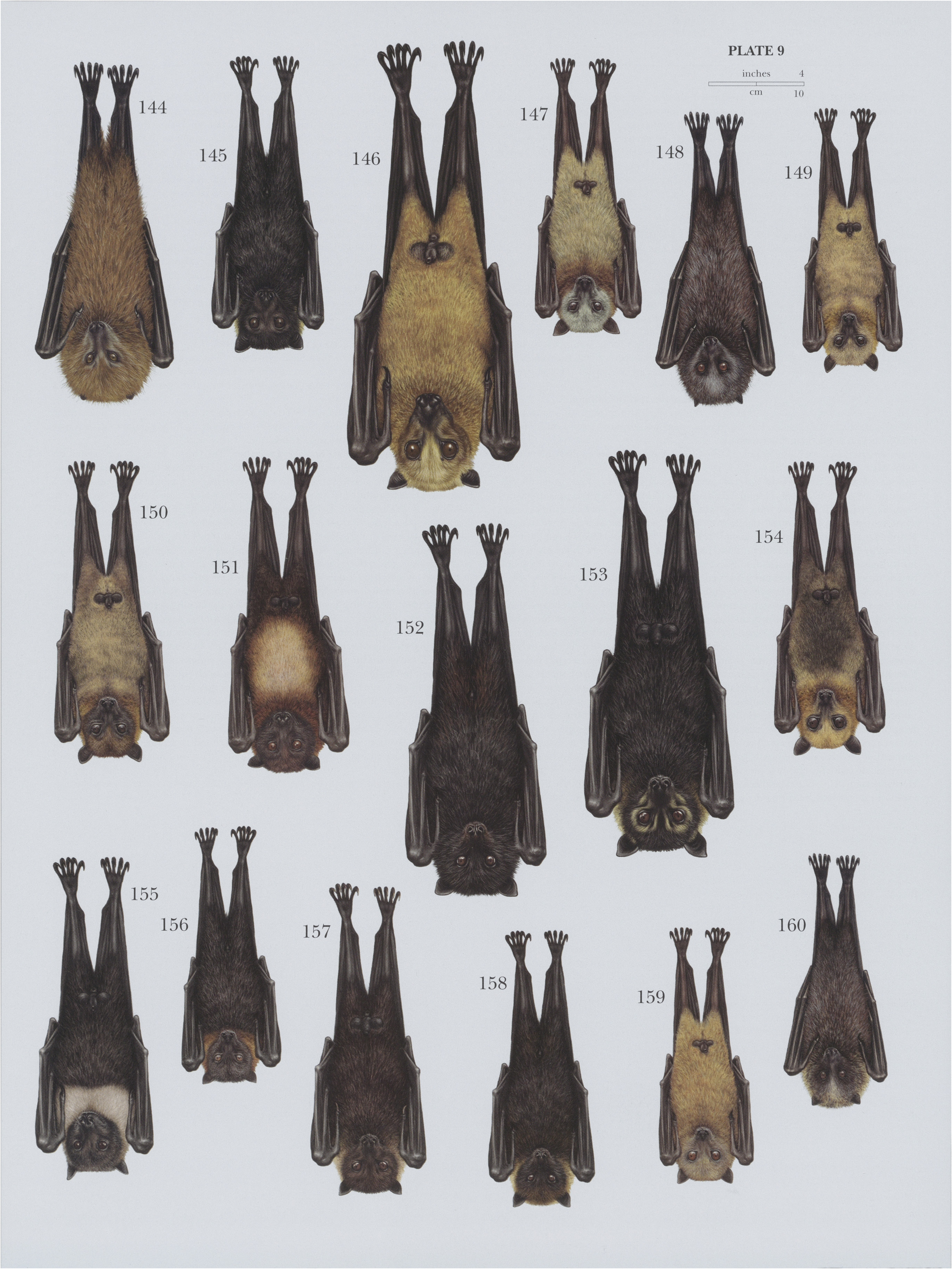
Descriptive notes. Head-body 194 - 225 mm (tailless), ear 24 - 27 mm, hindfoot 52 - 68 mm, forearm 125 - 145 mm; weight 300 - 420 g. Wingspans are 1000 - 1200 mm, depending on subspecies. Greatest lengths of skulls are 59 - 69 mm and tibias 56 - 62 mm. The Island Flying Fox is highly variable, with robust skull and laterally compressed rostrum. Forearm length and body mass vary among subspecies and geographical regions, but subspecific variations is primarily in color. Ears are somewhat broad and rounded. Fur is short and adpressed on back and humerus, with some longer hairs in middle of back. Tibia is naked. Base offur is dark brown. Wing membranes are brown and attach near spine. Subspecies in eastern end ofits distribution (hypomelanus, luteus, and macassaricus) have dark brown backs and pale to ocherous bellies; luteus is considerably paler brown on front and back of body, with reddish brown on fore neck and sides of neck and brown head. Western subspecies have varieties of darker fur, some with sprinklings of grayish flecks and other variation in color, such as chestnut, cinnamon, or golden ocherous. Subspecies in the South China Sea area are slightly larger in average size of teeth, and subspecies enganus is significantly smaller in size overall and wholly dark in color. Subspecies geminorum is wholly dark, with two color morphs: one almost without bright colors and the other with grizzled extension of gray and black sprinkling on head, flanks, and sides of chest and belly; this morph might also occur in western and central subspecies. Skull has well-developed postorbital processes, and temporal ridges joined to form sagittal crest. Orbit is rather large. Coronoid is moderate and somewhat sloping. Canines are distinctly recurved, with narrow but distinct cingulum around entire base. Incisors are arranged in semicircle, with gap away from canines. P' is reduced and minute, lost in many adults. Chromosomal complement has 2 n = 38 and FN = 72. Habitat. Secondary and mangrove forests (few records in primary forests) from sea level up to elevations of ¢. 900 m. The Island Flying Fox occurs on species-poor, small islands and primarily roosts on small offshore islands.
Sumber: Pteropodidae
Distribusieng
Recorded at: Johor: Pulau Pemanggil [23]; Terengganu: Pulau Redang [23], Pulau Perhentian [23]; Kedah: Pulau Paya [23]; Pahang: Pulau Tioman [23, 78; 90].
Sumber: A checklist of the bats of Peninsular Malaysia and progress towards a DNA barcode reference library
Distribusieng
New records Middle Andaman Islands: Baratang Island, Neil Island and Karmatang. Previous records North Andaman Islands: Narcondam Island and Barren Island (Andersen, 1912; Aul et al., 2014).
Sumber: Recent surveys of bats from the Andaman Islands, India: diversity, distribution, and echolocation characteristics
Konservasieng
Conservation: CITES – Appendix II. IUCN / SSC Action Plan (1992) – Not Threatened. IUCN 2003 – Lower Risk (lc).
Sumber: Order Chiroptera - Family Pteropodidae