
Deskripsieng
(Figs. 1 – 3, 11 – 13, 15, 16, 24, 25, 30 – 33, 42, 43, 48, 53 – 56, 65, 66)
Sumber: A revision of Scutellera (Hemiptera: Heteroptera: Scutelleridae)
Family Scutelleridae · Order Hemiptera
Data diperbarui secara berkala dari berbagai sumber observasi biodiversitas.
6 titik observasi Scutellera nepalensis di Indonesia
Memuat peta...
Setiap titik merepresentasikan satu lokasi observasi yang tercatat. Klik titik untuk melihat detail.
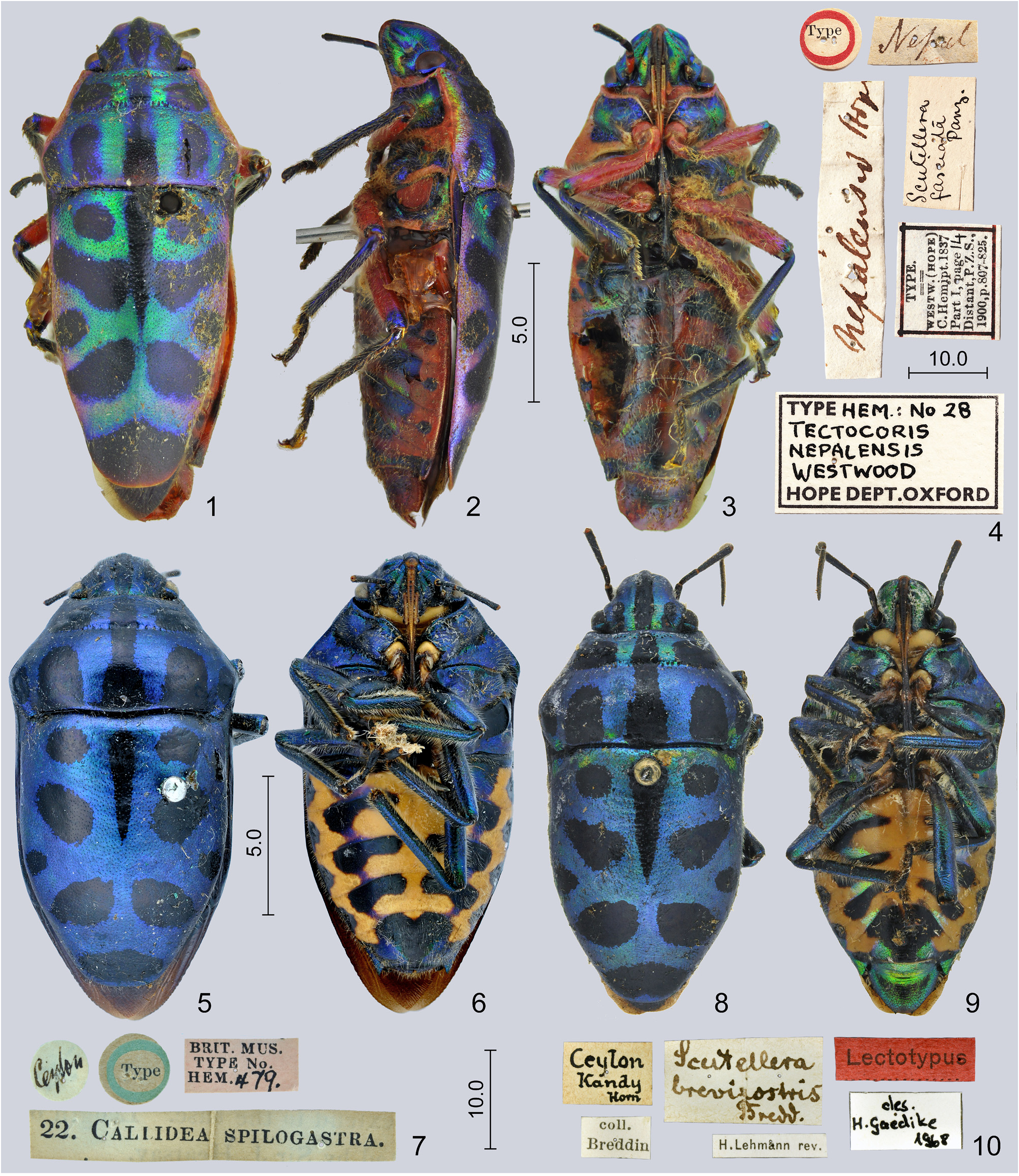
Foto: Rédei, Dávid;Tsai, Jing-Fu
Otoritas penamaan: (Westwood, 1837) (1837)
Status taksonomi: DOUBTFUL
Status konservasi (IUCN): NE Belum Dievaluasi
Total Catatan di Indonesia
0
Provinsi Ditemukan
0
dari 38 provinsi
Catatan Pertama
0
tahun pertama tercatat
Tren Tahunan
-0%
-33.3% vs 2023
Scutellera nepalensis (Scutellera nepalensis) termasuk dalam famili Scutelleridae, ordo Hemiptera, kelas Insecta. Berdasarkan data yang terhimpun, spesies ini telah tercatat sebanyak 55 kali di Indonesia, tersebar di 7 provinsi. Catatan pertama tercatat pada tahun 1881.
Jawa Timur merupakan provinsi dengan catatan observasi terbanyak untuk spesies ini, dengan 32 catatan (58.2% dari total). Data distribusi ini mencerminkan akumulasi dari berbagai kegiatan survei, penelitian, dan kontribusi citizen science. Pola distribusi yang tercatat mungkin tidak sepenuhnya menggambarkan persebaran alami spesies, karena dipengaruhi oleh intensitas pengamatan di masing-masing wilayah.
Tren observasi tahunan Scutellera nepalensis menunjukkan penurunan signifikan (-33%) pada periode terakhir dibanding tahun sebelumnya, dengan catatan pertama pada tahun 1881.
Catatan deskriptif tentang Scutellera nepalensis dari sumber literatur primer (via GBIF).
(Figs. 1 – 3, 11 – 13, 15, 16, 24, 25, 30 – 33, 42, 43, 48, 53 – 56, 65, 66)
Sumber: A revision of Scutellera (Hemiptera: Heteroptera: Scutelleridae)
Redescription. Colour. Dorsum deep metallic blue-green (S. nepalensis nepalensis) (Figs. 1, 2) or purple (S. nepalensis amethystina) (Figs. 11 – 13, 15, 16), with complex and extensive black pattern; a median vitta completely occupying clypeus and extending to base of head and a pair of broad, short sublateral vittae on vertex black; mandibular plates bright orange or at least with considerable reddish or orange iridescence; antenna black, scape brownish or red at least basally; labium orange to reddish, apex of segment II darkened, segments III – IV black; pronotum broadly margined with orange or red laterally, a broad median vitta, a pair of large transverse spots on calli, a pair of large sublateral spots and a pair of small humeral spots on posterior lobe of pronotum black; scutellum with a median vitta from its base to about its middle, gradually tapering posteriad, with a pair of rounded spots at posterior part of basal tumescence, a pair of obliquely transverse fasciae anteriad to middle joining median vitta, a pair of small marginal spots at middle, a pair of broad, obliquely transverse fasciae posteriad to middle approaching or joining posterior extremity of median vitta, and a large apical spot black; exposed portion of fore wing black, its base marginally orange; venter of head and thorax metallic green usually with considerable purplish lustre, base of head posteriad to eyes, lateral margin of propleuron, anterior margin of proepisternum, greatest part of pre-, mes- and metepimeroids together with most of pro-, meso- and metathoracic supracoxal lobes orange or reddish, peritreme of metathoracic scent gland ostiole bright red; coxae, trochanters and most of femora red, an apical annulus on each femora as well as tibiae and tarsi bright metallic green; abdominal venter bright orange, ventrite II greatly black except laterally, small patches surrounding spiracles III – VII black, a pair of broad black fasciae at anterior margins of each of ventrites III – VII (medially confluent on ventrite VII) black with extensive metallic blue-green or coppery areas posteriad of them on segments III – VI; genital capsule and female terminalia greatly red, genital capsule often with a large black spot ventrally. Body elongate, 2.3 – 2.4 times as long as greatest width. Body surface and vestiture as in the redescription of the genus. Pronotum relatively long, 1.6 – 1.7 times as broad as its median length, anterior margin broad, lateral margin nearly straight. Scutellum 1.6 – 1.7 times as long as broad. Membrane slightly exposed beyond apex of scutellum at rest. External male genitalia (Figs. 24, 25, 30 – 33, 42, 43, 48) (described in detail by Tsai et al. 2011). Genital capsule (Figs. 24, 25, 30) subrectangular, boadly transversely truncate posteriorly in dorsal view, minute submedian denticles on posterior margin broadly separated, lateral margin (ventral rim) distinctly emarginate (Figs. 24, 25, 30: arrow), with a pair of blunt tubercles immediately anteriad of concavity; infolding of ventral rim weakly protruding laterally, with a longitudinal ridge along meson adjacent to a pair of submedian depressions; dorsal setal patches situated along dorsal rim, ventral setal patches aside median projection of cuplike sclerite. Paramere (Figs. 31 – 33) with a relatively elongate and weakly curved crown with distal portion enclosing an acute angle with axis of stem. Phallus (Figs. 42, 43, 48): second conjunctival processes with a small, externally partly sclerotized lateral lobe (Figs. 42, 43, 48: cp-II 1) and a large mesal lobe (cp-II 2) (Figs. 42, 43, 48: cp-II 2) terminating in a small, denticle-like sclerotized process; third conjunctival processes (Figs. 42, 43, 48: cp-III) short, irregularly rod-like, apex with a sharp longitudinal edge; distal portion of aedeagus s. str. (Figs. 42, 43, 48: aed) and phallotreme broad. External female genitalia (Figs. 53 – 56, 65, 66). Ovipositor. Laterotergites VIII (Figs. 53 – 55: lt 8) enlarged, forming a pair of strongly protruding, rounded, lobe-like projections (Figs. 53 – 55: arrow) laterad of laterotergites IX; laterotergites IX (Figs. 53, 54: lt 9) obliquely directed, leaving sclerotized sternite X and median part of fused valvifers IX broadly exposed. Gynatrium (Fig. 65: gy) with ring sclerites (Fig. 65: rs) approaching apex of anterolateral pouch; small, paired sclerites posteriad of spermathecal opening fused along midline. Spermatheca: proximal duct (Fig. 65: pd) much longer than distal duct (Fig. 65: dd) and conspicuously longer than longitudinal diameter of dilation (Fig. 65: dil). Measurements (in mm). Body length to apex of scutellum 15.5 – 22.0; length of head 3.50 – 4.00, width across eyes 3.75 – 4.40, interocular distance 2.70 – 3.35; lengths of scape 0.95 – 1.05: basipedicellite 0.65 – 0.75: distipedicellite 1.45 – 1.90: basiflagellum 2.25 – 2.60: distiflagellum 2.20 – 2.40; median length of pronotum 4.00 – 5.50, humeral width 6.80 – 8.70; length of scutellum 10.0 – 13.7, greatest width 6.10 – 8.20. Intraspecific variability. The ground colour of the dorsum is strongly different between the populations in Indo-China (Fig. 1, 2) and the Malay Archipelago (Fig. 11, 12, 15), but it is invariable within each population. Accordingly, two geographic subspecies, S. nepalensis nepalensis and S. nepalensis amethystina, are recognized in the present work. The variability of the black markings of the body is insignificant. Preimaginal stages. Photos of egg batches and / or different larval instars were presented by Kanai & Sameshima (2011), Sameshima (2013) and Yiu & Yip (2012). Habitat, bionomics, economic importance. This species was recorded from oil-seed camellia, Camellia oleifera Abel (Theaceae) (Jiang 1985, Zhang et al. 1987) and persimmon, Diospyros kaki Thunb. (Ebenaceae) (Xiong 1995, Lin et al. 1999) in China. In Taiwan it frequently occurs on bishop wood, Bischofia javanica Blume (Phyllanthaceae) (Miyamoto 1965, Liu & Tseng 2005, Tsai et al. 2011); an invasive population occurring in the Ryūkyū Archipelago was observed on the same host plant (Kanai 2010, 2013, Kanai & Sameshima 2011). Adults and larvae mainly feed on the generative parts of the host plant and frequently aggregate (Kanai & Sameshima 2011, Sameshima 2013). Host plant records presented by Ahmad & Moizuddin (1978) and Ahmad et al. (1979) from Pakistan are based on misidentification and pertain to S. perplexa. No published data are available on its bionomics in the Malay Archipelago, but a specimen from Java examined during the present study was collected on fruits of Malay gooseberry, Phyllanthus acidus (L.) Skeels (Phyllanthaceae). The life cycle of the species was described based on observations in the Ryūkyū Archipelago (Kanai & Sameshima 2011, Sameshima 2013). Egg batches are laid on the leaves of the bishop wood, usually on the lower side, composed of 60 – 70 (Kanai & Sameshima 2011, Sameshima 2013) or up to 78 (our observation) eggs arranged in two rows. Eggs hatch 12 – 13 days after oviposition. First instar larvae aggregate around the empty egg shells without feeding. The postembryonic development is completed in about 28 days (Kanai & Sameshima 2011, Sameshima 2013). Although it was recorded as a pest of persimmon in China (Xiong 1995), it is probably of insignificant economic importance.
| # | Provinsi | Catatan | % |
|---|---|---|---|
| 1 | Jawa Timur | 32 | 58.2% |
| 2 | Sumatera Utara | 9 | 16.4% |
| 3 | Bali | 6 | 10.9% |
| 4 | Sulawesi Utara | 5 | 9.1% |
| 5 | DKI Jakarta | 1 | 1.8% |
| 6 | Jawa Barat | 1 | 1.8% |
| 7 |
Jumlah catatan observasi Scutellera nepalensis di Indonesia per tahun
Scutellera nepalensis
Foto: Rédei, Dávid;Tsai, Jing-Fu
Scutellera nepalensis
Foto: Rédei, Dávid;Tsai, Jing-Fu
Scutellera nepalensis
Foto: Rédei, Dávid;Tsai, Jing-Fu
Scutellera nepalensis
Foto: Rédei, Dávid;Tsai, Jing-Fu
Scutellera nepalensis
Foto: Rédei, Dávid;Tsai, Jing-Fu
Scutellera nepalensis
Foto: Rédei, Dávid;Tsai, Jing-Fu
Scutellera nepalensis
Foto: Rédei, Dávid;Tsai, Jing-Fu
Scutellera nepalensis
Foto: Rédei, Dávid;Tsai, Jing-Fu
Scutellera nepalensis
Foto: Rédei, Dávid;Tsai, Jing-Fu
Scutellera nepalensis
Foto: Rédei, Dávid;Tsai, Jing-Fu
Scutellera nepalensis
Foto: Rédei, Dávid;Tsai, Jing-Fu
Scutellera nepalensis
Foto: Rédei, Dávid;Tsai, Jing-Fu
Berdasarkan data 55 observasi, Jawa Timur adalah provinsi dengan catatan Scutellera nepalensis (Scutellera nepalensis) terbanyak — 32 observasi (58.2% dari total catatan di Indonesia). Spesies ini tersebar di 7 provinsi.
Catatan pertama Scutellera nepalensis (Scutellera nepalensis) di Indonesia tercatat pada tahun 1881. Hingga kini terdapat 55 catatan dari 7 provinsi, yang dihimpun dari survei lapangan, koleksi museum, dan platform citizen science.
Scutellera nepalensis diklasifikasikan sebagai berikut: Kingdom Animalia, Phylum Arthropoda, Class Insecta, Order Hemiptera, Family Scutelleridae, Genus Scutellera. Spesies ini dideskripsikan oleh (Westwood, 1837).
Sumber: A revision of Scutellera (Hemiptera: Heteroptera: Scutelleridae)
Distribution. Scutellera nepalensis is widely distributed in the Sub-Himalayan belt, South China, Indo-China, Taiwan, the Ryūkyū Archipelago, and the Malay Archipelago (Fig. 72); see also under its two subspecies.
Sumber: A revision of Scutellera (Hemiptera: Heteroptera: Scutelleridae)
| Nusa Tenggara Barat |
| 1 |
| 1.8% |