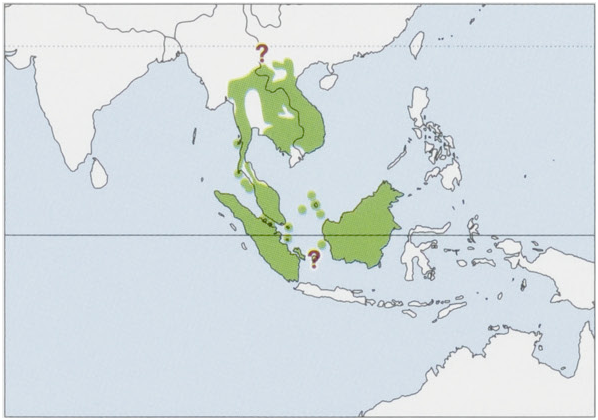
Distribusieng
Distribution: Indochina, Burma (isthmus of Kra), Brunei, Cambodia, China (S Yunnan), Indonesia (Kalimantan, Sumatra, and many small islands), Laos, Malaysia (peninsular Malaya, Sarawak, and many small islands), Singapore, Thailand, and Vietnam.
Sumber: Order Artiodactyla
Distribusieng
Distribution: Brunei Darussalam, Cambodia, Indonesia, Laos, Malaysia, Singapore, Thailand and Vietnam. In Myanmar, recorded in Tanintharyi Region (Htaung Pru RF and Lampi Marine NP).
Sumber: Mammals of Myanmar: an annotated checklist
Biologi & Ekologieng
Habitat. Tall forest in lowlands, amidst undergrowth on edges of heavy lowland forest. It has been suggested that 7. kanchil occurs primarily in hilly areas, but other sources stated that the species was absent from areas above 250 m in Sarawak, whereas 7. napu occurred much higher. This species also occurs in cultivated areas up to 600 m in elevation. The habitat of this species could be described as a mosaic ofriverine, seasonal swamp and dry undulating country, vegetated predominantly by legumes and dipterocarps, with stands of dense bamboo or palms for daytime resting. In Sabah, they also inhabit mangrove forest, and they can be quite common in monocultural tree plantations in a matrix of secondary forest stands. Even though the evidence is somewhat ambiguous, it appears that this species prefers disturbed forests to primary ones. A review of encounter rates in various parts of the species’ range suggested that the distribution of 7. kanchil is perhaps highly patchy and correlated to specific habitat features and microhabitats. What these features are remains unresolved, but their water requirements are important, as authors note commonness in riverine areas with surprising regularity. The habitat use of this species with respect to edge — interior areas shows startling heterogeneity, at least in non-Sundaic areas, but this cannot yet be explained; in particular, disentangling the contributions of intrinsic habitat suitability and the effects of hunting is difficult.
Sumber: Tragulidae
Biologi & Ekologieng
Movements, Home range and Social organization. A study of this species in the Malaysian state of Sabah suggested thatit is mostly solitary, with 93 - 9 % of the observations being single animals and the remainder pairs or a female with one or two young. In apparent contrast with this statement, camera trap photos of the species often show two adult animals together. Further studies are needed to determine the social organization of the species and how this varies spatially as well temporally. Population densities on Borneo were estimated at 21 - 39 ind / km?, with density positively correlated with fruit mass, seed mass, and total fruit resources. The species does not appearto be territorial. The core areas of neighboring animals were completely separate among same-sex individuals, but overlapped widely among opposite-sex individuals. The results suggest that this species is mostly monogamous, although apparently males can also be polygamous. The core area of a paired female overlapped not only with the core area of the paired male, but also with that of another neighboring male. This suggests that males tolerate the presence of females in their core areas and that paired males do not control the movement of paired females into the home ranges of other males. Females establish new home ranges when giving birth. Home range size for females was estimated at 4 - 4 ha and for males 5 - 9 ha using the minimum convex polygon method, but the differ ence between males and females was not significant. Mean daily distance travelled for males was 519 - 1 m (+ 88 - 8 m), that for females 573 - 8 m (+ 219 - 7 m). In a Bornean study area, the density was negatively correlated with pioneer trees, grass, and herbs, suggesting that the species is negatively influenced by the effects of timber harvest, although, as pointed at above, this remains ambiguous. Data from Indochina, suggest that the species is quite tolerant of forest disturbance and may even be considered an edge species that benefits from disturbance. Further studies are needed to elucidate this issue.
Sumber: Tragulidae
Konservasieng
Status and Conservation. Classified as Least Concern on The IUCN Red List, because it remains widespread and locally common, and at least in non-Sundaic areas persists in environments of very heavy forest degradation, fragmentation, and hunting. The presumed short generation length of the species (under five years) also influences assessment. Thus although there may be or may have been drastic local reductions, these have probably not been synchronous over a large enough area. The IUCN review points out several major uncertainties in the conservation status assessment. Firstly, there are few modern records of Tragulus from both the Sundaic and non-Sundaic portions of the range that have been identified conclusively as to species. Secondly, the conflicting nature of the information available concerning the effects of hunting (harvest levels are locally very high) and habitat destruction makes it difficult to estimate population declines. Thirdly, there are strong indications that in its non-Sundaic range (i. e. Asian mainland) it is localized in occurrence, a pattern for which the reasons remain opaque, but which might be the result of hunting. And fourthly, the apparent restriction to lowland forest, at least in Borneo, suggests that with the rapidly dwindling lowland forests in this part ofits range, the species is losing habitat and its range might decrease and become fragmented. The species apparently has become extinct in Bangladesh due to high hunting and trapping pressure, although in many other areas it seems to survive despite local poaching and trapping.
Sumber: Tragulidae
Deskripsieng
Descriptive notes. Head — body 37 - 56 cm, tail 6 - 9 cm; weight 1.5 - 2. 5 kg. Thisis a small chevrotain species that was recently split from 7. javanicus. It is separated from the larger 1. napu primarily by its smaller size, the number of throat stripes, the visibility of the nape line, and the lack of mottling of the upperparts. There is some degree of melanism in 7. kanchil specimens from small islands, leading to the development of extra dark, transverse lines, which makes the throat pattern hard to distinguish from that of 1. napu. The degree of erythrism (reddish pigmentation) and melanism is, however, less pronounced than in 7. napu. Dental formulais 10 / 3, C 1 / 1, P 3 / 3, M 3 / 3 (x 2) = 34.
Sumber: Tragulidae