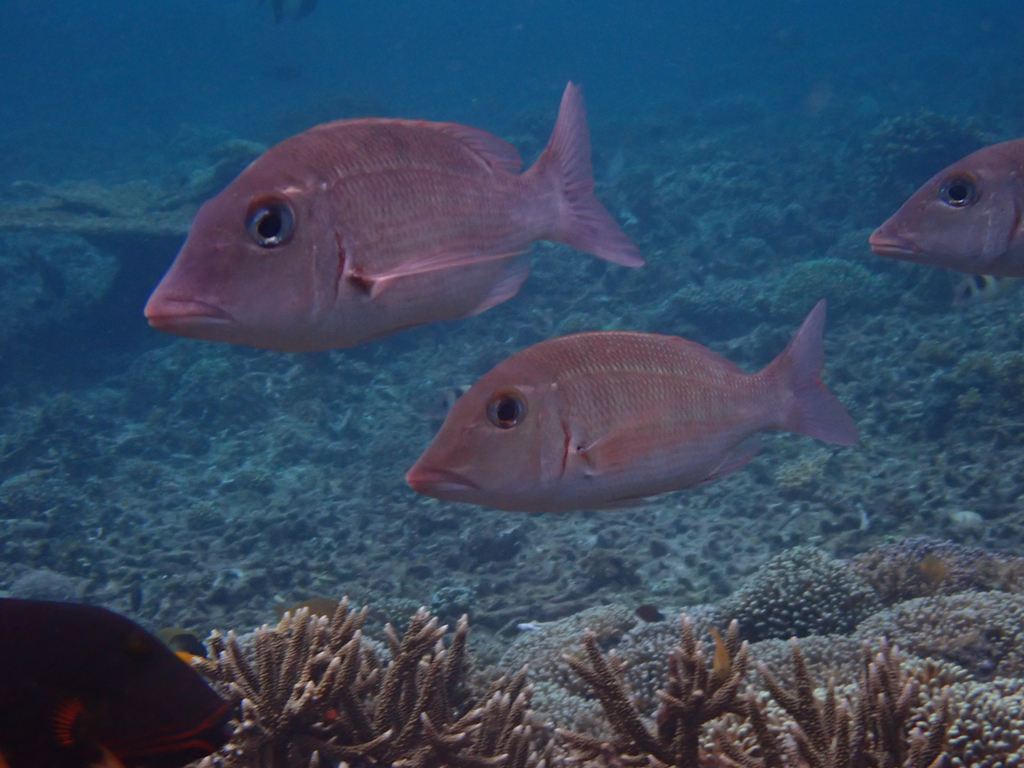
Ecology. Uncommon al Green Island. restricted to shoreline seagrass areas (0.2 - 1.5 m: Cymodocea, fIafodllfe. Thaiassia), occurring over shallow (2 - 4 m) open sand / coral rubble at greater than 100 mm; not appearing site-attached, a single 35 mm individual was observed swimming in a loose multi-species school with similar-sized Siganus juscescens, Halichoeres species (Labridae) and congeners (L. atkinsoni, L. harak, L. obsoletus), periodically picking food items off seagrass blades and adjacent substratum; no aggressive interactions noted, other field behaviours unknown. Field identification. Rarely encountered in the field as early juveniles, a combination of the slender body and snoutprofiles, horizontal shoulderblotch, narrow mid-lateral stripe, ventral diagonal banding and absence of coloured primary stripes may distinguish this species. The intense fin pigmentation characteristic of dead specimens was not noted in field observations, althoughis faintly visible in the colour plate of a 150 mm juvenile given in Myers (1989). During display of the dark mid-lateral stripe pattern, L. olivaceus may be confused with numerous species, particularly L. genivittatus. Individuals may need to be followed for several minutes before other patterns are displayed. Previous descriptions. Kuiter & Debelius (1994) included a colour plate of L. olivaceus (as L. microdon) showing the characteristic horizontal shoulder blotch and ventral banding. A 150 mm juvenile (as L. semicinctus) is shown in Myers (1989, PI. 56 E), displaying the intense shoulder blotch and narrow mid-lateral stripe characteristic of field observations. Lieske & Myers (1994, PI. 53) also figured the L. olivaceus dark mid-lateral stripe pattern.
Sumber: A description of the early juvenile colour patterns of eleven Lethrinus species (Pisces: Lethrinidae) from the Great Barrier Reef, Australia