
Biologi & Ekologieng
Habitat. Primarily primary tropical moist forest from sea level up to an elevation of at least 1800 m.
Sumber: Pteropodidae
Family Pteropodidae · Order Chiroptera
Data diperbarui secara berkala dari berbagai sumber observasi biodiversitas.
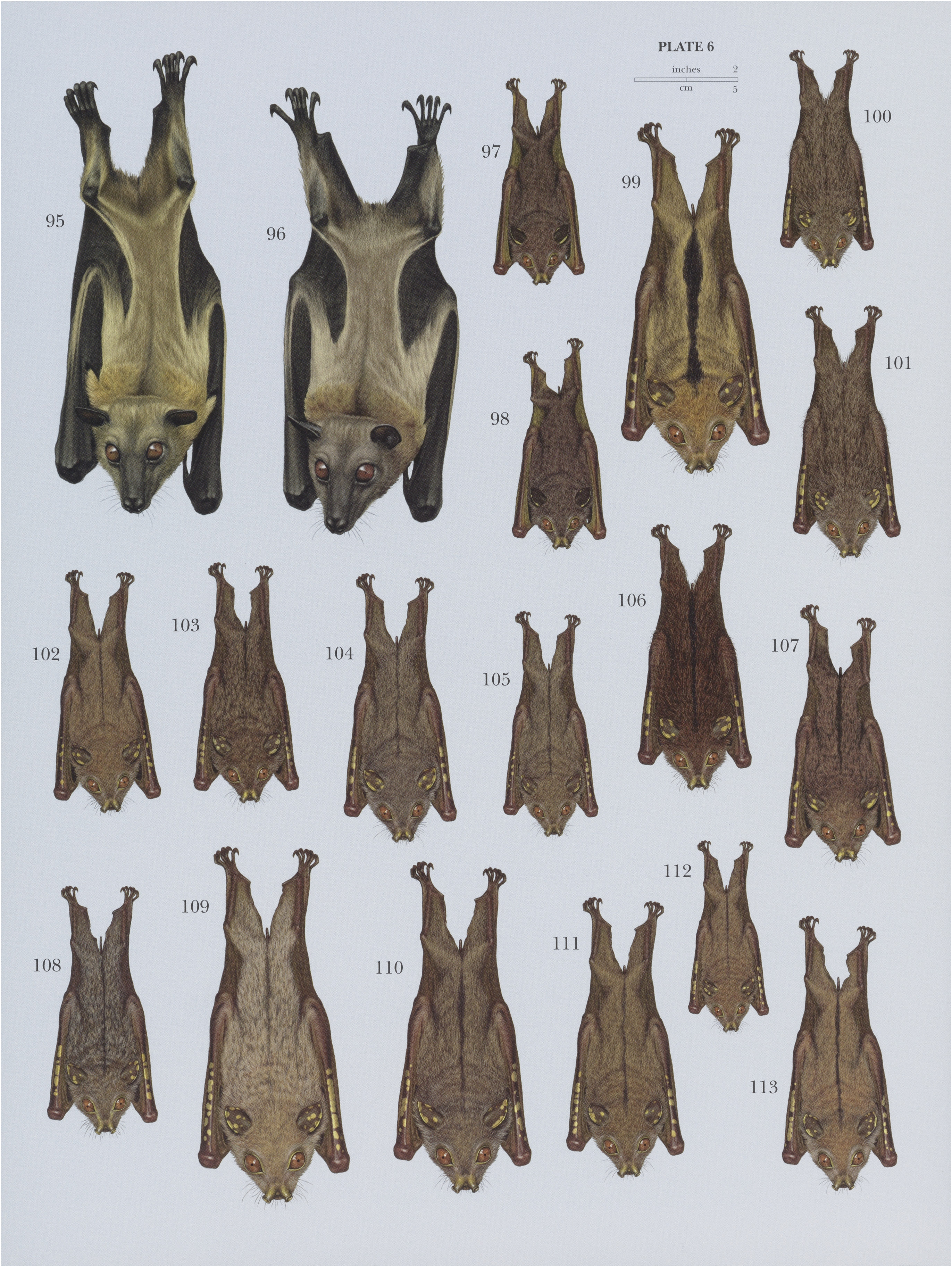
Foto: Don E. Wilson;Russell A. Mittermeier
Otoritas penamaan: (Pallas, 1767) (1767)
Status taksonomi: ACCEPTED
Status konservasi (IUCN): LC Risiko Rendah
Dipublikasikan dalam: Spicil. Zool. vol.3 p.10
Total Catatan di Indonesia
0
Provinsi Ditemukan
0
dari 38 provinsi
Catatan Pertama
0
tahun pertama tercatat
Tren Tahunan
+0%
+0.0% vs 2024
Paniki Pallas (Nyctimene cephalotes) termasuk dalam famili Pteropodidae, ordo Chiroptera, kelas Mammalia. Berdasarkan data yang terhimpun, spesies ini telah tercatat sebanyak 228 kali di Indonesia, tersebar di 7 provinsi. Catatan pertama tercatat pada tahun 1865.
Sulawesi Tengah merupakan provinsi dengan catatan observasi terbanyak untuk spesies ini, dengan 11 catatan (4.8% dari total). Data distribusi ini mencerminkan akumulasi dari berbagai kegiatan survei, penelitian, dan kontribusi citizen science. Pola distribusi yang tercatat mungkin tidak sepenuhnya menggambarkan persebaran alami spesies, karena dipengaruhi oleh intensitas pengamatan di masing-masing wilayah.
Tren observasi tahunan Nyctimene cephalotes relatif stabil pada periode terakhir dibanding tahun sebelumnya, dengan catatan pertama pada tahun 1865.
Catatan deskriptif tentang Nyctimene cephalotes dari sumber literatur primer (via GBIF).
Habitat. Primarily primary tropical moist forest from sea level up to an elevation of at least 1800 m.
Sumber: Pteropodidae
Movements, Home range and Social organization. Pallas’s Tube-nosed Fruit Bats roost alone.
Sumber: Pteropodidae
Status and Conservation. Classified as Least Concern on The IUCN Red List. Pallas’s Tube-nosed Fruit Bat has a relatively wide distribution but is dependent on primary forests. Deforestation seems to be its greatest threat, and it might have disappeared from Timor already due to the near complete loss of primary moist forest on the island. This species is occasionally hunted in some regions and sold as food in markets.
Sumber: Pteropodidae
Descriptive notes. Head-body 87 - 4 - 100 - 6 mm, tail 17 - 8 - 25 - 4 mm, ear 12: 7 - 18 mm, hindfoot 13: 7 - 18 mm, forearm 62 - 2 - 69 - 6 mm; weight 40 - 49 g. Head of Pallas’s Tube-nosed Fruit Bat is broad, with deep face, broad, bluntly pointed ears, and tubular divergent nostrils. Eyes are large, with amberirises. Pelage is thick and woolly. Dorsal pelage is mottled gray and brown (hairs with dark brown bases, pale gray brown middles, and medium brown tips), with distinctive thin dark blackish brown mid-dorsal stripe (3 - 5 - 5 mm thick) stretching from shoulders to rump. Ventral pelage is pale grayish brown, with some yellowish patches. Females generally have paler dorsum than males. There is yellow spotting on forearms, wings, and ears (ears sometimes not spotted); wings are dark brown, with greenish wash. Second digit of wing has a claw, and wing attaches at second digit of foot. Tail is short, black, and wrinkled, and narrow uropatagium connects at base and stretches to calcar at ankles. Claws are brown. Skull and mandible are robust; rostrum is short; incisive foramen to posterior palatal length is shorter relative to postorbital breadth compared with the Common Tube-nosed Fruit Bat (N. albiventer); condylo-basal length is generally longer relative to both rostrum height, interorbital breadth, and cranial height compared with Keast’s Tube-nosed Fruit Bat (N. keasti); lambdoidal and sagittal crests are moderately developed; and margin of posterior palate is a broad U-shape and extends well beyond M'. Single lower incisor is completely deciduous, falling out before adulthood; lower molars are broad and rounded in dorsal view; C, replaces incisors and is long and powerful; and P, is elongated and longer than P, andP,.
Sumber: Pteropodidae
Conservation: IUCN / SSC Action Plan (1992) – Not Threatened. IUCN 2003 – Lower Risk (lc).
Sumber: Order Chiroptera - Family Pteropodidae
Distribution: Indonesia: Sulawesi, Sula Isls; Seram, Boano, Ambon, and Buru Isls (Molucca Isls); extreme S New Guinea and Moa Isl (Australia). Records reported from Timor probably represent keasti; see Kitchener et al. (1995 c). A record from Numfor Isl (off N coast New Guinea) represents an undescribed species, and another undescribed species occurs in the Sangihe Isls (K. Helgen, pers. comm.).
Sumber: Order Chiroptera - Family Pteropodidae
| # | Provinsi | Catatan | % |
|---|---|---|---|
| 1 | Sulawesi Tengah | 11 | 4.8% |
| 2 | Sulawesi Tenggara | 7 | 3.1% |
| 3 | Sulawesi Utara | 5 | 2.2% |
| 4 | Sulawesi Selatan | 3 | 1.3% |
| 5 | Maluku | 3 | 1.3% |
| 6 | Maluku Utara | 2 | 0.9% |
| 7 | Papua Barat | 2 | 0.9% |
Jumlah catatan observasi Nyctimene cephalotes di Indonesia per tahun
Nyctimene cephalotes
Foto: Don E. Wilson;Russell A. Mittermeier
Nyctimene cephalotes
Foto: Don E. Wilson;Russell A. Mittermeier
| Nama | Bahasa | Sumber |
|---|---|---|
| Groothoofdbuisneusvleermuis | Belanda | Catalogue of Life |
| Northern Tube-nosed Bat | Inggris | Catalogue of Life |
| Nyctimeno de Pallas | - | Pteropodidae |
| Nyctiméne a grosse téte | Prancis | Catalogue of Life |
| Nördlicher Röhrennasenflughund | Jerman | Catalogue of Life |
| Pallas's Tube-nosed Bat | Inggris | Catalogue of Life |
| Pallas's Tube-nosed Fruit Bat | Inggris | Order Chiroptera - Family Pteropodidae |
| Pallas-Rohrennasenflughund | Jerman | Catalogue of Life |
| Pallas’s Tube-nosed Bat | Inggris | Catalogue of Life |
| Pallas’s Tube-nosed Fruit Bat | Inggris | Pteropodidae |
| Paniki Pallas | Indonesia | Catalogue of Life |
| Pipistrello della frutta dalle narici a tubo di Pallas | Italia | Catalogue of Life |
| Rurkonos sulaweski | pol | Catalogue of Life |
| Torresian Tube-nosed Bat | Inggris | Catalogue of Life |
| kaloň pikohubý | ces | Catalogue of Life |
| täpläputkikuono | fin | Catalogue of Life |
| Большеголовый трубконосый крылан | rus | Catalogue of Life |
| パラステングフルーツコウモリ | Jepang | Catalogue of Life |
| 북부관코박쥐 | kor | Catalogue of Life |
| 토레스관코박쥐 | kor | Catalogue of Life |
Berdasarkan data 228 observasi, Sulawesi Tengah adalah provinsi dengan catatan Paniki Pallas (Nyctimene cephalotes) terbanyak — 11 observasi (4.8% dari total catatan di Indonesia). Spesies ini tersebar di 7 provinsi.
Catatan pertama Paniki Pallas (Nyctimene cephalotes) di Indonesia tercatat pada tahun 1865. Hingga kini terdapat 228 catatan dari 7 provinsi, yang dihimpun dari survei lapangan, koleksi museum, dan platform citizen science.
Menurut IUCN Red List, Paniki Pallas (Nyctimene cephalotes) berstatus "Risiko Rendah" (kode LC). Status ini mencerminkan tingkat risiko kepunahan global spesies, bukan khusus Indonesia.
Di Indonesia dan Malaysia, Nyctimene cephalotes dikenal dengan beberapa nama lokal: Paniki Pallas. Penamaan dapat berbeda antardaerah dan bahasa.
Nyctimene cephalotes diklasifikasikan sebagai berikut: Kingdom Animalia, Phylum Chordata, Class Mammalia, Order Chiroptera, Family Pteropodidae, Genus Nyctimene. Spesies ini dideskripsikan oleh (Pallas, 1767).
59 titik observasi Nyctimene cephalotes di Indonesia
Memuat peta...
Setiap titik merepresentasikan satu lokasi observasi yang tercatat. Klik titik untuk melihat detail.