Biologi & Ekologieng
Habitat. Tropical rainforests, preferring mature primary forest rather than secondary regrowth forest, subtropical forests, complex notophyll vine forests, and araucarian notophyll vine forests. Queensland Tube-nosed Fruit Bats appear to favor streamside habitats in coastal rainforest and moist eucalypt forests with well-developed understories.
Sumber: Pteropodidae
Biologi & Ekologieng
Movements, Home range and Social organization. Queensland Tube-nosed Fruit Bats primarily roost alone, but they occasionally roost communally in small groups (and there is debate as to which is normal). Roosting sites change often because roosts are chosen opportunistically, but individuals usually remain in the same general small area for months or years. Some individuals roosted in the same tree that they had foraged in the night before. They are generally not aggressive toward one another unless one is holding food, and there is no evidence of territoriality. Individuals kept together in a small space in captivity were generally aggressive toward each other regardless of gender, but one male and one female seemed to get along and even roosted embracing each other. They generally seem to forage alone but have been observed in large congregations in some foraging locations at night.
Sumber: Pteropodidae
Konservasieng
Status and Conservation. Classified as Least Concern on The IUCN Red List. The Queensland Tube-nosed Fruit Bat has a wide distribution and is generally considered common. Its distribution is rather patchy in the south, and its distribution in New Guineais still uncertain. There are no major threats overall, and they are a potential pest in fruit orchards in Australia. Barbed-wire fences are a minor source ofdirect mortality, and they might be affected by habitat loss from agricultural expansion. These problems have resulted in the Queensland Tube-nosed Fruit Bat being listed as vulnerable by the New South Wales Threatened Species Conservation Act.
Sumber: Pteropodidae
Deskripsieng
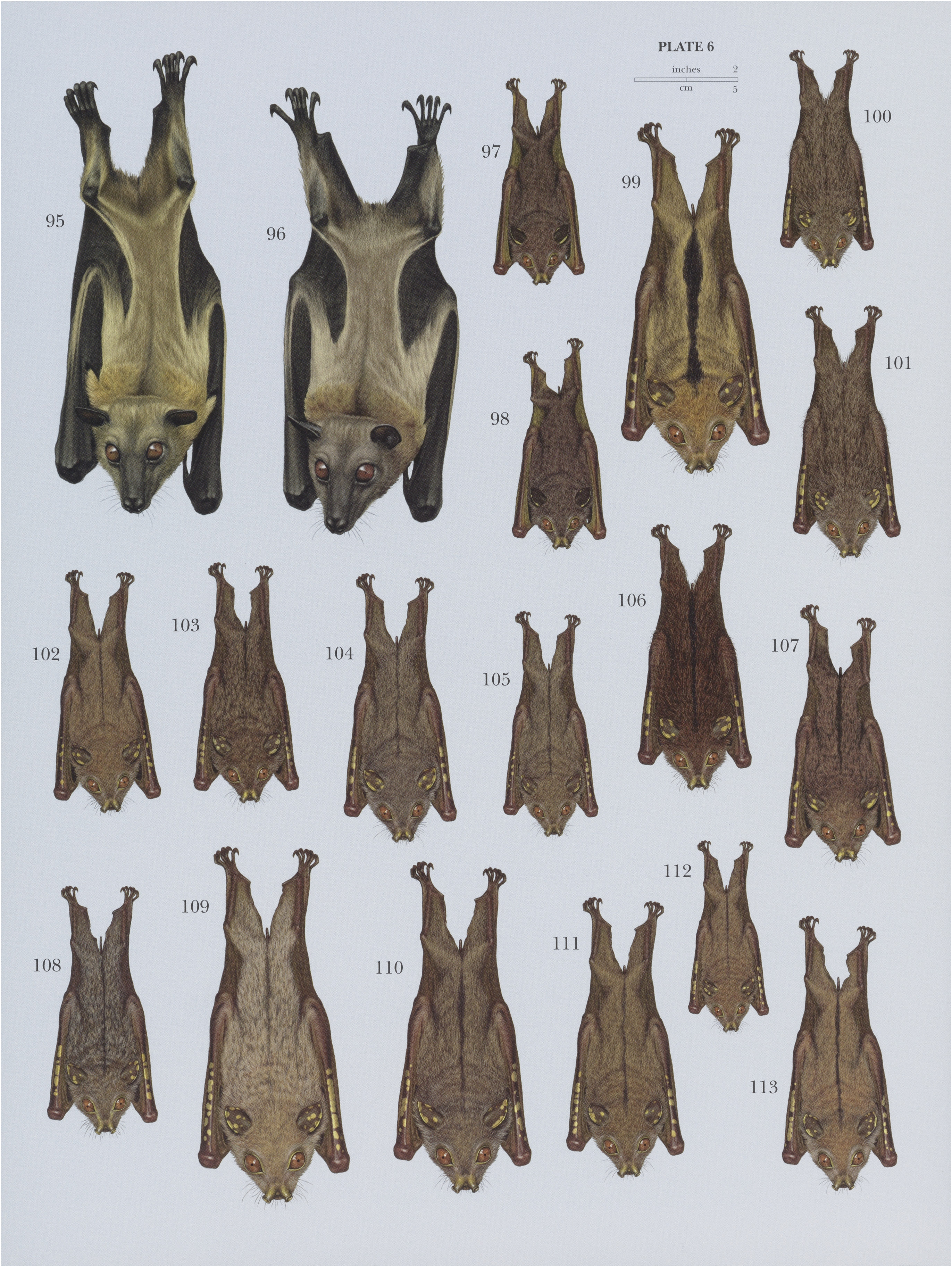
Descriptive notes. Head-body 83 - 93 mm, tail 21 - 24 mm, ear 15 - 8 - 19 - 6 mm, forearm 65 — - 68 - 9 mm; weight 42 - 3 - 59 g. Head of the Queensland Tube-nosed Fruit Bat is broad, with deep face, broad, bluntly pointed ears, and tubular divergent nostrils (that are able to move independently of one another). Eyes are large, with amber irises. Pelage is thick and woolly. Dorsal pelage varies from gray to reddish brown, with distinctive thin dark brown mid-dorsal stripe stretching from head to rump. Ventral pelage is generally paler. Wings are dark brown, with irregular darker and yellow spots throughout (more spotting on digits). Ears are light yellowish brown, with some yellow or yellowish green spotting; nostrils can also have yellow blotching. Second digit of wing has a claw, and wing attaches at second digit of foot. Tail is short, black, and wrinkled, and narrow uropatagium connects at base and stretches to calcar at ankles. Claws are brown. Tongue has four circumvallate papillae (two large and two small), as in other sampled species of Nyctimene but unlike any other pteropodid genus (with three circumvallate papillae). The Queensland Tube-nosed Fruit Bat has complex papillae arrangement and structure that corroborates it is an obligate frugivore. Skull and mandible are robust, rostrum is short, braincase is comparatively narrow, and sagittal and lambdoidal crests are moderately developed. Single lower incisor is completely deciduous, falling out before adulthood; lower molars are broad and rounded in dorsal view; C replaces incisors and is long and powerful; P, is elongated and longer than P, and P,; C' lacks secondary cusp; and there isnoe distinct notch on P, P, or M,.
Sumber: Pteropodidae
Konservasieng
Conservation: IUCN / SSC Action Plan (1992) – Not Threatened. IUCN 2003 – Lower Risk (lc).
Sumber: Order Chiroptera - Family Pteropodidae
Distribusieng
Distribution: E Queensland (Australia).
Sumber: Order Chiroptera - Family Pteropodidae