Deskripsieng
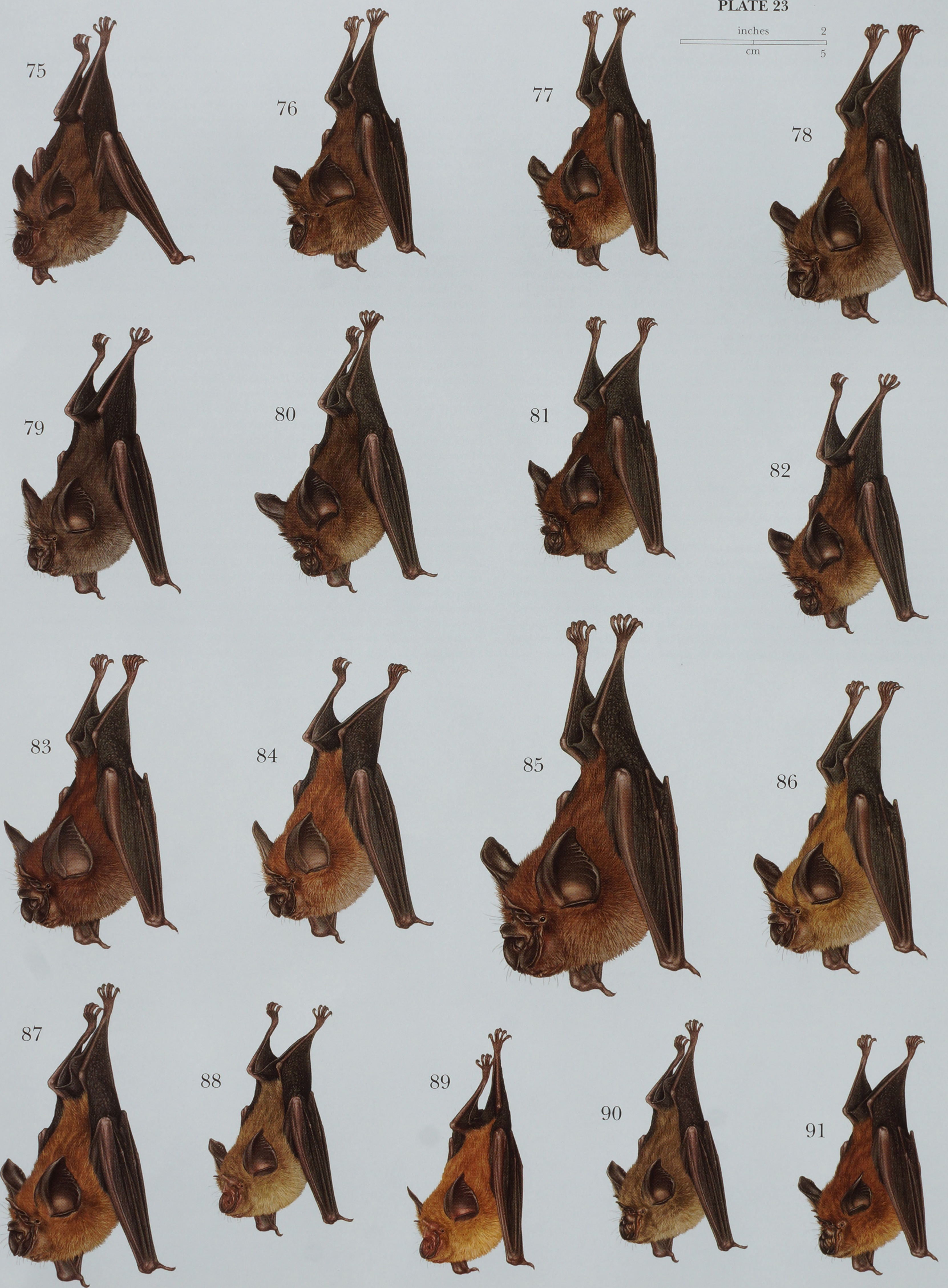
Ears somewhat shorter than the head, acute, the outer margin not deeply hollowed out beneath the tip; antitragus large, separated by a deep angular incision. Horizontal horseshoe-shaped membrane moderate, not extending so far in front or laterally as to conceal the sides of the muzzle when viewed from above, yet larger than in Rh. ferrum-equinum; vertical front surface of the sella maintaining the same width upwards, rounded off above, exceeded in height by the summit of the laterally flattened connecting-process, which forms a rounded-off angle from which a few hairs arise; terminal nose-leaf rather short, the subacute triangular terminal process with slightly concave sides (Plate VII. fig. 5). Lower lip with three distinct grooves. Wing-membrane from the tarsus or ankle, or from the tibia higher up. Interfemoral membrane square or slightly angular behind; tail wholly included, or projecting by the extreme tip. Fur variable in colour, greyish brown or reddish brown or even golden orange-brown, the hairs darker towards their extremities. Rh. cinerascens, fulvidus, et rubidus, Kelaart, were founded on these differences in the colour of the fur. Length, head and body 2 " ' 3, tail 0 " ’ 9, head O' ' - 95, ear 0 " ’ 75, antitragus 0 " ‘ 28, nose-leaf O', - 55 x 0 ” - 35, forearm 2 " -, thumb 0 " - 35, third finger 3 ', - 25, fifth finger 2 7, tibia 0 " - 95, foot 0 48.
Sumber: Rhinolophus
Distribusieng
Hab. Peninsula of India, from the Himalaya to Cape Comorin (inhabiting hill-tracts); Ceylon, Burma, Sumatra, Java, Borneo.
Sumber: Rhinolophus
Biologi & Ekologieng
Habitat. The Intermediate Horseshoe Bat is found in a wide variety ofhabitats and is very adaptable; it occurs in both primary and secondary forests as well as disturbed habitats, orchards, and other agricultural areas. In China, it can be found both in the wet and more temperate western highlands and in the more tropical eastern lowlands. In Vietnam, the species has been reported from both primary and secondary tropical forests but appears to avoid heavily disturbed landscapes, although it has been observed flying into houses and under tents in campsites. Recorded at elevations of 200 - 2000 m. Food and Feeding. Intermediate Horseshoe Bats forage by aerial-hawking and perchhunting. They are frequently observed flying along streams and roads (c. 1 - 5 - 2 m aboveground). They feed on a variety of insects but seem to prefer Coleoptera and Lepidoptera. In Jiangxi, China, this species fed mainly on Coleoptera (61 - 4 % by volume) and Lepidoptera (28 - 9 %), and less on Hymenoptera, Orthoptera, Homoptera, Megaloptera, Neuroptera, Diptera, Hemiptera, and Trichoptera; this was a much wider variety than in the sympatric Pearson’s Horseshoe Bat (. pearsoni), with which has an extensive trophic niche overlap. Breeding. Females give birth to a single young. In Peninsular Malaysia, there appear to be two breeding seasons per year, with pregnant females being collected in April-May and in October. Lactating females have also been captured in June. Activity patterns. Intermediate Horseshoe Bats emerge from their roosts at dusk to forage; by day they roost mainly in caves, although they may also use rock crevices or hollow trees. Calls are FM / CF / FM shaped with a peak F recorded at c. 90 kHz in Vu Quang and c. 78 kHz on the Langbian Plateau, Vietnam; and 71 - 3 kHz in Thailand (duration of 29 - 2 milliseconds and interpulse interval of 59 - 4 milliseconds). InJiangxi, China, the peak F of the first harmonic averaged 42 - 9 kHz and the second harmonic averaged 85 - 9 kHz, with a duration of 46 - 5 milliseconds and interpulse interval of 45 - 2 milliseconds. Movements, Home range and Social organization. Intermediate Horseshoe Bats roost in large colonies with up to thousands of individuals.