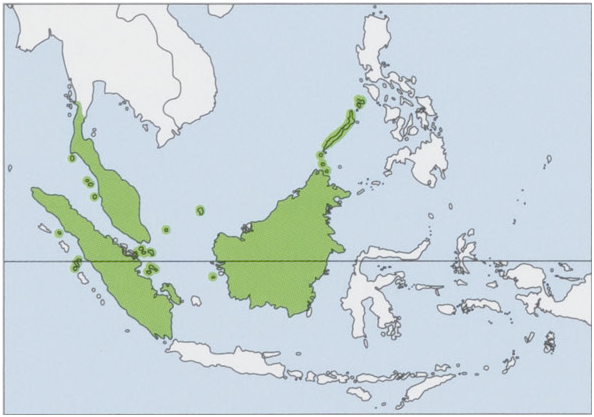
Distribusieng
DISTRIBUTION: Sunda Shelf only: SW peninsular Burma, peninsular Thailand, Malay Peninsula, Sumatra, Borneo, Palawan, and many smaller islands on the Shelf; records from islands off of Sunda Shelf (Nicobars, for example) proved to represent other species (see maps in Musser and Newcomb, 1983).
Sumber: Order Rodentia - Family Muridae
Biologi & Ekologieng
Movements, Home range and Social organization. Miller's Rat generally maintains a permanent den along a stream with an elongated territory down the stream. Territories have been recorded down a stream at lengths from 76 - 184 m long. Average lifetime range is 409 m.
Sumber: Muridae
Konservasieng
Status and Conservation. Classified as Least Concern on The IUCN Red List. Muller's Rat seems to be abundant in wide variety of habitats. Given its wide distribution in the Sundaland, it might include several crypticspecies on smaller island archipelagos.
Sumber: Muridae
Deskripsieng
Descriptive notes. Head-body 185 - 299 mm, tail 212 - 370 mm, ear 20 - 27 mm, hindfoot 37 - 55 mm; weight 196 - 292 g. Muiller’s Rat is a medium sized and variable species of Sundamys, being twice as large as Annandale’s Sundaic Rat (S. annandaler) but smaller than the other two species in the genus. Pelage is harsh and slightly shaggy with long black guard hairs. Dorsal pelageis grayish brown to dark tawny brown, being darkest along the midline of the back and lighter on the sides. Ventral pelage varies from white or grayish white to dark gray or a pale yellowish, occasionally with a buff tinge; ventral pelage is not sharply demarcated from the dorsal pelage. Ears are long, rounded, and dark brown; vibrissae extend beyond the ears. Feet are long and broade, being furred dorsally and a similar color to the dorsal pelage. Tail is long (110 - 120 % of head-body length), lightly furred, and uniformly dark brown. Zygomatic plate of zygomatic arch is placed anterior to M'. Compared with skull length, molars are small in Muller’s Rat. Cusp pattern of Bartels’s Rat (S. maxi) is similar to that of Miiller’s Rat. Reduced tympanic bullae do not overlap squamosal root of zygomatic arch along antero-posterior axis. Spheno-pterygoid vacuity is closed with bony wall. Sphenoid and vomer bridge is always present and very visible between mesopterygoid fossa. Most populations of Muller’s Rat have five roots under M!, four roots under M? and three roots under M?, but some specimens had three to four roots on M’. On lower molars, there are four roots under m and three roots under m, and m,. Cusp t 3 on M * and M’ is present and well-developed i in most specimens of Miller’S Rat. There are four pairs of mammae: one pectoral, one postaxillary, and two inguinal. Habitat. Lowland primary and tall secondary forest, urban areas, mangrove forests, and evergreen forests from sea level up to elevations of 1650 m. Food and Feeding. Miller’s Rat eats fruits, leaves, shoots, insects, and other vegetable matter. In Malaysia, some mollusks are eaten as well. Rare food items include crabs, land snails, or a caecilian (limbless amphibian).
Sumber: Muridae
Distribusieng
Distribution. SW peninsular Myanmar, peninsular Thailand, Malay Peninsula, Sumatra, Borneo, Palawan I, and many offshore Is.
Sumber: Muridae
Konservasieng
Conservation: IUCN – Lower Risk (lc).
Sumber: Order Rodentia - Family Muridae